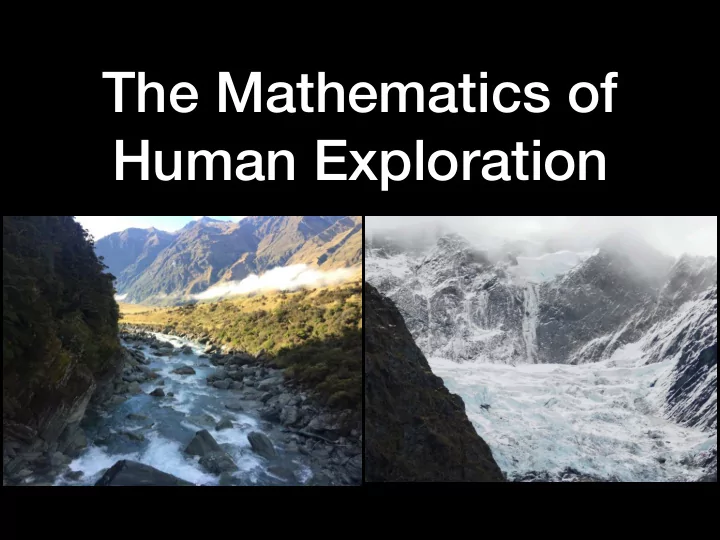
The Mathematics of Human Exploration Four Objectives 1. Get - - PowerPoint PPT Presentation
The Mathematics of Human Exploration Four Objectives 1. Get students outside to develop a connection with their local environment so they become future stewards and sustainability advocates. 2. Emphasize mathematical questions and practice
Four Objectives
- 1. Get students outside to develop a connection with their
local environment so they become future stewards and sustainability advocates.
- 2. Emphasize mathematical questions and practice standards
so students can produce unique research.
- 3. Give students the language to connect with the global
community.
- 4. Restore my love of adventure, math, history, and teaching.
"You can often view glimpses of ingeniousness not as inexplicable miracles, but as the residue of
- experience. And when you do, the idea of genius
goes from being mesmerizing to instead being actively inspirational.”
- Grant Sanderson (3blue1brown)
Why Math?
- 1. Math is uniquely suited to international collaborations because of
its status as a universal language.
- 2. Students are seldom given a true introduction to the field of
mathematics:
A. Make sense of problems and persevere in solving them. B. Reason abstractly and quantitatively. C. Construct viable arguments and critique the reasoning of others. D. Model with mathematics. E. Use appropriate tools strategically. F . Attend to precision. G. Look for and make use of structure. H. Look for and express regularity in repeated reasoning.
- 3. Student life trajectories are unpredictable, but it is certain
mathematical understanding expands future options.
- 4. There are fascinating human stories behind discoveries we take for
granted today.
Why Exploration
- 1. Humans have a long history of exploring that continues to this day:
A. Wilderness/Oceans B. Space C. Research
- 2. Exploration is inspirational and allows for possible partnerships
with NASA, NFS, NPS, and National Geographic.
- 3. It’s an excuse to get students outside and show the questions that
arise from paying attention to one’s surroundings.
- 4. There are fascinating human stories behind past and current
human explorations.
Time in New Zealand
- 1. Being an explorer myself through visits to wilderness
areas and glaciers.
- 2. Discussions/interviews with leaders in the international
climate and science communication communities.
- 3. Weekly attendance of climate and science
communication courses.
- 4. Freedom of living in a society open to discussions on
environment and climate- Te Papa for example.
- 5. Time to think, read, write, and learn.
My Product
Mathematics of Human Exploration open-source research curriculum: https://pointsofdiscontinuity.com/
Next Steps
- 1. Begin the work of classroom implementation to create a proof of concept.
- 2. Finding contacts at the Green Mountain National Forest, White Mountain National
Forest, and Acadia National Park.
- 3. Explore local wilderness areas by foot, bike, and ski, while employing different
navigational skills/technologies to connect student math research with field experiences.
- 4. Present at a 2020/2021 Regional/National NCTM Conference and NZ Math
Teachers Association conference.
- 5. Share this with Derek Smith, Ginny Wharoa, Robin Averill, Michael Drake, Dillon
Mayhew, and James Renwick for outreach efforts.
- 6. Use my Colombia and NZ contacts to find “research partner classrooms” for
international collaborations among students.
- 7. Work on a National Geographic grant to fund personal and classroom
explorations (explorer-educator).