The memory of a program Source-code is compiled into linkable object - - PDF document

the memory of a program
SMART_READER_LITE
LIVE PREVIEW

The memory of a program Source-code is compiled into linkable object - - PDF document

The memory of a program Source-code is compiled into linkable object modules Paging and Virtual Memory Memory addresses given as relative offsets Libraries contain object modules Object modules are linked together into a Operating


slide-1
SLIDE 1

OS Spring ‘04

Paging and Virtual Memory

Operating Systems Spring 2004

OS Spring ‘04

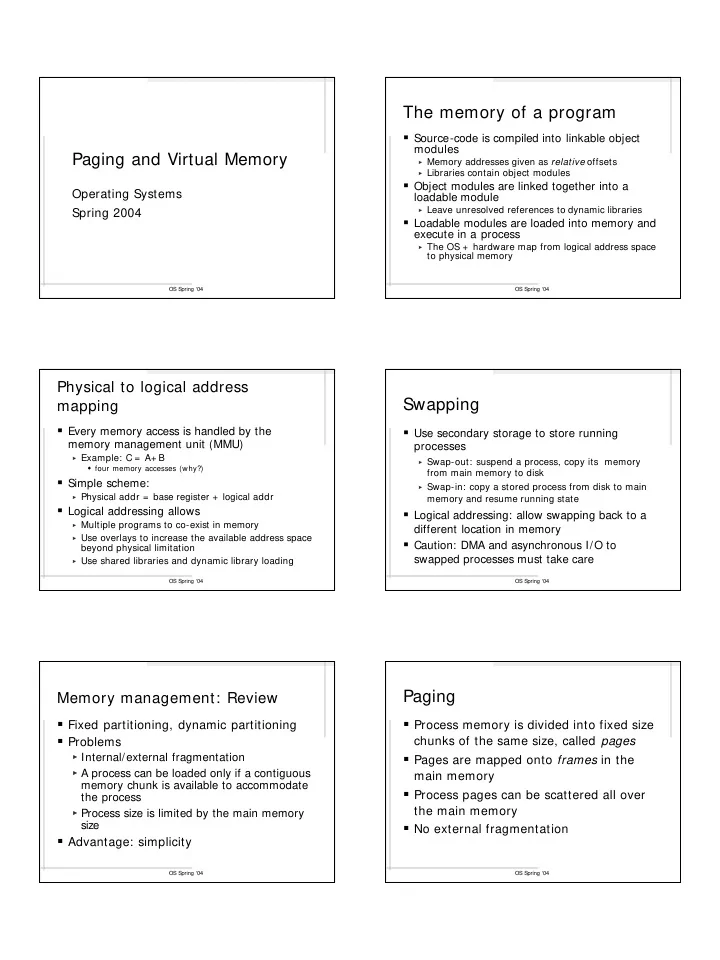
The memory of a program

Source-code is compiled into linkable object

modules

Memory addresses given as relative offsets Libraries contain object modules

Object modules are linked together into a

loadable module

Leave unresolved references to dynamic libraries

Loadable modules are loaded into memory and

execute in a process

The OS + hardware map from logical address space to physical memory

OS Spring ‘04

Physical to logical address mapping

Every memory access is handled by the

memory management unit (MMU)

Example: C = A+ B

four memory accesses (why?)

Simple scheme:

Physical addr = base register + logical addr

Logical addressing allows

Multiple programs to co-exist in memory Use overlays to increase the available address space beyond physical limitation Use shared libraries and dynamic library loading

OS Spring ‘04

Swapping

Use secondary storage to store running

processes

Swap-out: suspend a process, copy its memory from main memory to disk Swap-in: copy a stored process from disk to main memory and resume running state

Logical addressing: allow swapping back to a

different location in memory

Caution: DMA and asynchronous I/O to

swapped processes must take care

OS Spring ‘04

Memory management: Review

Fixed partitioning, dynamic partitioning Problems

Internal/external fragmentation A process can be loaded only if a contiguous memory chunk is available to accommodate the process Process size is limited by the main memory size

Advantage: simplicity

OS Spring ‘04

Paging

Process memory is divided into fixed size

chunks of the same size, called pages

Pages are mapped onto frames in the

main memory

Process pages can be scattered all over

the main memory

No external fragmentation

slide-2
SLIDE 2

OS Spring ‘04

Paging example

1 2 3 4 5 6 7 8 9 10 11 12 13 14 A.0 A.1 A.2 A.3 C.0 C.1 C.2 C.3 D.0 D.1 D.2 D.3 D.4 1 2 3 Process A 1 2 3 1 2 Process B

  • 1

2 3 4 1 2 3 Process C 7 8 9 10 4 5 6 11 12 Process D Free Frame List 13 14

OS Spring ‘04

Paging support

Page table maintains mapping of process

pages onto frames

Hardware support is needed to support

translation of relative addresses within a program (logical addresses) into the memory addresses

OS Spring ‘04

Address translation

Page (frame) size is a

power of 2

with page size = 2r, a logical address of l+ r bits is interpreted as a tuple (l,r) l = page number, r =

  • ffset within the page

Page number is used

as an index into the page table

OS Spring ‘04

Hardware support

Program Paging Main Memory

Logical address Register Page Table Page Frame

Offset

P#

Frame # Page Table Ptr Page # Offset Frame # Offset

+ OS Spring ‘04

Virtual Memory

Paging makes virtual memory possible

Logical to physical address mapping is dynamic

= > It is not necessary that all of the process pages be in main memory during execution

OS Spring ‘04

Benefits

More processes may be maintained in the

main memory

Better system utilization and throughput

The process size is not restricted by the

physical memory size: the process memory is virtual

But what is the limit anyway?

Less disk I/O to swap/load programs

slide-3
SLIDE 3

OS Spring ‘04

How does this work?

CPU can execute a process as long as

some portion of its address space is mapped onto the physical memory

E.g., next instruction and data addresses are mapped

Once a reference to an unmapped page

is generated (page fault):

Page fault interrupt transfers control to the OS handler

OS Spring ‘04

Page Fault Handler

Put the process into blocking state Program disk controller to read the page

from disk into the memory

Later on: I/O interrupt signals completion Resume the process

OS Spring ‘04

Why is this practical?

Observation: Program branching and data

access patterns are not random

Principle of locality: program and data

references tend to cluster = > Only a fraction of the process virtual address space need to be resident to allow the process to execute for sufficiently long

OS Spring ‘04

Virtual memory implementation

Efficient run-time address translation

Hardware support, control data structures

Fetch policy

Demand paging: page is brought into the memory only when page-fault occurs Pre-paging: pages are brought in advance

Page replacement policy

Which page to evict when a page fault

  • ccurs?

OS Spring ‘04

Thrashing

A condition when the system is engaged

in moving pages back and forth between memory and disk most of the time

Bad page replacement policy may result

in thrashing

Programs with non-local behavior

OS Spring ‘04

Address translation

Virtual address is divided into page

number and offset

Mapping of virtual pages onto physical

frames are facilitated by page table(s)

Forward-mapped page tables (FMPT) Inverted page tables (IPT)

Virtual Address Page Number Offset

slide-4
SLIDE 4

OS Spring ‘04

Forward-mapped page tables (FMPT)

Page table entry

(PTE) structure

Page table is an array

  • f the above

Index is the virtual page number

P M Frame Number Other Control Bits

Page Table

Frame #

Page #

P: present (valid) bit M: modified bit

OS Spring ‘04

Address Translation using FMPT

Program Paging Main Memory

Virtual address Register Page Table Page Frame

Offset

P#

Frame # Page Table Ptr Page # Offset Frame # Offset

+ OS Spring ‘04

Handling large address spaces

One level FMPT is not suitable for large

virtual address spaces

32 bit addresses, 4K (212) page size, 232 / 2 12 = 2 20 entries ~ 4 bytes each = > 4Mbytes resident page table per process! What about 64 bit architectures??

Solutions:

multi-level FMPT Inverted page tables (IPT)

OS Spring ‘04

Multilevel FMPT

Use bits of the virtual address to index a

hierarchy of page tables

The leaf is a regular PTE Only the root is required to stay resident

in main memory

Other portions of the hierarchy are subject to paging as regular process pages

OS Spring ‘04

Two-level FMPT

page number page offset pi p2 d 10 10 12

OS Spring ‘04

Two-level FMPT

slide-5
SLIDE 5

OS Spring ‘04

Inverted page table (IPT)

A single table with one entry per physical

page

Each entry contains the virtual address

currently mapped to a physical page (plus control bits)

Different processes may reference the

same virtual address values

Address space identifier (ASID) uniquely identifies the process address space

OS Spring ‘04

Address translation with IPT

Virtual address is first indexed into the

hash anchor table (HAT)

The HAT provides a pointer to a linked

list of potential page table entries

The list is searched sequentially for the

virtual address (and ASID) match

If no match is found -> page fault

OS Spring ‘04

Address translation with IPT

Virtual address

page number

  • ffset

hash +

HAT base

register

ASID

register

page number ASID

Frame#

I PT +

IPT base

register

frame number

HAT

OS Spring ‘04

Translation Lookaside Buffer (TLB) With VM accessing a memory location

involves at least two intermediate memory accesses

Page table access + memory access

TLB caches recent virtual to physical

address mappings

ASID or TLB flash is used to enforce protection

OS Spring ‘04

TLB internals

TLB is associative, high speed memory

Each entry is a pair (tag,value) When presented with an item it is compared to all keys simultaneously If found, the value is returned; otherwise, it is a TLB miss Expensive: number of typical TLB entries: 64-1024 Do not confuse with memory cache!

OS Spring ‘04

Address translation with TLB

slide-6
SLIDE 6

OS Spring ‘04

Bits in the PTE: Present (valid)

Present (valid) bit

Indicates whether the page is assigned to frame or not A reference to an invalid page generates page fault which is handled by the operating system

OS Spring ‘04

Bits in PTE: modified, used

Modified (dirty) bit

Indicates whether the page has been modified Unmodified pages need not be written back to the disk when evicted

Used bit

Indicates whether the page has been accessed recently Used by the page replacement algorithm

OS Spring ‘04

Bits in PTE

Access permissions bit

indicates whether the page is read-only or read-write

UNIX copy-on-write bit

Set whether more than one process shares a page If one of the processes writes into the page, a separate copy must first be made for all

  • ther processes sharing the page

Useful for optimizing fork()

OS Spring ‘04

Protection with VM

Preventing processes from accessing

  • ther process pages

Simple with FMPT

Load the process page table base address into a register upon context switch

ASID with IPT

OS Spring ‘04

Page size considerations

Small page size

better approximates locality large page tables inefficient disk transfer

Large page size

internal fragmentation

Most modern architectures support a

number of different page sizes

a configurable system parameter