The Minimum Wage in the UK and Beyond Professor Alan Manning Nicola - - PowerPoint PPT Presentation

the minimum wage in the uk and beyond
SMART_READER_LITE
LIVE PREVIEW

The Minimum Wage in the UK and Beyond Professor Alan Manning Nicola - - PowerPoint PPT Presentation

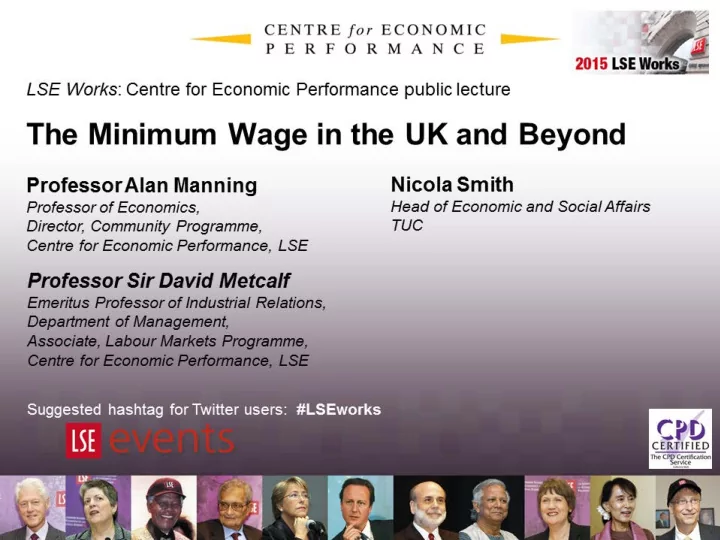
LSE Works : Centre for Economic Performance public lecture The Minimum Wage in the UK and Beyond Professor Alan Manning Nicola Smith Professor of Economics, Head of Economic and Social Affairs Director, Community Programme, TUC Centre for


slide-1
SLIDE 1

Suggested hashtag for Twitter users: #LSEworks

The Minimum Wage in the UK and Beyond

LSE Works: Centre for Economic Performance public lecture

Professor Alan Manning

Professor of Economics, Director, Community Programme, Centre for Economic Performance, LSE

Nicola Smith

Head of Economic and Social Affairs TUC

Professor Sir David Metcalf

Emeritus Professor of Industrial Relations, Department of Management, Associate, Labour Markets Programme, Centre for Economic Performance, LSE

slide-2
SLIDE 2

The Minimum Wage in the UK and Beyond

Alan Manning Centre for Economic Performance And Department of Economics

slide-3
SLIDE 3

Overview of the Talk

  • Some history on the UK experience with

minimum wages

  • Our minimum wage research at CEP
  • The establishment of the National Minimum

Wage

  • Evidence on the impact of the NMW
  • Influences of the NMW beyond the UK
  • The future of the NMW in the UK
slide-4
SLIDE 4

A Brief History of Minimum Wages in the UK, pre-1992

  • 1909: Winston Churchill establishes Wages Councils to set minimum

wage rates in certain industries – the ‘sweated trades’

“It is a serious national evil that any class of His Majesty's subjects should receive less than a living wage in return for their utmost exertions”

  • This was a complicated and (by 1992) archaic system

– Covered some very small industries ‘ostrich and fancy feather and artificial flower’ – Did not cover some large low-paid industries e.g. cleaning, social care

  • So there was a need for change
  • In 1992 UK general election:

– Labour proposes to introduce a National Minimum Wage – Conservatives proposes abolition of the 26 remaining Wages Councils

slide-5
SLIDE 5

The arguments for and against minimum wages then (and now)

  • Those in favour

– argue minimum wages are necessary to protect against extreme exploitation in the labour market and is an important part of an anti-poverty strategy

  • Those against

– Argue minimum wages destroy jobs so may harm those it seeks to help

slide-6
SLIDE 6

Some Intellectual Background

  • 25 years ago economists were generally very

hostile to the minimum wage

  • Supporters of the minimum wage were widely

regarded as economically illiterate

slide-7
SLIDE 7

The Motivation for our early Research

  • In early 1990s Richard Dickens, Steve Machin and

I became interested in the impact of the minimum wages set by Wages Councils

  • Partly inspired by policy differences in the 1992

election

  • But also inspired by a new wave of academic

research in the US led by David Card and Alan Krueger that challenged the conventional wisdom – also connected with political battle in the US to raise the minimum wage

slide-8
SLIDE 8

The Conventional Wisdom: The Minimum Wage Destroys Jobs

  • For example, OECD Jobs Study (1994)

“Reassess the role of statutory minimum wages as an instrument to achieve redistributive goals, and switch to more direct instruments. If it is judged desirable to maintain a legal minimum wage as part of an anti- poverty strategy, consider minimising its adverse employment effects”

  • The only question is how many jobs are lost
slide-9
SLIDE 9

The Theory Behind the Conventional Wisdom

  • Most economists thought labour market well-

approximated by perfect competition

  • Market wages equate supply and demand
  • Any institution that raises wages causes demand

for labour to fall causing job loss

  • So strong is this view held by some that this is

regarded as a ‘natural law’

– In congressional testimony Finis Welch said “If you drop an apple and it rises, question your experiment before concluding that the laws of gravity have been repealed“

slide-10
SLIDE 10

The Problem with the Conventional Wisdom

  • The empirical evidence that minimum wages

causes job loss is a lot weaker than for gravity

  • In the US this point was made by David Card

and Alan Krueger in their book ‘Myth and Measurement’ – published in 1994

  • This was controversial – to say the least
  • But there is a lot of evidence that the

relationship between employment and wages is not so simple

slide-11
SLIDE 11

My favourite example

  • Best evidence that one can alter wage

structure in big way without harming employment comes from the Equal Pay Act, 1970

  • This raised pay of women relative to men by a

lot

slide-12
SLIDE 12

The headline gender pay gap in hourly earnings, 1948-2009

.55 .6 .65 .7 .75 .8 Female/Male Average Hourly Earnings 1945 195019551960 196519701975 19801985 199019952000 20052010 2015 year

slide-13
SLIDE 13

The Times – October 1st 1969

slide-14
SLIDE 14

The Share of Female Employment

30 35 40 45 50 Female Employment as % of Total Employment 1950 1960 1970 1980 1990 2000 2010 year

slide-15
SLIDE 15

How is this possible?

  • A simple plausible explanation – labour

markets are not perfectly competitive

  • Employers have some market power over

their workers

  • Actual employment outcomes a balance

between demand and supply factors

  • If raise minimum wage reduce incentives of

employers to hire workers but raise incentives to work

slide-16
SLIDE 16

Implications

  • Over some range minimum wage may not lose

jobs, may even raise employment

  • But nobody in their right mind thinks there

won’t be some point at which minimum wage causes job loss

  • Have to have evidence to decide about the

effect, theory is not enough

slide-17
SLIDE 17

Our early research on Wages Councils

  • We found no evidence that the minimum

wages set by Wages Councils had caused job losses

  • If anything higher minimum wages seemed to

be associated with higher employment

slide-18
SLIDE 18

Reference to this in the FT led a prominent businessman to complain to the Director of LSE about us

slide-19
SLIDE 19

1992-1997

  • But John Major won the 1992 election, abolished

the Wages Councils in 1993, claiming this would lead to an increase in employment

  • Our research suggested it did not
  • From 1993-1997 there was no wage floor in the

UK (except in agriculture)

  • Some very low rates of pay

– Security officer £2 per hour, must provide own dog

slide-20
SLIDE 20

The 1997 election

  • In 1997 election campaign, Labour again

proposed a National Minimum Wage,

  • pposed by Conservatives
  • Lot of scare stories about how millions of jobs

would be lost

  • Labour won, set up the Low Pay Commission
slide-21
SLIDE 21

The Low Pay Commission

  • Makes recommendations to government on level

and form of NMW

  • Recommendations have almost always been

accepted

  • Consists of employer and worker representatives

plus ‘independents’

  • Has always taken an ‘evidence-based’ approach

– Commissions its own research – Absence of ideological/political posturing

slide-22
SLIDE 22

Establishing the National Minimum Wage

  • The Low Pay Commission produced its first

report in 1998

  • In April 1999, the National Minimum Wage

came into being.

  • Initially cautious – set at a relatively low level
  • f £3.60
slide-23
SLIDE 23

The Level of the NMW Adult Minimum Wage as Percentage of Median Hourly Earnings

45 50 55 Adult Minimum as % of Median Hourly Earnings 1998 2000 2002 2004 2006 2008 2010 2012 2014 year

slide-24
SLIDE 24

Current Level and Form

  • £6.50 per hour for those aged 21+
  • £5.13 per hour for those aged 18-20
  • £3.79 per hour for those aged 16-17
  • £2.73 per hour for apprentices
  • For context
  • £11.54 is median hourly earnings
  • £6.64 is 10th percentile of hourly earnings
slide-25
SLIDE 25

The LPC Strategy

  • Would like to increase NMW but limit set by

fears about job losses

  • Initial level of NMW was low
  • Fears that dangers of being too high and

having to cut it bigger than dangers of being too low.

  • Then increased faster than median earnings as

job losses did not materialize – research very important in reaching this conclusion.

slide-26
SLIDE 26

Has the Minimum Wage had any impact – the answer is a clear YES

slide-27
SLIDE 27

The NMW has helped to reduce wage inequality in bottom half of the wage distribution

slide-28
SLIDE 28

What About Job Losses?

  • Prior to NMW some estimates suggested it would

destroy 1m jobs

  • Turned out to be only scare stories
  • Loss of credibility for those who had told them
  • Virtually none of the research commissioned by

the LPC has ever found evidence of significant job losses

  • Some evidence of modest job losses among care

workers in retirement homes (30% of workers paid the NMW)

slide-29
SLIDE 29

Longer-Term Impact of the NMW

  • NMW has bigger effect on low-paid workers –

women, the young, in low-wage regions

  • Lets look at changes in wages and

employment, 1997-2007 by these labour market segments

slide-30
SLIDE 30

Clear Impact on Pay

  • f Low-Paid Workers
  • .1
  • .0 5

.0 5 .1

  • .2
  • .1

.1 .2 Im p a c t o f M in im u m W a g e on G ro up Fitte d v alu e s % C ha n g e in W a g e s , 19 97 -2 0 0 7

slide-31
SLIDE 31

But little evidence for impact on employment

  • .2
  • .1

.1

  • .2
  • .1

.1 .2 Im p a c t o f M in im u m W a g e on G ro up F itted v a lu e s % C h a n g e in E m p lo ym e n t, 1 99 7 -2 0 0 7

slide-32
SLIDE 32

But….

  • now smaller and smaller rises in NMW so hard

to get good estimate of employment effect as hard to disentangle impact of NMW from

  • ther factors
  • There is no doubt there is a level of the NMW

that would cause job losses

  • LPC currently cautious about aggressive rise in

NMW

slide-33
SLIDE 33

The NMW and LPC have been fabulously successful

  • Conservative party went from opposition to

support

– 2005 David Cameron 'I think the minimum wage has been a success' – 2008 George Osborne “Modern Conservatives acknowledge the fairness of a minimum wage”

  • Institute of Government voted the minimum

wage the most successful UK government policy

  • f the past 30 years
  • Currently no sizeable lobby campaigning for

abolition of NMW

slide-34
SLIDE 34

Beyond the UK

  • The success of the NMW and LPC structure

become a model in a number of countries which have increasingly being introducing minimum wages e.g.

– Hong Kong from 2011 – Germany (from January 2015)

slide-35
SLIDE 35

Advice of international organizations has changed

  • 2012 joint report of the IMF, OECD, ILO and

World Bank (not always bed-fellows when it comes to labour market policy)

“a statutory minimum wage set at an appropriate level may raise labour force participation at the margin, without adversely affecting demand, thus having a net positive impact especially for workers weakly attached to the labour market”

slide-36
SLIDE 36

But what about the future for the NMW and LPC in the UK?

  • Has been very successful so one argument is ‘if its

not broken, don’t fix it’

  • But some concerns it has become prematurely

middle-aged

– Is it very cautious and short-term, learning little from relatively small changes in the minimum wage – Still have a wider problem of persistent low pay

  • All political parties are pressing for more

aggressive approach

– George Osborne dropped heavy hint he thought £7 was affordable

slide-37
SLIDE 37

The NMW has done nothing to reduce the fraction of people paid less than 2/3rds of median

slide-38
SLIDE 38

Ideas for rejuvenation

  • A Wider remit

– The Low Pay Commission has become a Minimum Wage Commission and needs to focus on wider problem of low pay – That requires more tools than the minimum wage

  • More explicit long-term targets

– E.g. Labour Party wants £8 by end of next Parliament (58% of median)

slide-39
SLIDE 39

More ideas…..

  • The living wage (currently £7.85, £9.15 in

London)

– Is this just a much higher minimum wage? – Should there be rewards/pressure on those employers who can afford it to pay the living wage

  • Should there be higher minimum wages in

London, in some industries?

slide-40
SLIDE 40

Conclusion

  • 25 years ago it looked like minimum wages were

disappearing

  • Now they are a very active area of policy and

debate

  • Research and the UK experience has played an

important role in this

– They can reduce wage inequality without harming jobs

  • But, don’t expect minimum wages to do

everything – they are useful but limited

slide-41
SLIDE 41

Suggested hashtag for Twitter users: #LSEworks

The Minimum Wage in the UK and Beyond

LSE Works: Centre for Economic Performance public lecture

Professor Alan Manning

Professor of Economics, Director, Community Programme, Centre for Economic Performance, LSE

Nicola Smith

Head of Economic and Social Affairs TUC

Professor Sir David Metcalf

Emeritus Professor of Industrial Relations, Department of Management, Associate, Labour Markets Programme, Centre for Economic Performance, LSE