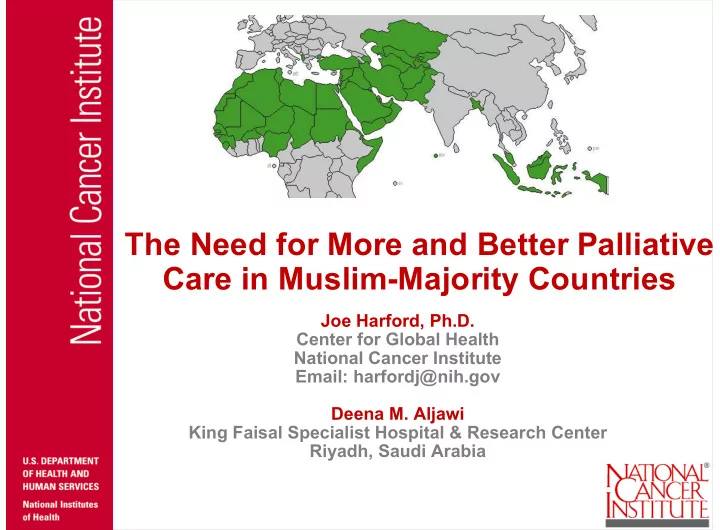
The Need for More and Better Palliative Care in Muslim-Majority - - PowerPoint PPT Presentation
The Need for More and Better Palliative Care in Muslim-Majority Countries Joe Harford, Ph.D. Center for Global Health National Cancer Institute Email: harfordj@nih.gov Deena M. Aljawi King Faisal Specialist Hospital & Research Center
The 3 Most Significant Features of Cancer in LMICs
“Where can I go in this desert to find out about how to prevent cancer or detect it early enough so that it won’t kill me?”
1. Late Diagnosis 2. Late Diagnosis 3. Late Diagnosis More & Better Palliative Care Needed!
Public Health Model for Palliative Care
2
Pain as a Barometer of Palliative Care
Pain control is NOT synonymous with palliative care, but pain control is a useful barometer on palliative care programs.
“A palliative care program cannot exist unless it is based on a rational drug policy including…ready access of suffering patients to opioids.” (WHO, 2002) 33
WPCA Report on Palliative Care Services
(October 2011)
The Bad News:
! Of the world’s 234 countries, 98 (42%) do not have even
- ne hospice or palliative care services available to
seriously ill people and their families.
! Only 20 countries globally (8.5%) provide palliative care
services that are fully integrated with wider healthcare services.
! 80% of the world’s population live in countries with no or
low access to medications to treat moderate to severe pain.
4
MAPPING LEVELS OF PALLIATIVE CARE DEVELOPMENT: A GLOBAL UPDATE 2011 Worldwide Palliative Care Alliance
Opioid Consumption as a Function of GDP
(Morphine Equivalence, 2008)
http://www.painpolicy.wisc.ed u/
(a) 1K 5K 10K 50K 100K GDP per Capita
800 600 400 200
Mo rph ine Eq uiv ale nc e (m g/c api ta) Virtually no opioid use Variable
- pioid use
Canada & U.S.
5
http://www.painpolicy.wisc.ed u/
(a) 1K 5K 10K 50K 100K GDP per Capita
800 600 400 200
Mo rph ine Eq uiv ale nc e (m g/c api ta)
Several high-income Arab states utilize >50X less opioids per capita than the U.S.
Opioid Consumption as a Function of GDP
(Morphine Equivalence, 2008) 6
Muslim Majority Countries (MMC’s)
7 The GDP’s of MMC’s range from $600 per person in Somalia to >$100,000 per person in Kuwait (Note: U.S. GDP per capita = ~$48,000).
Opioid Use
(Morphine equivalents; mg/capita; minus methadone; 2008)
MAPPING LEVELS OF PALLIATIVE CARE DEVELOPMENT: A GLOBAL UPDATE 2011 Worldwide Palliative Care Alliance
8
The U.S. uses >50-fold more opioids per capita than Turkey and ~12,000- fold more than Ethiopia.
= MMC
Morphine Use in the 15 Largest MMC’s Adequacy of Consumption Measure (ACM)
ND ND
AC M
Aljawi & Harford, 2012. Based on data from Seya et al., J. Pain & Palliative Care Pharmacology 25:6-18 (2011)
Moderate Consumption = ACM > 0.3 and < 1.0 Low Consumption = ACM > 0.1 and < 0.3 Very Low Consumption = ACM < 0.1 Virtually Nonexistent Consumption = ACM < 0.03
“Very Low Consumption” “Virtually Nonexistent Consumption”
Canadian ACM = 2.56 U.S. ACM = 2.48
Level of Palliative Care Development
MAPPING LEVELS OF PALLIATIVE CARE DEVELOPMENT: A GLOBAL UPDATE 2011 Worldwide Palliative Care Alliance
10
Distribution of Muslim-majority Countries via the Typology of the International Observatory on ELC
(data from Wright et al., 2008; compilation in Aljawi & Harford, 2012)
- 1. No known activity
- 2. Capacity building
- 3. Localized provision
- 4. Approaching integration
Afghanistan, Burkina Faso, Chad, Comoros, Djibouti, Guinea, Libya, Maldives, Mali, Mauritania, Niger, Senegal, Somalia, Syria, Turkmenistan, Western Sahara, Yemen Algeria, Bahrain, Brunei, Kuwait, Lebanon, Oman, Palestinian Authority, Qatar, Sudan, Tajikistan, Tunisia, Turkey, Uzbekistan Albania, Azerbaijan, Bangladesh, Egypt, Indonesia, Iraq, Jordan, Kazakhstan, Kyrgyzstan, Morocco, Pakistan, Saudi Arabia, Sierra Leone, The Gambia, United Arab Emirates Malaysia
No Pa tie nt Ac ce ss
11
*2006 Survey of Health care workers, and hospice/PC staff in Asia, Africa and Latin America
Adams, V. (2007). Access to Pain Relief – an essential human right. Help the Hospices, Worldwide Palliative Care
Barriers* to accessing oral morphine:
!
Excessively strict national drug laws and regulations;
!
Fear of addiction;
!
Poorly developed health care systems;
!
Lack of knowledge (in patients, families, healthcare providers, and policymakers/regulators)
Why is opioid use so low?
12
Cultural and religious issues can also have an impact on palliative care.
Increase in Morphine Equivalence in the U.S. (1965-
2003)
http://www.painpolicy.wisc.ed u/
GDP per Capita
Mo rph ine Eq uiv ale nc e (m g/c api ta)
800 600 400 200
(a) 1K 5K 10K 50K
The Good News: Opioid use can be increased on a relatively short timeframe without significant change in GDP. 13
Muslim Population of the World by Percentage of Each Country That are Muslim
!
Muslims represent ~25%
- f the world’s
population
!
79 Countries will have >1 million Muslims by 2030 14
For more details on any aspect of the presentation, contact: Joe B. Harford, PhD Center for Global Health, NCI harfordj@nih.gov
15
References:
Aljawi DM, Harford JB: Palliative Care in the Muslim-Majority Countries:The Need for More and Better Care, Contemporary and Innovative Practice in Palliative Care, Esther Chang and Amanda Johnson (Eds.), ISBN: 978-953-307-986-8, InTech, (2012) Open access available from: http:/ /www.intechopen.com/articles/show/ title/palliative-care-in-muslim-majority- countries-the-need-for-more-and-better-care Harford JB, Aljawi DM: The need for more and better palliative care for Muslim
- patients. Palliative and Supportive Care,
Available on CJO 2012 doi:10.1017/S1478951512000053