The newborn calf The newborn calf Probiotic product from Salem, - - PDF document

the newborn calf the newborn calf probiotic product from
SMART_READER_LITE
LIVE PREVIEW

The newborn calf The newborn calf Probiotic product from Salem, - - PDF document

2/20/2011 The Effect of Continuous Low-level Feeding of Aureomycin on Dairy Cows CE Polan , GA McLaren, AH Rakes - 1962 - West Virginia University, Agricultural The effect of continuous feeding of chlortetracycline on lactating dairy cows.


slide-1
SLIDE 1

2/20/2011 1

ROLE OF BACTERIA IN RUMINANT NUTRITION ROLE OF BACTERIA IN RUMINANT NUTRITION

The Effect of Continuous Low-level Feeding of Aureomycin on Dairy Cows CE Polan, GA McLaren, AH Rakes… - 1962 - West Virginia University, Agricultural … The effect of continuous feeding of chlortetracycline on lactating dairy cows. CE Polan - 1960 - West Virginia University Biohydrogenation of unsaturated fatty acids by rumen microorganisms. CE Polan - 1963 - North Carolina State College.

1

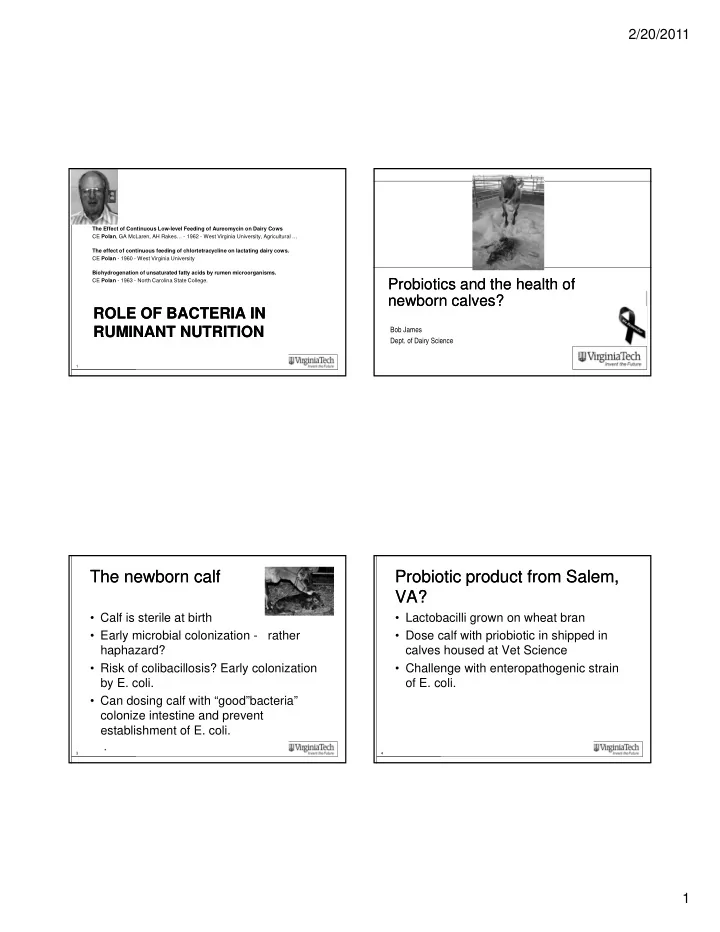
Probiotics and the health of newborn calves? Probiotics and the health of newborn calves?

Bob James

  • Dept. of Dairy Science

The newborn calf The newborn calf

  • Calf is sterile at birth
  • Early microbial colonization -

rather haphazard?

  • Risk of colibacillosis? Early colonization

by E. coli.

  • Can dosing calf with “good”bacteria”

colonize intestine and prevent establishment of E. coli.

.

3

Probiotic product from Salem, VA? Probiotic product from Salem, VA?

  • Lactobacilli grown on wheat bran
  • Dose calf with priobiotic in shipped in

calves housed at Vet Science

  • Challenge with enteropathogenic strain
  • f E. coli.

4

slide-2
SLIDE 2

2/20/2011 2

Problems with probiotics –

according to W. E. C. Moore – VPI Anerobe Lab

Problems with probiotics –

according to W. E. C. Moore – VPI Anerobe Lab

  • Most intestinal organisms are anaerobes

not aerobes

  • Microflora is a mixed culture of
  • rganisms.
  • Liklihood of single species or few

species to successfully populate is nill

  • Intestine is rapidly populated by
  • rganisms at birth.

5

Source of meaningful probiotic? Source of meaningful probiotic?

  • Source of organisms for probiotic?
  • Older milk-fed calf?
  • Duodenal cannulated
  • Collect and mix with whey solution
  • Intestinal fluid is of low palatability.

6

Influence of “probiotic” on resistance to enteropathogenic E. coli challenge

James et al, 1976

Influence of “probiotic” on resistance to enteropathogenic E. coli challenge

James et al, 1976

  • Calves entered our facility @~ 3 hour of

age

  • Colostrum fed @ ~ 5 hours of age
  • No E.coli challenge
  • E. coli challenge @ 12 hours
  • E. coli challenge @ 24 hours
  • All with or without “probiotic” inoculum of

200 ml of duodenal fluid from milk-fed calf.

  • Whey solution as carrier

7

Results Results

  • Calves receiving probiotic inoculum had

less diarrhea and higher ADG for 1st 14 days.

8

slide-3
SLIDE 3

2/20/2011 3

Serum gamma globulin – g/100 ml @ 24 h Serum gamma globulin – g/100 ml @ 24 h

9

Inoculum O 12 h challenge 24 h challenge Means No inoculum 1.1 0.94 1.68 1.24 Inoculum .5 0.49 .59 .53 Means .80 .72 1.14 .89

Follow up study

James et al., (1978)

Follow up study

James et al., (1978)

  • Three Treatments
  • Colostrum @ 2.5 hours of age
  • Colostrum and inoculum (200 ml duodenal

fluid) concurrently @ 2.3 hours of age

  • Inoculum followed three h later by colostrum

@ 5.6 hours of age

  • No E. coli challenge

10

Mean total protein and gamma globulin (g/dl) @ 24 hours of age. Mean total protein and gamma globulin (g/dl) @ 24 hours of age.

Treatment Total serum protein Gamma globulin No inoculum 5.97+/-0.94 1.05+/-.36 Colostrum and inoculum concurrent 6.07+/-0.64 1.08+/-.41 Delayed colostrum 5.22+/-.59 .76+/-.31

11

Delayed colostrum calves had lower protein and gamma globulin

Cause of apparent depression in Ig absorption? Cause of apparent depression in Ig absorption?

  • Live bacteria?
  • Cell walls of bacteria (endotoxins)?
  • Carrier for the inoculum – dried whey?

12

slide-4
SLIDE 4

2/20/2011 4

Intensive study

James et al, (1981)

Intensive study

James et al, (1981)

  • Utilized “gut loops” in newborn calves ~

8.6 hours at beginning of treatments

  • Constructed beginning 1.8 M anterior to

ileocecal junction

  • Each calf received all treatments
  • Incubated for 4 hours
  • Inject loops with 125I – gamma globulin in

electrolyte solution incubated for 75 min.

13

Treatments Treatments

  • Live bacteria – .3ml duodenal fluid – 9 ml

anaerobic rumen fluid glucose cellobiose broth (RGC). Anaerobic culture

  • Autoclaved culture
  • Sterile RGC broth

14

Treatment means for uptake, bacterial

  • no. in tissue and inoculum

Treatment means for uptake, bacterial

  • no. in tissue and inoculum

Uptake of gamma globulina Bacterial growth in tissueb Live bacteria Sterile broth Autoclaved bacteria Live bacteria Sterile broth

Autoclaved

bacteria 2.09 +/- 1.15 3.18 +/- 1.50 3.56 +/- 1.49 594+/- 316 86 +/- 82 220

15

a milligrams gamma globulin internalized/g tissue b Bacteria (X106)

Uptake reduced only with live bacteria culture – (P<.05) # organisms significantly related to uptake

Three Q’s of colostrum management Three Q’s of colostrum management

  • Quickness – feed as

soon as possible with a goal of less than 6 hours

  • Quantity – 4 liters in

1st 12 hours

  • Quality - >50g/liter
  • Not colostrum again!

16

slide-5
SLIDE 5

2/20/2011 5

Add another letter to the list? Add another letter to the list?

  • “C” for cleanliness

17

Microbial risks associated with feeding colostrum Microbial risks associated with feeding colostrum

18

Review Ig absorption in the calf Review Ig absorption in the calf

Ig Absorption

  • Large MW

macromolecules absorbed from Jejunum and proximal ileum

  • 1st 2 – 24 hours of life
  • Variable efficiency
  • Little selectivity in uptake
  • Some selectivity in

transfer through serosal side Calf epithelium ~ 24 hours

19

Corley et al. 1977

Cessation of Ig absorption Cessation of Ig absorption

  • Cessation termed closure
  • Differs by species
  • In the calf
  • Not as diet dependent
  • Very variable onset – 6 – 24 hours
  • Precipitous decline in absorptive efficiency

20

slide-6
SLIDE 6

2/20/2011 6

Closure - One step process where uptake and transfer ceases Closure - One step process where uptake and transfer ceases

  • Theories
  • Development of gastric and enzymatic

function

  • Reduction in permeability of villus epithelial

cells

  • Replacement by generation of cells

incapable of pinocytocis

21

Replacement by generation of cells incapable of absorption. Replacement by generation of cells incapable of absorption.

  • Micropinocytotic IgG transfer by newborn

calf enterocytes

  • Existence of a receptor mediated transport

system?

  • Relationship between apoptosis in

cessation of Ig transfer

22

Apoptosis and IgG absorption in goats Castro-Alonso et al. (2008) Apoptosis and IgG absorption in goats Castro-Alonso et al. (2008)

  • 10 new born kids
  • Fed colostrum – 2,000 mg IgG/kg body

weight – 2X @ 2 and 14 h

  • Sacrificed - birth – 60 d of age.
  • Assessed for apoptotic cells and stained

for IgG.

23

IgG staining in duodenum of goat kids harvested at ….. IgG staining in duodenum of goat kids harvested at …..

24

Birth - no IgG immunoreactivity Day 1 – IgG internalized Day 2 + IgG was bound to enterocytes but minimal internalization Day 60 – No staining for IgG

slide-7
SLIDE 7

2/20/2011 7

Terminal deoxynucleotidyl transferase nick end labeling (TUNEL) – identifies apoptotic cells Terminal deoxynucleotidyl transferase nick end labeling (TUNEL) – identifies apoptotic cells

25

Birth – TUNEL staining at center of villus Day 1 – staining is significantly reduced after day 1 Day 60 – only cells at villus terminus are staining

Conclusions Conclusions

  • Relationship of IgG absorption with

apoptosis in the intestine?

  • Apoptosis is influenced by composition
  • f colonizing intestinal bacteria in pigs

(Willing and Van Kessel, 2007)

  • How to delay apoptosis?

26

Feeding heat-treated colostrum or unheated colostrum with two different bacterial concentrations to neonatal calves - Elizonda-Salazar and Heinrichs, 2009 Feeding heat-treated colostrum or unheated colostrum with two different bacterial concentrations to neonatal calves - Elizonda-Salazar and Heinrichs, 2009

  • Treatments
  • Colostrum frozen - low bacteria
  • Colostrum pasteurized – 60oC / 30 min.

then frozen

  • Colostrum stored at 20oC for 24 h then

frozen

  • First feeding 3.8 liters / 68g IgG/liter - 1.5 –

2 h after birth with esophageal feeder.

27

IgG (g/L) and SPC of colostrum Serum protein and IgG @24 h IgG (g/L) and SPC of colostrum Serum protein and IgG @24 h

Item Low bacteria High bacteria Heat – treated IgG (g/L) 69.55 69.55 66.17 SPC x103/ml 9.332 40.738 .645 Serum protein @ 24h (g/L) 57 56.2 62.5 IgG @ 24 h (g/L) 20.2 20.1 26.7 AEA of IgG @ 24 h (%) 35.4 32.4 43.9

28

Heat treating improved AEA and IgG at 24 h. High bacteria load was relatively low / less than 100,000 goal (McGuirk)

slide-8
SLIDE 8

2/20/2011 8

Role for microbial colonization and Ig absorption? Role for microbial colonization and Ig absorption?

  • Rate of intestinal cell production in the

crypts

  • Migration of cells up the villus and

desquamation from the tips influenced by microbial colonization?

  • Microbes may occupy binding sites on

the apical plasma membrane.

29

Intestinal microflora and the absorptive surface Intestinal microflora and the absorptive surface

  • Colostrum deprived

calf receiving E. coli O55

  • Exfoliation of

microvilli

  • Intracellular

penetration of epithelial cells

30

Corley et al. , 1977

31

Colostrum deprived Colostrum fed calf

How is colostrum managed on many dairies? How is colostrum managed on many dairies?

32

slide-9
SLIDE 9

2/20/2011 9

How is colostrum managed on dairies? How is colostrum managed on dairies?

33

Field studies of colostrum quality Field studies of colostrum quality

  • Swan et al., 2007 –
  • 12 Minnesota and Wisconsin dairies
  • Median TPC – 6.15x10⁸
  • Varied from 7X 10⁷ - >109
  • 93% of samples over goal of 100,000 TPC
  • Poulsen et al., 2002
  • 82% of samples over 100,000 TPC

34

Critical control points for colostrum contamination Critical control points for colostrum contamination

35

udder Collection bucket Esophageal feeder

Critical control points Critical control points

36

Stewart et al, 2005 Samples from cow, bucket and tube feeder 64% of samples collected within 20 min of harvest were <100,000 TPC

slide-10
SLIDE 10

2/20/2011 10

Growth during storage Growth during storage

37

Goal – 100,000

Batch pasteurization of colostrum Batch pasteurization of colostrum

  • 60o – 60 minutes
  • Batch pasteurization
  • Higher temperatures

= cottage cheese

38

Total Bacteria Counts in Minnesota Colostrum

(Swan et al. 2007. JDSci. 90)

Total Bacteria Counts in Minnesota Colostrum

(Swan et al. 2007. JDSci. 90)

Median TPC = 615 million cfu/ml (73 to 104 billion) 93% of samples > 100,000 cfu/ml TPC

“We are feeding ‘fat-laden’ manure” Rob Trembley, 2006

From - S. Godden

Raw vs. pasteurized colostrum

Johnson et al., 2007

Raw vs. pasteurized colostrum

Johnson et al., 2007

Colostrum Serum protein IgG concentration AEA % Raw 5.9 g/dl 18.1 mg/ml 35.6 Pasteurized 6.3g/dl 22.34 mg/ml 26.1

40

Correct table in proceedings

Parameter Raw Pasteurized IgG – mg/ml 72.6 67.3 Total plate count 46,000 872

slide-11
SLIDE 11

2/20/2011 11

Recent UMN Field Study

  • M. Donahue, S. Godden

Recent UMN Field Study

  • M. Donahue, S. Godden
  • 1,000 calves / 6 herds
  • ½ fed raw and ½ fed heat-treated colostrum
  • Colostrum total plate count and serum

IgG – negative

  • Colostrum IgG concentration – positive

effect

  • Heat treatment – positive – independent
  • f Total plate count

41

30 years later - lots of common sense 30 years later - lots of common sense

42

Did some “West Virginia” rub off? I hope so!!!!

Common Sense and Colostrum Common Sense and Colostrum

  • Clean cows – infection and sanitation
  • Don’t pool colostrum
  • Milk fresh cows first and process colostrum

immediately.

  • If refrigerating – cool rapidly in ice bath
  • Clean buckets, bottles and esophageal feeders
  • If herd size and herd infection status warrants –

pasteurize or use replacer

  • Avoid use of probiotics for 24 hours

43

Thanks, Carl! Thanks, Carl!

44