SLIDE 1
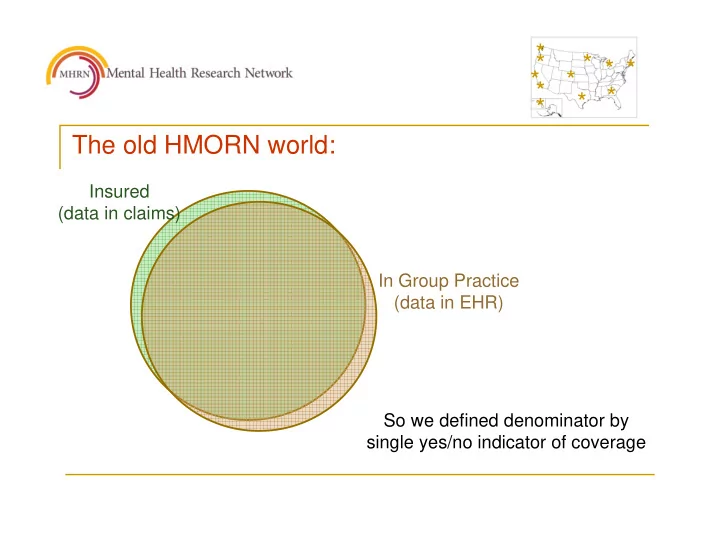
* * * * * * * * * * * The old HMORN world:
Insured (data in claims) In Group Practice (data in EHR) So we defined denominator by single yes/no indicator of coverage
SLIDE 2
* * * * * * * * * * * The new world can look like this:
Insured (data in claims) Primary Care in Group Practice (data in EHR) OP Mental Health in Group Practice (data in EHR)
SLIDE 3
* * * * * * * * * * * Or even like this:
Insured (data in claims) Primary Care in Group Practice (data in EHR) OP Mental Health in Group Practice (data in EHR) IP Mental Health (in claims, not EHR)
SLIDE 4 * * * * * * * * * * *
Defining denominator populations:
Old Question: Was this person “covered” in
X month?
New Question: If this service was provided to
this person in X month:
Would we observe it? In what data source?
SLIDE 5 * * * * * * * * * * *
The good old days were not that good
There was always some “leakage” in claims data:
Dual coverage Paid out of pocket because of privacy concerns
We didn’t need to distinguish between claims and EHR
capture because EHR data didn’t exist
SLIDE 6 * * * * * * * * * * *
New denominator definitions:
Likely data capture varies according to:
Health system structure Insurance coverage Geographic region within health sytem Referral patterns
Need new patient-level indicators that reflect likely
capture of specific types of data in claims and/or EHR
SLIDE 7
* * * * * * * * * * *
New denominator definitions example 1
Group Health member insured by commercial plan thru XXX retail chain, lives in Issaquah, Washington
Claims EHR OP Primary Care Visit Y Y OP Specialty MH Visit Y Y IP Medical / Surgical Admit Y N IP Mental Health Admit Y N OP Medication Orders N Y OP Medication Fills N ? ED Visit Y Y
SLIDE 8
* * * * * * * * * * *
New denominator definitions example 2
Health Partners insured member receiving primary care from Essentia clinic and living in Brainerd, Minnnesota
HealthPartners Claims HealthPartners EHR Essentia EHR OP Primary Care Visit Y N Y OP Specialty MH Visit Y N Y? IP Medical / Surgical Admit Y N Y? IP Mental Health Admit Y N Y? OP Medication Orders Y N Y? OP Medication Fills Y N Y? ED Visit Y N Y?
SLIDE 9
* * * * * * * * * * *
Proposed new denominator table
One record per person per month:
Claims Expected Claims Observed EHR Expected EHR Observed OP Primary Care Visit Y/N Y/N Y/N Y/N OP Specialty MH Visit Y/N Y/N Y/N Y/N IP Medical / Surgical Admit Y/N Y/N Y/N Y/N IP Mental Health Admit Y/N Y/N Y/N Y/N OP Medication Orders Y/N Y/N Y/N Y/N OP Medication Fills Y/N Y/N Y/N Y/N ED Visit Y/N Y/N Y/N Y/N Etc. Y/N Y/N Y/N Y/N
SLIDE 10 * * * * * * * * * * *
What is our expectation about claims data:
Question: If this happened, would someone send us a
bill for it?
Assumption: If a provider has any hope of payment, they
will send us a bill
How much do we need to worry about:
Dual coverage High deductibles Low-cost generics Low-prevalence coverage variants
SLIDE 11 * * * * * * * * * * *
What is our expectation about EHR data:
Question: If this patient received this service, would they
receive it from us?
Assumption: But how much are utilization patterns consistent:
Across types of service (primary care vs ED) Across conditions (rheumatoid arthritis vs. depression)
Lots of extrapolation needed for low-frequency events
SLIDE 12 * * * * * * * * * * *
Example: Pragmatic trial of outreach to prevent suicide attempt
Participants identified from PHQ9 depression
questionnaires recorded in EHR
Assigned to continued usual care or to usual care plus
Outcome is Inpatient or ED diagnosis of definite or
probable self-inflicted injury – in EHR or claims
SLIDE 13
* * * * * * * * * * * If a PHQ9 were completed, would it be in our EHR?
Insured (data in claims) Primary Care in Group Practice (data in EHR) OP Mental Health in Group Practice (data in EHR) NO YES MAYBE
SLIDE 14 * * * * * * * * * * *
For eligibility (PHQ9 in EMR):
We can include any PHQ9 record We know that primary care will be somewhat over-
represented
SLIDE 15
* * * * * * * * * * * Would an ED visit for suicide attempt show in our claims?
Insured (data in claims) Primary Care in Group Practice (data in EHR) OP Mental Health in Group Practice (data in EHR)
YES
MAYBE
SLIDE 16 * * * * * * * * * * *
Outcome ascertainment (diagnosis in EHR
We can certainly include those insured at time of PHQ9
– and censor at disenrollment
What about those receiving care but not insured?
We cannot assume that EHR capture of outpatient
PHQ9 implies EHR capture of ED visit for suicide attempt
What about ED care for other conditions? OR ED
care for mental health problem?
SLIDE 17 * * * * * * * * * * *
Summary
Increasing diversity of healthcare systems will require
more complex denominator definitions (even the HMORN is not just HMOs any more)
There is a trade-off between higher certainty of capture
(claims) and much richer clinical information (EHR)
“Coverage” or “denominator-hood” has within-person as
well as between-person variation
Documenting variation in claims and EHR coverage will
usually require local knowledge (and maybe blood oaths)
Utilization-based proxies for “denominator-hood” have
promise, but certainly need more work