SLIDE 1
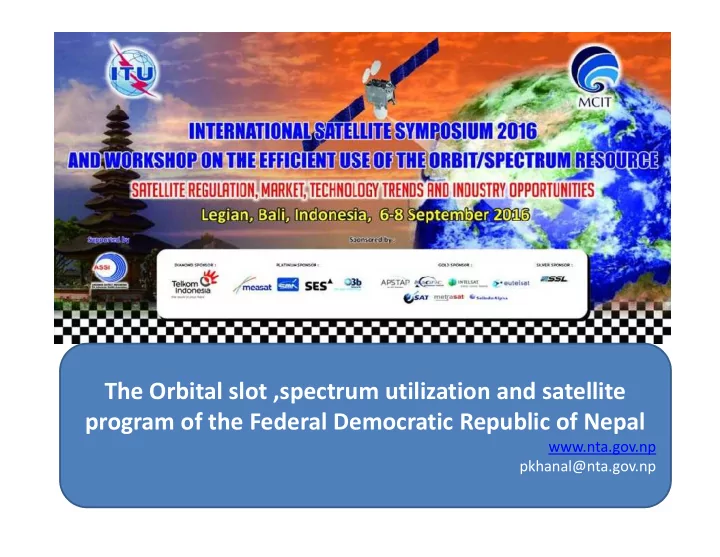
The Orbital slot ,spectrum utilization and satellite program of the Federal Democratic Republic of Nepal
www.nta.gov.np pkhanal@nta.gov.np
SLIDE 2 Geography and Demography of Nepal
Continent Asia Region Southern Asia coordinates = 28°00′N84°00′E Area Ranked 93
rd (occupying just 0.1% of the earth’s surface )
Total 147,181 square kilometers (56,827 sq mi) Land 92.94% Water 7.06% Coastline 0 km (0 mi) Borders
China: ,1,236 km (768 mi) India:,1,690 km (1,050 mi
Total land borders: 2,926 km (1,818 mi) Highest point Mount Everest, 8,848 m (29,029 ft) Population
26,494,504 growth rate of 1.35% (Based on the 2011 Nepal
census)
SLIDE 3
REGULATORY FRAMEWORK
Radio Act 1957 National Broadcasting Act 1993 Telecom Act 1997 Consumer Protection Act 1998 Radio Communication (License) Regulation 1992 National Broadcasting Regulation 1995 Telecommunication Regulation 1997 Consumer Protection Regulation 1999 Long Term Policy of Information and Communication Sector, 2002 Telecommunication Policy 2004 IT Policy 2010 Spectrum Policy2013 and Amendment-2016 Broadband Policy2015 ICT Policy2015
SLIDE 4
REGULATORY FRAMEWORK continue……..
ADMINISTRATION UNIT: Ministry of information and communications Ministry of Science and Technology REGULATOR: Nepal telecommunications Authority (Telecom Sector) Ministry of information and communications (Broadcasting) Press Council Nepal (Printing Media)
SLIDE 5
ICT Statistics at a Glance
Licenses Issued to Telecom Sector: –
S . No. Name of the Services No of Licensee 1
Basic Telecommunications Service
3 2
Basic Telephone Service
1 3
GSM Cellular Mobile Service
2 4
Network Service Provider
10 5
VSAT Users
26+10 6
Internet (With E-mail) Service
43+4 7
GMPCS Service
2 8
Rural Telecom Service
1 9
Limited Mobility Service
83 10
International Trunk Telephone Service
3 11
Pre-Paid Calling Card Service
1
Total 189
SLIDE 6
ICT Statistics at a Glance continue…………
Licenses Issued to Broadcasting Sector: –
S . No. Name of the Services No of Licensee
1
FM Radio
652 2
Terrestrial TV
14 3
Satellite TV
17 4
DTH
7 5
Cable Television
40 6
Cable TV network Operators
852
Total
1582
Tele Density ( Subscription ) :
Voice Data
116.06% 51.10%
SLIDE 7 Orbital slot and its spectrum utilization for Federal Democratic Republic of Nepal
- ITU has allocated the radio orbital slot for Nepal in 50
degree East in geostationary orbit for the purpose of broadcasting satellite service (BSS).
- Also, ITU has allocated the radio orbital slot for Nepal in
123.3 degree East in geostationary orbit for the purpose of fixed satellite service (FSS).
- Satellite Bandwidth utilized in Telecom Sector = 33 MHz (30
Mbps/30 Mbps) compared to 33,170 Mbps symmetric data rate
- for buying satellite bandwidth is 3000 US$ as compared to
average of RMC of 40 US$ per Mbps of fiber bandwidth.
- Number VSATs used in telecom sector is around 400 to 500.
SLIDE 8 Scope of Satellite and use of the Orbital Slot in Nepal
- There are different satellite users both in the broadcasting
and telecommunication sector.
- Significant amount of money is being sent out of country for using
the international satellite bandwidth.
- There is demand of the satellite service in applications such as
DTH, Cellular Backhaul traffic , Cable heads and new Applications.
- Satellite is essential to cater the need in such areas where it is very
difficult to lay the fiber cable or build microwave links.
SLIDE 9 Scope of Satellite and use of cont……….
- DTH is a fast growing industry in Asia and currently paid
channels/licensed services from neighboring countries are available in Nepal.
- Without a national satellite, media content and regulatory regime,
the revenue goes to neighboring countries.
- Regulating downlink would immediately move bandwidth to national
domestic satellite.
- In order to provide rural internet and cellular access, satellite
bandwidth is quite essential and applicable.
- School/university internet connectivity can also be a market for the
usage of satellite bandwidth.
- The demand of HDTV and cellular backhaul traffic, cable head are
also create value for the satellite bandwidth.
SLIDE 10 Potential Market of Satellite in Nepal
- The potential market of satellite bandwidth could be the
telecom infrastructure for cellular, fixed line and internet services, broadcast, DTH services, Emergency Communications, national security and defense applications.
- The potential users of the international satellite bandwidth
in Nepal include the followings:
DTH Operators NTV and Other TVs- Terrestrial, Cable Radio Nepal and Other Radios FMs
SLIDE 11 Potential Market of Satellite in Nepal contd…..
- Telecommunication sector
- Nepal Doorsanchar Company Limited and other telecom
companies.
- Network Service Providers
- VSAT Users
- GMPCS operators etc.
- National security and Defense.
- Civil Aviation Authority (CAN)
- Nepal Airline sector.
- The satellite bandwidth could be very important asset in the
case of disaster for the emergency communications.
SLIDE 12 Satellite Program of the Nepal
government finally gearing up to explore the possibility of utilizing the space.
- The budget for the fiscal year 2016-17, had announced of
carrying out a feasibility study on satellites.
- NTA has already, invited interested international consultancy
firms to submit their expression of interest (EoI).
- Six international firms shortlisted for the bidding process and is
in process to send them RFA shortly.
SLIDE 13 Satellite Program of the Nepal contd……..
- NTA is in the process to hire a consultant for utilization of the
slots.
- NTA plans to consider two options to utilize the slots.
- 1. Procure and launch its own satellite and
- 2. Negotiate a long-term lease.
- The consultant will be required to study:-
- a. The national and international legal framework.
- b. Detailed financial/business model.
- c. Engineering and economic issues.
- d. Define implementation/monitoring plan.
- e. Support government in procurement process.
SLIDE 14 Thank you
Purushottam Khanal Director Nepal Telecommunications Authority Kathmandu Nepal Pkhanal@nta.gov.np +9779841381609 www.nta.gov.np