
SLIDE 1
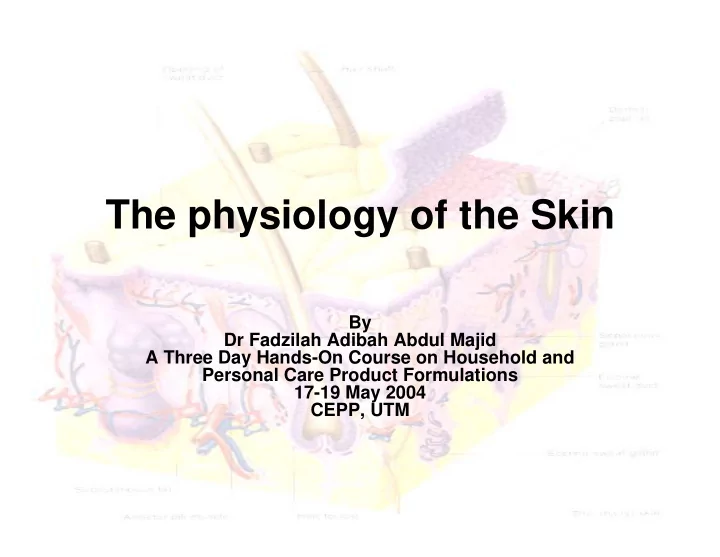
The physiology of the Skin
By Dr Fadzilah Adibah Abdul Majid A Three Day Hands-On Course on Household and Personal Care Product Formulations 17-19 May 2004 CEPP, UTM
The physiology of the Skin By Dr Fadzilah Adibah Abdul Majid A - - PowerPoint PPT Presentation
The physiology of the Skin By Dr Fadzilah Adibah Abdul Majid A Three Day Hands-On Course on Household and Personal Care Product Formulations 17-19 May 2004 CEPP, UTM The skin is a window through which the physician can "see" the
By Dr Fadzilah Adibah Abdul Majid A Three Day Hands-On Course on Household and Personal Care Product Formulations 17-19 May 2004 CEPP, UTM
rebuild the surface of the skin from within
the skin’s strength and helping thwart wear and tear.
nearly a month for the stratum corneum to be completely replaced.
generally slows with age, though in some people it becomes abnormally accelerated, causing a flaky, scaly skin condition known as psoriasis.
When the amount of stored water is increased, the skin becomes tight and stretche.
In the event that a foreign organism makes it past the epidermis, these cells will engulf and destroy it.
scents used to attract a mate; however, no one is sure of their function in humans.
responsible for body odor.
hormones.
regulate body temperature by bringing water via the pores to the surface of the skin, where it evaporates and releases heat.
give you clammy hands when you’re nervous.
Though these glands can produce up to two liters of sweat an hour when they’re working at their full potential, they’re not usually to blame for body odor.
– a milky substance that contains infection-fighting immune system
body’s tissues to the lymph nodes.
– (the scientific reason a funny face won’t stay that way)
– It is not easy to describe it. Like happy people it has no story, not a rough look but on the contrary, soft and smooth. No open pores, but invisible or barely visible. No special redness or
is defined as
– the cellular life pace is well established; – its epidermal renewal is regular – its deep circulation is normal and its secretions are sufficient to insure a good humidity rate without obstructing the pores. – Its deep fibres are flexible and resistant because the collagen is healthy.
a good (but not abrasive) cleansing efficient exfoliating techniques (but not irritating) secretion regularizing techniques an adequate extraction of comedones (blackhead), as needed tightening of the ostiums ( protection, appropriate to the sebum flow.
– UvA (go deeper into the skin and are linked to aging, cancer and damage to the immune system) and – UvB (caused burning).
– initiation and promotion.
system cells.
form of skin cancer, which quickly spreads to the vital organs of the body, and that will kill you.
eraser, multi-colored or a symmetrical in shape. If you have any questions, see a dermatologist.
(but at least 15) should be used year-round, and applied every few hours while exposed to the sun.
cosmetic-pharmaceutical hybrids intended to enhance the health and beauty of skin.
– Retinoic acid – Alpha-hydroxy acids (AHA) – Beta-hydroxy acids (BHA) – Hydroquinone – Vitamin E – Vitamin C – Kinetin (hormone growth factor) – Grape seed extract – Coenzyme Q10
– eyewear (both regular glasses and sunglasses) be coated to screen for UV..
– direct delivery and reduced systemic toxicity.
i) Cream – a semi-solid emulsion of oil-in-water; contains a preservative to prevent overgrowth of micro-
ii) Gel – a semi-solid transparent non-greasy emulsion. iii) Lotion – liquid vehicle, aqueous or alcohol based, which may contain a salt in solution. Calamine lotion is a shake
lotion which contains an insoluble powder. Lotions evaporate to cool the inflamed/exudative skin.
iv) Ointment – a semi-solid grease/oil, sometimes also containing powder, but little or no water. The active ingredient
is suspended. Usually, no preservative needed. Ointments are best suited for dry skin disorders – rehydrate and occlude. Because they are greasy, they are difficult to remove.
v) Paste – An ointment with a high proportion of powder which gives a stiff consistency. Pastes can be applied to well-
demarcated lesions. Due to its ointment base, they are difficult to remove.
Emollients - Emollients are useful in dry-skin disorders due to their ability to re-establish the surface lipid layer
and enhancing rehydration of the epidermis. There are several emollient ointments, creams and oils added to baths.