SLIDE 1
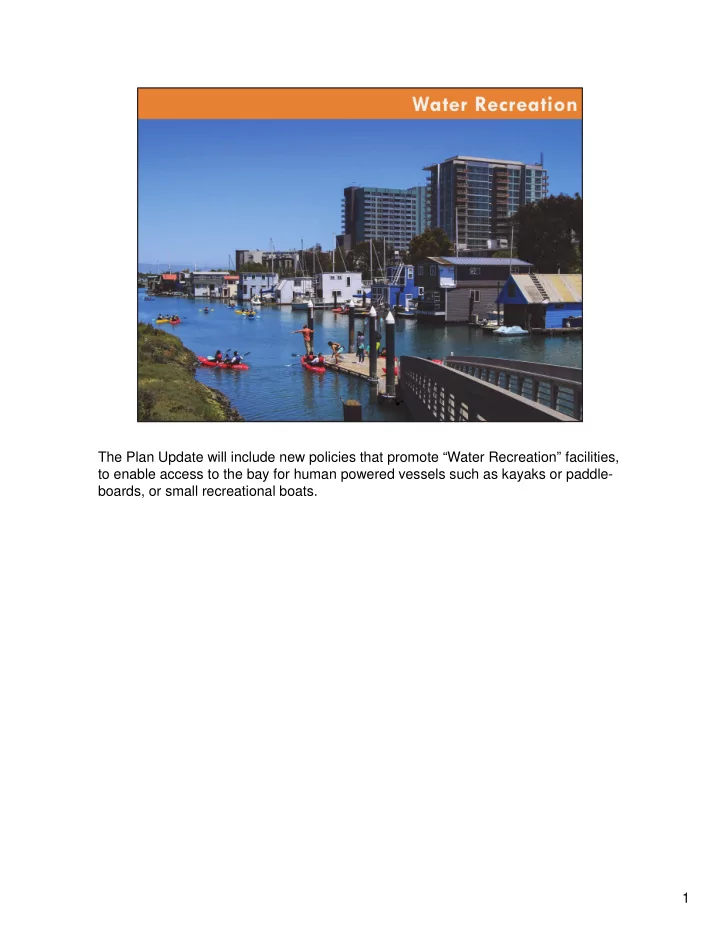
The Plan Update will include new policies that promote “Water Recreation” facilities, to enable access to the bay for human powered vessels such as kayaks or paddle- boards, or small recreational boats. 1
SLIDE 2
Over the past 10 years, Port has undertaken significant planning to promote water recreation at the Port – developing the Blue-greenway design guidelines in the Southern Waterfront – and further – developed a PORT-WIDE water trail program. Port worked in close collaboration with ABAG’s Bay Water Trail Program, BCDC and a host of community partners and water recreation groups. Five existing water trail designated launch sites: Islais Creek; Mission Creek; Pier 52; Pier 40; Pier 39. Two additional: Aquatic Park and Pier 1.5 2
SLIDE 3
The main objectives are three-fold: 1) Maintain and expand the network of water access facilities 2) Maintain ongoing communication and coordination with stakeholders and partner-agencies 3) Promote safe and sensitive water recreation use – including site-specific signage tailored for San Francisco (as shown) 3
SLIDE 4
4
SLIDE 5
5
SLIDE 6 GREEN = Open space network advanced by the Port over past 17 years – interconnected parks and open space network along the 7.5 miles, a core public trust use. BLUE/PURPLE = Active maritime berths, either under lease to a Tenant, or
- perated by Port Maritime Division
ORANGE = Berths that may be returned-to-service after pier apron and fendering repairs are made ASTERISK = Areas where maritime operations and public access utilized shared space Majority of heavy industrial, deep water berths are located south of China Basin at Pier 50, 70 and the Maritime Eco Industrial area at Pier 80-96. These operations preclude shared public access for safety and homeland security reasons, so public access network is focused on public access at the outskirts of working waterfront, and on natural habitat areas. North of China Basin, the piers host a mix of shared maritime/public access areas, and exclusive, industrial berthing areas. Maritime berthing is a character-defining use in Northern Waterfront that reflects the 6
SLIDE 7
Port’s historic purpose, and factors positively toward compliance with Historic Preservation standards. 6
SLIDE 8
Piers alone are insufficient for berthing: The pier “aprons” must be in good, sturdy condition. 7
SLIDE 9
And pier “fendering” systems must be in place – for boats to lay-up against – something other than the concrete pier deck. 8
SLIDE 10
Pile Fender was designed for cargo vessels or vessel with high freeboard. Horizontal Fendering vs vertical – useful for smaller vessels 9
SLIDE 11
Fendering knees, curve away from vessel Ferry Float designed for (midsize) inspected passenger vessels (different from uninspected and small passenger vessels) 10
SLIDE 12
Lay-berth not ADA compliant for passengers. This is a working-berth. Note that windows would be damaged on fender pile – specialized fendering attached to barge is necessary. Barge is least expensive and most flexible (to install and remove) berth option. 11
SLIDE 13
- Temporary berthing occurs all along the 7.5 miles – there are important
deepwater berths in the Southern Waterfront, but several other locations in Northern Waterfront that are critical to meet the ongoing demand for “transient” berthing
- Transient berthing is a fundamental trust purpose of the Port and an interesting
and unique visual experience – the wide variety of ships, local and from all over the world 12
SLIDE 14
- Example of a Small Vessel Dock @ Pier 15, built with the Exploratorium project
- The pier apron is fully accessible to the public
- Would be more useful if a little bit longer (to allow excursion vessel in support of
Exploratorium, and for more transient landings) 13
SLIDE 15
14
SLIDE 16
Lay-berth, Public Access, Crew required to maintain vessel security 15
SLIDE 17
16
SLIDE 18
@ 300’ of transient vessels (USCG) Ongoing need for this type of pier-side berthing 17
SLIDE 19
Temporary berths, varying levels of security; this is a government research vessel Able to maintain public access around the pier, with limited temporary fencing 18
SLIDE 20
Some Research Vessels require lots of secure working room on the pier, for a temporary period while at berth 19
SLIDE 21
Security measures (Temp or Permanent) are not all the same 20
SLIDE 22
Most excursion and ferry vessels are secured according to Federal Requirements and/ or to comply with Federal Vessel Security Plan 21
SLIDE 23
Excursion operations are conducted from float – separated from public access pathway by a gate along the edge of the pier. Floats or barges are used to provide a “soft” fendering system that is necessary for most vessels. Floats are more compatible with lower freeboard (compared to Cargo) 22
SLIDE 24
Secured area starts where pubic access ends, at the edge of the shoreline Temporary queuing occurs right before vessel departure 23
SLIDE 25
Public Access ends at Secured Area, at edge of shoreline. 24
SLIDE 26
Temp Queuing in public access area near SF Downtown Ferry Terminal. 25
SLIDE 27
Area secured in compliance with Federal Facility Security Plan 26
SLIDE 28
27
SLIDE 29
Harbor Services make full use of Apron for ops, safety and security. 28
SLIDE 30
Ferry/ Excursion Lay-berth and Maintenance: Operations, Safety & Security preclude public access on pier apron. Operations are visible from the Bay shoreline. 29
SLIDE 31
Harbor Services Apron is secured for Operation, Safety and Security 30
SLIDE 32
Harbor Services Ops., Safety & Security Barge loaded with ship stores from adjacent shed 31
SLIDE 33
Crane to load the barges on working pier-apron 32
SLIDE 34
Public photographing boats (of all types) berthed alongside piers is common. 33
SLIDE 35 Harbor Services (Tug and Barge, Pilots) and Ferry/ Excursion Lay- Berth/Maintenance operators all require additional berthing and apron/operating area today for their operations. Potentially more berthing is needed going forward, to support industry growth. Some maritime berthing offers opportunities for shared public access on the pier
- apron. Other maritime berth/operations are maintenance intensive and best suited
for exclusive apron use; the aprons themselves may have poor visibility and security, depending upon orientation and the adjacent use of shed. Some pier aprons may be used exclusively for public access. 34
SLIDE 36
Attractive vessel, temporarily berthed. 35