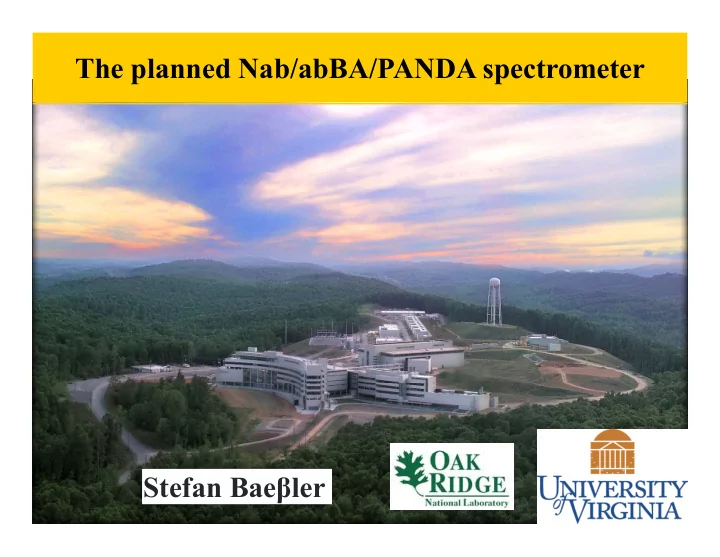
The planned Nab/abBA/PANDA spectrometer Stefan Bae ler The - - PowerPoint PPT Presentation
The planned Nab/abBA/PANDA spectrometer Stefan Bae ler The Spallation Neutron Source SNS in Oak Ridge, TN Linear H - accelerator Accumulator ring (buncher) Target Target Guide Hall Usage of neutrons @ SNS 7 - Engineering 11A - Powder 9
The Spallation Neutron Source SNS in Oak Ridge, TN
Linear H- accelerator Accumulator ring (buncher) Target Target Guide Hall
Usage of neutrons @ SNS
11A - Powder Diffractometer Commission 2007 7 - Engineering Diffractometer IDT CFI Funded C i i 2008 9 – VISION 12 - Single Crystal Diffractometer Commission 2009 Commission 2008 6 - SANS Commission 2007 4B - Liquids 5 - Cold Neutron Chopper Spectrometer Commission 2007 13 - Fundamental Physics Beamline Commission 2008 4A - Magnetism Reflectometer C i i 2006 Reflectometer Commission 2006 14B - Hybrid Spectrometer Commission 2011 3 - High Pressure Diffractometer Commission 2008 Commission 2006 18 - Wide Angle 17 - High Resolution Chopper Spectrometer 15 – Spin Echo 1B - Disordered Mat’ls Commission 2010 2 - Backscattering Spectrometer Commission 2006 18 Wide Angle Chopper Spectrometer Commission 2007 Commission 2008
Performance of FNPB beamline
Wrap-around neutrons Measured (@1 MW) neutron capture flux at FNPB beam exit:
9 c 2
1 4 10 @ 1.4 MW cm s F = ´ ⋅
Neutron beta decay
p+ e-
n
n
e
Beta Decay in the Standard Model
60Co
I I
e-
≠
Fermi’s golden rule:
2 weak
2 decay probability
i f
f H i
Parity Violation found by Wu et al, 1956
5
G V
e-
60Co
ud 5 F weak 5
h.c. 2 1
μ μ e
G H p γ γ γ n e γ γ γ ν V
3 Helicity 1 Quark mixing 2 Nucleon structure 3. Helicity
… of elementary fermions: –p/E,
μ
- νμ
- 1. Quark mixing
2
95% V
2. Nucleon structure effects
gV = GF·Vud·1 … of elementary anti- fermions: +p/E
e
d u s c
2 ud
95% V
gA= GF·Vud·λ
No nuclear structure effects e-
e e
p
b t c
(for neutrons)
Observables in Neutron Beta Decay
p e-
n
e
Jackson et al., PR 106, 517 (1957): Observables in Neutron beta decay, as a function of generally possible coupling constants (assuming only
2 2 2
2 1 3 V dw G E
p n
e
generally possible coupling constants (assuming only Lorentz-Invariance)
2 e e
1 3 1 b m d E p p
d e u e
1 3
F V
G E dE
2 e e e e e e e
1 3 1 + a b A B dw E E p p E E p p p p D
Fierz interference term b
e e n e e
+ A B p p p p E E E E D
2
R Beta-Asymmetry Neutrino-Electron-Correlation
2
Re 2 1 3 A
2 2
1 a
u 1 2 2 e 2 n d
2 1 3
F
G V E
Neutron lifetime
2
1 3
The Standard Model Parameters Vud and λ
νe
2 1
p
Fermi-Decay: gV = GF·Vud
νe e- e-
A = 0
S = 0, mS = 0
n
Gamow-Teller-Decay:
p
2 1
νe νe e- e-
A = 0
S = 1, mS = 0
y gA = GF·Vud·λ
p e- νe
A = -1
S = 1, mS = 1
n
1 cos ,
e e e
p dw A p E
,
S (after D. Dubbers, Prog. Part. Nucl. Phys. 26, 173 (1991)
Two unknown parameters, gA and gV, need to be determined in 2 experiments
- 1. Neutron-Lifetime:
1 2 2 n V A
3 g g
n
885 s
2 2
2 0.1 1 3 A
A V
g g
- 2. Beta-Asymmetry:
Neutron Lifetime Measurements
Decrease of Neutron Counts N with storage time t: N(t) = N(0)exp{-t/τeff} 1/ τeff = 1/τβ+1/τwall losses
895 Spivak 88 Nesvizh.92 Byrne 96 Arzumanov Nico 05 PDG2010 890 me [s] Mampe 89 00 PDG2010 Pichlmaier 10 Serebrov 08 885 Neutron lifetim Mampe 93 Serebrov 05 Serebrov 10 875 880
Many new attempts mostly with UCN in magnetic bottles: Ezhov et al (ILL PNPI Gatchina)
1988 1992 1996 2000 2004 2008 2012 Experiment publication
Many new attempts, mostly with UCN in magnetic bottles: Ezhov et al. (ILL, PNPI Gatchina), Arzumanov et al. (Kurchatov Inst., ILL), Liu et al. (Indiana), Paul et al. (TUM), Huffman et al. (NIST, NCSU), Nico et al. (NIST), Zimmer et al., (ILL) are (at least) under construction.
The Beta Asymmetry
p+ n e-
- 1.255
e
Electron Detector (Plastic Scintillator)
Yerozolimski Liaud PDG2010 1 265
- 1.26
( ) Decay Electrons
PERKEO I Mostovoi PDG2010
- 1.27
- 1.265
λ
Polarized Neutrons Decay Electrons
PERKEO II UCNA PERKEO II, prelim
- 1.28
- 1.275
1985 1990 1995 2000 2005 2010 Publication year
Ongoing funded experiments:
Split Pair Magnet Magnetic Field
PERKEO II Ongoing funded experiments: UCNA (NCSU, LANL), PERKEO III (Heidelberg), PERC (Europe)
Use of coupling constants in Primordial Nucleosynthesis
W± e- p W± νe p
Before Phase Transition: Equilibrium
W± e- p νe n
n + νe ↔ p + e-
e+ n
n + e+ ↔ p + νe
After Phase Transition (some minutes
n ↔ p + e-+ νe
νe n
After Phase Transition (some minutes after Big Bang):
n + p → d + γ d + d → 3He + n → t + p d + 3He → 4He + p d + He → He + p
Then the Primordial Nucleosynthesis stops, as there are no stable nuclei with A = 5, 8, and as h f di ….. the free neutrons die out. Stronger coupling constants in n ↔ p reactions ⇒ Phase transition later ⇒ nucleon density lower after phase transition ⇒ less 4He, more d
Search for Standard Model Parameters
0.980 0.975
ft(0+→0+) [Hardy09] ft(0+→0+) [Liang09 – DD-ME2] Kaons +Unitarity [PDG 2010]
0.970
Vud
ft(0+→0+) [Liang09 – PKO1] PIBETA [Pocanic04]
0.965
PDG 2010] 010]
0 960
λ [P A [UCNA 20
- 1.290
- 1.280
- 1.270
- 1.260
λ = gA/gV
0.960
A [PERKEO II, prel.]
Unitarity and superallowed nuclear decays
V Telegdi 1977:
- V. Telegdi, 1977:
I would like to say that the theory of β-decay is the theory of the decay of the neutron. I have always thought that nuclear β-decay experiments were only done faute de mieux: … If you do not know how to do the one experiment, you take the average of twenty.
( )
2 2 2 V F ud 2 ud 2
1 2 1
V
Ft g G V V G Ft µ = µ +D
( )
F
2 1
R
G Ft +D
2 2 2
1 V V V
u ud s ub
1 V V V = -
- (Dubbers
average)
Liang et al., PRC 79, 064316 (2009) Dubbers, Schmidt, RMP (2011), in press
Possible Tests of the Standard Model
1 S h f Ri ht h d d C t (l t i hth d d) W ? Multiple determinations (nuclear physics, other correlation coefficients)
- verconstrain problem, enable:
- 1. Search for Right-handed Currents (leptons are righthanded): WR?
- 2. Search for Scalar and Tensor interactions (neutrinos have opposite
handedness to electrons – 4 new coupling constants possible): Leptoquarks? Charged Higgs Bosons? Supersymmetry?
- 3. Test of the Unitarity of the Cabbibo-Kobayashi-Maskawa-Matrix:
ud u ub s
d' d V V V
Extra Z bosons? Supersymmetry? 4th quark generation?
2
95% V cd cs cb td td tb
s' s b' b V V V V V V
d u s c
2 ud
95% V
2 us
5% V us 2 2 ub u 2 d
1 ? V V V + + = +
b t c
2 ub
0.000015 V
Determination of the Coupling Constants
νe
2 1
p
Fermi-Decay: gV = GF·Vud
νe e- e-
a = 1
n
Gamow-Teller-Decay:
p
2 1
νe νe e- e-
a = 1
y gA = GF·Vud·λ
p e- νe
a = -1
1 cos ,
e
e
v dw a p p c
Two unknown parameters, gA and gV, need to be determined in 2 experiments
- 1. Neutron-Lifetime:
1 2 2 n V A
3 g g
n
885 s
A V
g g
- 2b. Neutrino-Electron-Correlation a:
2 2
1 ~ 0.1 1 3 a
e-
Idea of the cos θeν spectrometer Nab @ SNS
p
n e
e
p Kinematics:
- Energy Conservation:
- Momentum Conservation
e,max e
E E E
Proton phase space (Dalitz plot) Probability (arb. units) 1 5
1 cos
e e e
p dw a E
e
- Momentum Conservation
2 2 2 e e p
2 cos
e
p p p p p
cos θeν = 1 Proton phase space (Dalitz plot) Probability (arb. units) 1 1.25 1.5 Ee = 236 keV 700 keV [MeV2/c2] 0.75 1 75 keV
2 2 p e min, max
Edges: Slope: p p p
pp
2 [
0.25 0.5 cos θeν = 0 cos θeν = -1 450 keV
2 e p e
Slope: 1 cos
e
p a p E
Ee [MeV] 0.2 0.4 0.6 0.8 Alternative approaches: aSPECT (Mainz, ILL), aCORN (Tulane, NIST)
The asymmetric version of Nab @ SNS
30 kV
Advantages of asymmetric configuration: D i f i I d fli h h
Segmented Si detector TOF region
- Detection function: Improved flight path
length
- Reduced sensitivity to electrostatic and
ti t ti l i h iti
magnetic filter region (field B0) g (field rB·B0)
magnetic potential inhomogeneities
- Avoid deep Penning trap
- Statistical uncertainty: Bigger decay
decay volume (field rB,DV·B0) 0 kV
y gg y volume vs. angular acceptance
- Polarized experiment (abBA, PANDA)
still possible
0 kV 0 kV Neutron beam 0 kV
The cosθeν spectrometer Nab @ SNS
ution
2 e p e
1 cos
e
p a p E
Segmented Si detector
- 30 kV
pp
2 distribu
2 p
cos 1
e
p
2 p
cos 1
e
p
magnetic filter i (fi ld B ) TOF region (field rB·B0)
107
pp
2 [MeV2/c2]
0.0 0.5 1.0 1.5
Ee = 550 keV
region (field B0) decay volume (field rB,DV·B0)
nt rate
106 107
Neutron beam 0 kV
Simulated coun Ee = 300 keV
104 105
Ee = 500 keV
- Measurement of Ee and tp for each event
B k d i th h i id f l t d
0 kV
0.00 0.02 0.04 0.06 0.08
1/tp
2 [1/μs2]
103 10
Ee = 700 keV
- Background suppression through coincidences of electron and
proton.
- Long flight path improves spectrometer
Determination of pp through tp: The magnetic field
30 kV
p
||
p
z Segmented Si detector TOF region Magnetic Field
abatic ersion
x magnetic filter region (field B0) g (field rB·B0) Proton Trajectory
Adia conv
z decay volume (field rB,DV·B0) 0 kV
p
||
p
x 0 kV 0 kV Neutron beam z
- Measurement of Ee and tp for each
event
- Background suppression through
0 kV x
g pp g coincidences of electron and proton.
- Long flight path improves
spectrometer
Silicon detector for Nab / abBA / PANDA
Front side Back side
Segmented ion-implanted silicon detector with fast readout electronics:
- Thickness 2 mm (less for testing)
- Thin dead layer of < 100 nm silicon (measured!):
Energy loss for 30 keV protons: < 11 keV (measured!)
- 127 channels
Sufficiently small count rate/pixel, Allows to find electron and correlated proton.
Detector properties: proton response
Proton beam, 32 keV, 50 s-1 Detector thickness: 500 μm
Detector properties: proton spectrum (II)
ld
10
3
10
4
10
5
average energy loss: 11 keV
Threshold?
Worst case simulation (dead layer: 100 nm Si)
Energy calibration: Si 1.0mm detector Yiel
10
1
10
2
10
3
Energy calibration: Si 1.0mm detector Cd-109 data Proton data
75 10
deposited Ep [keV] (w/o electronic noise)
5 10 15 20 25
E (keV)
50
Threshold lost protons efficiency slope 8 keV 0.19% 110(30) ppm/keV 10 keV 0.20% 131(31) ppm/keV 12 k V 0 21% 165(32) /k V
25
dead layer: 65 nm (but pulse height defect neglected)
12 keV 0.21% 165(32) ppm/keV 14 keV 0.28% 304(76) ppm/keV channels
100 200 300
For uncertainty in a, we assume a threshold
- f 10 keV and direct measurement of
efficiency slope to 50%.
Electron energy measurement with backscattering suppression
30 kV
10
4
10
5
detected Ee for e- in lower detector detected Ee with only lower detector
D t t f Segmented Si detector TOF region Yield
10
1
10
2
10
3
Detector response for incoming Ee = 300 keV magnetic filter region (field B0) g (field rB·B0) detected Ee [keV]
1 10 50 100 150 200 250 300
decay volume (field rB,DV·B0) 0 kV
e [
]
1000
incoming Ee = 300 keV 0 kV 0 kV Neutron beam Yield
10 100
0 kV electron TOF between detectors [ns]
1 50 100 150
- 50
- 150
- 100
Electron energy measurement with backscattering suppression
30 kV
10
4
10
5
detected Ee for e- in lower detector detected Ee with only lower detector
D t t f Segmented Si detector TOF region Yield
10
1
10
2
10
3
Detector response for incoming Ee = 300 keV magnetic filter region (field B0) g (field rB·B0) detected Ee [keV]
1 10 50 100 150 200 250 300
decay volume (field rB,DV·B0) 0 kV
- Measurement of Ee (and tp) for each event
e [
] 0 kV 0 kV Neutron beam
e ( p)
- Backscattering suppression through adding
energies of both detectors.
- Reconstructing of electron energy needs
0 kV
g gy time resolution of < 20 ns
Detector properties: Speed
Extraction of a in Nab
2 e p e
1 cos
e
p a p E
A.U.] pp
2 distribution
2 p
cos 1
e
p
2 p
cos 1
e
p
lated counts [A Ee = 300 keV
0.0 0.5 1.0 1.5 Ee = 550 keV
Simul Ee = 500 keV Ee = 700 keV
pp
2 [MeV2/c2]
0.002 0.004 0.006
1/tp
2 [µs-2]
Data analysis: Use edge to determine or verify the shape of the detection function
p p p p
cos ( ) m dz t p z q =
ò
shape of the detection function. Then, use central part to determine slope and the correlation coefficient a.
Detailed spectrometer magnet design
0.50 37.50 14.75 25.90
c1i z c1o
eld [T] B
3 4 5 B (on axis) Si detector
0.03 25.28 43.81 481.25
c1i c1o
Magnetic fie
1 2 Bz (on axis) Decay volume
4 m flight path is omitted here 466.25 5.00 4.34 10.52 20.58 38.16 29 94 3.19 3.28 4.93 12.92 8 00 16.77
r c4i c3i c2i c4o c3o c2o
M z [m]
1
- 1
2 3 4 5 5 Filter
41.66 4.34 3.13 3.13 29.94 16.41 30.24 8.00
c5i c5o
c field [T] B
2 3 4 Decay volume Filter
67.09 14.77 25.90
20
- 20
10
- 10
- 30
Bz (on axis) Bz (off axis)
Magnetic
1 2
0.47
c6i c6o
z [cm]
Nab setup, about to scale
B Passive Antimagnetic Shield
200cm 300cm
Top view:
Beam shutter Beam stop Beam pipe
200cm
Beam shutter Spectrometer magnet Neutron guide
Side view:
Detector supportt Magnet Pit
Prototype detector spectra
Source: Cd 109. Preamp: LANL homemade. Micron detector, thickness: 1.5 mm 18.5 keV e- 62.5 keV e- 84.2,87.3,87.9 keV e-
Kelvin Probe: Tool to measure Work Functions
V Material 1 Material 2 Φ2 Φ2 Material 1 Material 2 Material 1 Material 2 VC Φ1 EF,1
2
EF,2 Φ1 Φ2 Φ1 EF 1 EF 2 EF,2 EF 1 VC _ _ _ + + + +
F,1 F,2 F,1
VBias = -VC 2 M t i l ith diff t Electrical Connection: → Charging, until Fermi Bi V lt 2 Materials with different work functions, isolated 1st material: to be tested 2nd t i l ti ith k g g, levels are equal → External electric field → If Material 2 is moved: Bias Voltage → Charge disappears, no external electric field N t if M t i l 2 i 2nd material: tip with known work function Capacitance changes, voltage is constant, therefore charge has to change (current) → No current if Material 2 is moved
Kelvin Probe: First results from early work on aSPECT
Work Function [meV]
30 35 40 4900
[ ]
20 25 30 ht [mm] 4950 5000 5 10 15 Heigh 5000 5050 50 100 150 200 250 300 350 5 Angle [°] 5100 g [ ] In collaboration with Prof. I. Baikie, KP Technologies
Now: Better coating
Work Function [meV]
30 35 40 4900 15 20 25 30 Height [mm] 4950 5000
(arbitrary offset added) 16
50 100 150 200 250 300 350 5 10 15 H 5050 5100
8 12
ight [mm] 50 100 150 200 250 300 350 Azimuth angle [°] 5100
In collaboration with Prof. I. Baikie, KP Technologies 4
Hei
4 8 12
Width [mm] Thanks to: Rachel Hodges (undergraduate research prize), Gertrud Konrad, Sean McGovern (Masters), Henry Bonner
Uncertainty budget
PLANNED systematic uncertainty budget: i i l i b d PLANNED systematic uncertainty budget: PLANNED statistical uncertainty budget:
lower Ee cutoff none 100 keV 100 keV 300 keV Experimental parameter Systematic uncertainty Δa/a Magnetic field curvature at pinch 5 10 4 upper tp cutoff none none 40 μs 40 μs Δa 2.4/√N 2.5/√N 2.5/√N 2.6/√N Δa (Ecal, l 2 5/√N 2 6/√N 2 7/√N 2 7/√N ... curvature at pinch 5·10-4 … ratio rB = BTOF/B0 2.5·10-4 … ratio rB,DV = BDV/B0 3·10-4 Length of the TOF region (*) Electrical potential inhomogeneity: variable) 2.5/√N 2.6/√N 2.7/√N 2.7/√N Δa (Ecal, l variable, inner 70% of data) 4.1/√N 4.1/√N 4.1/√N 4.1/√N Electrical potential inhomogeneity: … in decay volume / filter region 5·10-4 … in TOF region 1·10-4 Neutron Beam: position 4·10-4
About 2×10⁹ events can be detected in 6 weeks (Decay volume V = 246 cm3, decay density n = 20 cm-3 12 7 % of decay protons
… position 4 10 … profile (including edge effect) 2.5·10-4 … Doppler effect small Unwanted beam polarization can be made small Adiabaticity of proton motion 1·10-4
density nd = 20 cm 3, 12.7 % of decay protons go to upper detector, 80% duty factor) → (Δa/a)stat < 1×10⁻³ can be reached
Adiabaticity of proton motion 1 10 Detector effects: … Electron energy calibration (*) … Electron energy resolution 5·10-4 … Proton trigger efficiency 2.5·10-4
Compare to Δa/a = 5 % of existing experimental results
gg y Residual gas small Background small Accidental coincidences small Sum 1·10-3
Other ongoing experiments: aSPECT
i fi ld
y rate w(E)
Magnetic field Proton detector Analyzing Plane B 0 314 T
and for a = -0.103 (PDG 2006) Decay Proton spectrum for a = +0.3
Superconducting Retardation voltage U
- +
- +
- +
- +
detector BA = 0.314 T
200 400 600
( ) Proton kinetic energy E [eV]
magnet Protons DecayVolume = 1.55 T B0 Mirror voltage Neutrons
- +
- +
- +
- +
Leading uncertainty probably trapped particle background, (Δa/a)background = 0.61%
Other ongoing experiments: aCORN @ NIST
solenoid B proton electron collimator electron decay volume +V neutron beam proton detector proton collimator electron detector
] l t t
4 Simulated Data
pe pp pν
ton TOF [ s] μ late protons
3 2
Expected total uncertainty of Δa/a ~ 1 % (limited by systematics) l t f th il bl t d
prot
600800 400 200
early protons
2 1 80-300 keV
- only part of the available neutron decays
used
- I find it hard to determine the acceptance
i l
beta kinetic energy [keV]
precisely
The determination of the Fierz Interference term
2 e e e
1 3 1 m dw E b E
Electron spectrum:
e
Systematic uncertainties:
nits)
Sy 1. Electron energy determination
Yield (arb. un
b = +0.1 SM
10
4
10
5
Detector response to decay
Y
SM Yield
10
2
10
3
electron with Ee = 300 keV
200 400 600 800
Ee,kin (keV)
2% of events in tail (deadlayer, external bremsstrahlung)
1 10
1
50 100 150 200 250 300
Δb ~ 3×10⁻³ can be reached (systematics limited) 2. Background
detected Ee [keV]
A/B at SNS or NIST: abBA / Nab / PANDA
Segmented Si detector
- A: reflect all protons to
bottom detector, use top detector for electrons
TOF region (field rB·B0)
S i AFP Spin 3He
- B: detect protons at top
decay volume (field rB,DV·B0)
Supermirror (3He) Spin Flipper Polarimeter AFP
- Main uncertainties in PERKEO II: statistics, detector, polarization, background
- Superior detector energy resolution, good enough time resolution
K i id t i b k d
- Keep coincidences to improve background
- Asymmetric detector: Filter improves on systematics; statistics @ SNS is an issue for A
- Polarization measurement seems manageable (XSM or He-3)
Uncertainty budget for A
PLANNED t ti t i t b d t PLANNED systematic uncertainty budget: PLANNED statistical uncertainty budget:
Experimental parameter Systematic uncertainty ΔA/A Relevant only for lower Ee cutoff none 100 keV 200 keV 250 keV ∆A 4.3/√N 4.8/√N 7/8/√N 11.9/√N
Nd is the number of decays. Only 13% are detected, due to asymmetric configuration.
Electrical potential inhomogeneity: y B/C Neutron Beam: … position irrelevant … profile (including edge effect) small D l ff ll ∆A 4.3/√N 4.8/√N 7/8/√N 11.9/√N
Nd = 2×10⁹ decay events (40 live days at SNS) → (ΔA/A)stat = 1×10⁻³ can be reached ibl i
… Doppler effect small … Beam polarization < 10-3 Detector effects: … Electron energy calibration 2·10-4 … Electron energy resolution small
Possible improvements:
- He3?
- NIST NG-C?
… Electron energy resolution small Residual gas small Background small Sum TBD
3
Our goal is a total uncertainty of ΔA/A = 10-3 or better (same for B/C, not discussed) Competition:
- UCNA: Goal ΔA/A = 2·10-3 (A. Young, NSAC), check of cold beam experiments
UCNA: Goal ΔA/A 2 10 (A. Young, NSAC), check of cold beam experiments
- UCNB: Goal ΔB/B = 10-3 , but electric potential homogeneities have to be ΔU < 0.3 mV
- PERC: Goal ΔA/A = 3·10-4
Time schedule
As presented at NSAC meeting, assuming NO major technical or funding delays 2011 2012 2013 2014 2015 2016 2017 2018 design Procurement, fabrication,
- ptimization
installation and data taking taking switc hover data taking Nab abBA / PANDA The experiment might move to NIST NG-C, probably for the polarized program.
Sensitivity to left-handed S-T couplings
“present limits” ( ) muon decay neutron and nuclear decays (survey, 68% C.L.) (68% C.L.) “90% C.L.” superallowed 0?0 d
++
l d 0?0 decays (68% C.L.) nuclear decays ((In), 90% C.L.) P
107
Present limits (n decay data) SM is in the origin of this plot Future limits, assuming a = -0.1059(1), A = -0.1186(1) , B = 0.9807(30), C = -0.23785(24), τn = 882 2(13) s b = 0±0 003 882.2(13) s, b 0±0.003 Model-dependent predictions: Supersymmetry, leptoquarks, …
Analysis similar to G. Konrad, S.B. et al., ArXiv:1007.3027
Sensitivity to right-handed S-T couplings
Present limits (n decay data) SM is in the origin of this plot Future limits, assuming a = -0.1059(1), A = -0.1186(1) , B = 0.9807(30), C = -0.23785(24), τn = 882.2(13) s 0.9807(30), C
- 0. 3785(
), τn 88 . ( 3) s
Analysis similar to G. Konrad, S.B. et al., ArXiv:1007.3027
The Nab collaboration
- R. Alarcona, L.P. Alonzib , S.B.b (Experiment Manager), S. Balascutaa, J.D. Bowmanc (Co-
Spokesmen), M.A. Bychkovb, J. Byrned, J.R. Calarcoe, T.V. Ciancioloc, C. Crawfordf, E. Frležb, M.T. Gerickeg, F. Glückh, G.L. Greenei, R.K. Grzywaczi, V. Gudkovj, F.W. Hersmane, A. Kleink,
- J. Martinl, S. McGovernb, S. Pageg, A. Palladinob, S.I. Penttiläc (On-site Manager), D. Počanićc
J , S G , S g , , S (O g ), (Co-Spokesmen), K.P. Rykaczewskic, W.S. Wilburnk, A.Youngm
a Department of Physics, Arizona State University, Tempe, AZ 85287-1504 b Department of Physics, University of Virginia, Charlottesville, VA 22904-4714 c Physics Division, Oak Ridge National Laboratory, Oak Ridge, TN 37831 d Department of Physics and Astronomy, University of Sussex, Brighton BN19RH, UK e Department of Physics, University of New Hampshire, Durham, NH 03824 f Department of Physics and Astronomy, University of Kentucky, Lexington, KY 40506 g Department of Physics, University of Manitoba, Winnipeg, Manitoba, R3T 2N2, Canada h IEKP, Universität Karlsruhe (TH), Kaiserstraße 12, 76131 Karlsruhe, Germany i Department of Physics and Astronomy, University of Tennessee, Knoxville, TN 37996 j Department of Physics and Astronomy, University of South Carolina, Columbia, SC 29208 k Los Alamos National Laboratory, Los Alamos, NM 87545 l Department of Physics, University of Winnipeg, Winnipeg, Manitoba R3B2E9, Canada m Department of Physics, North Carolina State University, Raleigh, NC 27695-8202
Tasks of UVa group: Spectrometer design, Superconducting magnet, Proton source
Summary
- Precise and reliable results from neutron physics are preferred
to extract information about the Standard Model without to extract information about the Standard Model without nuclear structure uncertainties
- Main difference to European effort (PERKEO II/III, aSPECT,
p ( , , PERC): less count rate, e--p coincidences
- Status of Nab spectrometer: Funding application at DOE to
perform Nab at the FNPB beamline at the SNS. Second funding application to NSF (MRI) E i i i d ( li i ) d f NSAC
- Experiment is received (preliminary) endorsement of NSAC