SLIDE 1
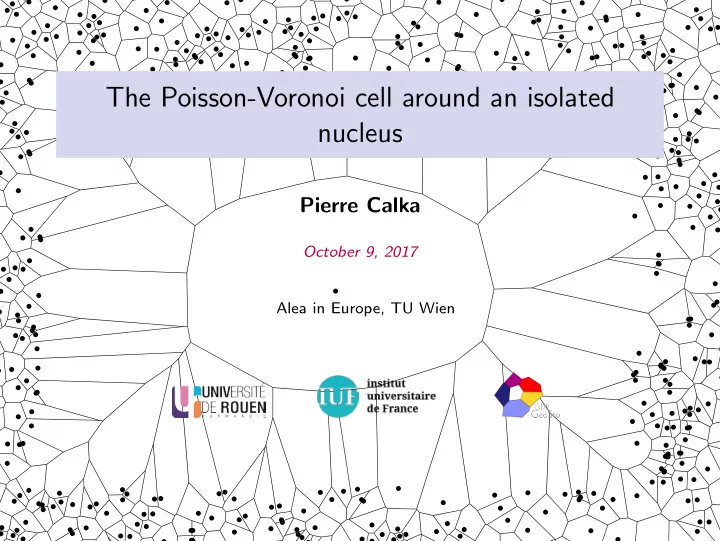
The Poisson-Voronoi cell around an isolated nucleus
Pierre Calka
October 9, 2017 Alea in Europe, TU Wien
SLIDE 2 default
Poisson point process
B2 B3 B4
Pλ said homogeneous Poisson point process in R2 with intensity λ if
◮ #(P ∩ B1) Poisson r.v. of mean λA(B1) ◮ #(P ∩ B1), · · · , #(P ∩ Bℓ) independent (B1, · · · , Bℓ ∈ B(R2), Bi ∩ Bj = ∅, i = j)
Two properties
◮ Scaling invariance: µ · Pλ
D
= P λ
õ
◮ Mecke’s formula: E
x∈Pλ
f (x, Pλ)
SLIDE 3
default
Poisson-Voronoi tessellation
◮ Pλ homogeneous Poisson point process in R2 of intensity λ ◮ For every nucleus x ∈ Pλ, associated cell C(x|Pλ) := {y ∈ R2 : y − x ≤ y − x′ ∀x′ ∈ Pλ}
SLIDE 4 default
Typical Poisson-Voronoi cell
◮ Typical cell C: chosen uniformly among all cells
E(f (C)) = lim
r→∞
1 Nr
C(x|Pλ)⊂Br(o)
f (C(x|Pλ)) a.s. E(f (C)) = 1 λA(B)E
f (C(x|Pλ) − x)
◮ Theorem (Slivnyak): C D = C(o|Pλ ∪ {o})
SLIDE 5 default
Being in the typical cell
K F0(K)
◮ K convex body containing o in its interior ◮ Flower of K: Fo(K) = ∪x∈KB(x, x) Two properties ◮ Capacity probability: P(K ⊂ C(o|Pλ ∪ {o})) = e−λA(Fo(K)) ◮ Conditional distribution: (Pλ|K ⊂ C(o|Pλ ∪ {o})) D = Pλ \ Fo(K)
SLIDE 6
default
The Poisson-Voronoi cell around an isolated nucleus
◮ K convex body in R2 ◮ An origin o chosen in int(K) ◮ Point process (Pλ|K ⊂ C(o|Pλ ∪ {o})) ◮ Problem 1. Asymptotics of the characteristics of the cell Kλ = C(o|Pλ ∪ {o})
SLIDE 7 default
The Poisson-Voronoi cell around an isolated nucleus
◮ An origin o chosen in int(K) ◮ Point process (Pλ|K ⊂ C(o|Pλ ∪ {o})) ◮ Problem 1. Asymptotics of the characteristics of the cell Kλ = C(o|Pλ ∪ {o})
SLIDE 8 default
The Poisson-Voronoi cell around an isolated nucleus
◮ An origin o chosen in int(K) ◮ Point process (Pλ|K ⊂ C(o|Pλ ∪ {o})) ◮ Problem 1. Asymptotics of the characteristics of the cell Kλ = C(o|Pλ ∪ {o})
SLIDE 9 default
The Poisson-Voronoi cell around an isolated nucleus
◮ An origin o chosen in int(K) ◮ Point process (Pλ|K ⊂ C(o|Pλ ∪ {o})) ◮ Problem 1. Asymptotics of the characteristics of the cell Kλ = C(o|Pλ ∪ {o})
SLIDE 10 default
Two associated problems
Problem 2. Cell Kλ containing K, Pλ conditioned on {K ⊂ one cell}
Problem 3. Cell Cλ(D) = C(o|Pλ ∪ {o}), Pλ conditioned on {Pλ ∩ D = ∅}
SLIDE 11
default
Plan
Problem 1: asymptotics for Kλ = C(o|Pλ \ Fo(K)) Problem 2: asymptotics for Kλ (no origin) Problem 3: asymptotics for Cλ(D) = C(o|Pλ \ D) Joint work with Yann Demichel (Paris Nanterre) & Nathana¨ el Enriquez (Paris-Sud)
SLIDE 12
default
Plan
Problem 1: asymptotics for Kλ = C(o|Pλ \ Fo(K)) Context Main results Support function Rewriting of the expectations Sketch of proof Problem 2: asymptotics for Kλ (no origin) Problem 3: asymptotics for Cλ(D) = C(o|Pλ \ D)
SLIDE 13 default
Context: large Poisson-Voronoi cells
◮ Large cells in a Poisson-Voronoi tessellation: close to the circular shape
- D. Hug, M. Reitzner & R. Schneider (2004)
◮ When K is the unit-disk,
E(A(Kλ)) − A(K) ∼
λ→∞ λ− 2
3 2−13− 1 3 πΓ
3
∼
λ→∞ λ
1 3 223− 4 3 Γ
3
◮ Estimate of the Hausdorff distance between Kλ and K for a Poisson line tessellation
- D. Hug & R. Schneider (2014), R. Schneider (1988)
SLIDE 14 default
Context: approximation of a convex body from the inside
K λ = Conv(Pλ ∩ K) Efron’s relation (1965): E(N(K λ)) = λ(A(K) − E(A(K λ))) K with a smooth boundary
A(K) − E(A(K λ)) ∼
λ→∞ λ− 2
3 2 4 3 3− 4 3 Γ
3 ∂K
r
− 1
3
s
ds
K polygon
A(K) − E(A(K λ)) ∼
λ→∞ (λ−1 log λ) · 2 · 3−1nK
enyi & R. Sulanke (1963, 1964)
SLIDE 15 default
Main results: smooth case
A(·): area, U(·): perimeter, N(·): number of vertices rs: radius of curvature, ns: outer unit normal vector at s ∈ ∂K
E(A(Kλ)) − A(K) ∼
λ→∞ λ− 2
3 2−23− 1 3 Γ
3 ∂K
r
1 3
s s, ns− 2
3 ds
E(U(Kλ)) − U(K) ∼
λ→∞ λ− 2
3 3− 4 3 Γ
3 ∂K
r
− 2
3
s
s, ns− 2
3 ds
E(N(Kλ)) ∼
λ→∞ λ
1 3 223− 4 3 Γ
3 ∂K
r
− 2
3
s
s, ns
1 3 ds
SLIDE 16 default
Main results: polygonal case
A(·): area, U(·): perimeter, N(·): number of vertices nK: number of vertices of K, {ai}: vertices of K, oi: projection of o onto (ai, ai+1)
∼
λ→∞ λ− 1
2 2− 9 2 π 3 2
nK
2 ai+1 − ai 3 2
E(U(Kλ)) − U(K) ∼
λ→∞ (λ−1 log λ) · 2−13−1 nK i=1 oi−1
E(N(Kλ)) ∼
λ→∞ (log λ) · 2 · 3−1nK.
SLIDE 17 default
Support function
K
uθ
Support function po(K, θ) = po(K, uθ) = sup
x∈K
x, uθ
with uθ = (cos(θ), sin(θ))
Two properties ◮ Link with the flower: sup{r > 0 : ruθ ∈ Fo(K)} = 2po(K, θ) ◮ Cauchy-Crofton formula: U(K) = 2π po(K, θ)dθ
SLIDE 18 default
Rewriting of the expectations
◮ Mean defect area E(A(Kλ)) − A(K) =
P(x ∈ Kλ)dx =
e−λ(A(Fo(K∪{x}))−A(Fo(K)))dx where A(Fo(K)) = 2 2π po(K, θ)2dθ ◮ Mean defect perimeter E(U(Kλ)) − U(K) = 2π E(po(Kλ, θ) − po(K, θ))dθ ◮ Mean number of vertices: Efron-type relation E(N(Kλ)) = λ(E(A(Fo(Kλ)) − A(Fo(K))) ∼
λ→∞ 4λ
2π po(K, θ)E(po(Kλ, θ) − po(K, θ))dθ
SLIDE 19 default
Sketch of proof, smooth case
@K
z(s) ns
1 2s
ns
1 2@Fo(K)
A(Fo(K ∪ {s + hns})) − A(Fo(K)) ∼
h→0 h
3 2 2 9 2 3−1r
− 1
2
s
s, ns
SLIDE 20 default
Sketch of proof, smooth case
@K
αs z(s) z0(s) z00(s) ns
1 2s 1 2(s + hns)
s + hns αs αs ns
2@Fo(K) 1 2@Fo(K)
ρz(s) =
ksk2 2kskr s cos αs h h
A(Fo(K ∪ {s + hns})) − A(Fo(K)) ∼
h→0 h
3 2 2 9 2 3−1r
− 1
2
s
s, ns
SLIDE 21 default
Sketch of proof, smooth case
∂K
ns ts Ys,λ Xs,λ ms,λ
◮ ms,λ: support point of Kλ in direction ns ◮ (Xs,λ, Ys,λ): coordinates of ms,λ in the Frenet frame at s (λ
1 3 Xs,λ, λ 2 3 Ys,λ) D
→ (X, Y ) with explicit density. E(po(Kλ, ns)−po(K, ns)) = E(Ys,λ) ∼
λ→∞ λ− 2
3 3− 4 3 Γ
2 3
1 3
s s, ns− 2
3
SLIDE 22 default
Problem 2: asymptotics for Kλ (no origin)
◮ Steiner point st(K) = 1 π 2π po(K, θ)uθdθ = argminxA(Fx(K)) ◮ K: convex body with Steiner point at o ◮ Kλ: cell containing K, conditional on Sλ = {K ⊂ one cell} ◮ Zλ: nucleus of Kλ Conditional on Sλ, λ
1 2 Zλ
D
→ N(o, (4π)−1I2). The expectation asymptotics of Kλ coincide with those of Kλ when o = st(K).
SLIDE 23 default
Problem 3: asymptotics for Cλ(D) = C(o|Pλ \ D)
K D
- ◮ D closed domain, o ∈ int(D)
◮ Cλ(D) = C(o|Pλ \ D) ◮ K: convex body such that Fo(K) is the largest flower in D ◮ D∗: maximal starlike set in D, with piecewise C 3 equation d(·) Cλ(D) P → K in the Hausdorff metric
E(A(Cλ(D))) − A(K) ∼
λ→∞ λ− 2
3 2− 8 3 3− 1 3 Γ
3
(d(θ) + d′′(θ))
4 3 d(θ)− 2 3 dθ
E(U(Cλ(D))) − U(K) ∼
λ→∞ λ− 2
3 2− 2 3 3− 4 3 Γ
3
(d(θ) + d′′(θ))
1 3 d(θ)− 2 3 dθ
E(N(Cλ(D))) ∼
λ→∞ λ
1 3 2− 8 3 3− 4 3 Γ
3
(d(θ) + d′′(θ))
1 3 d(θ) 1 3 dθ
SLIDE 24
default
Problem 3: asymptotics for Cλ(D) = C(o|Pλ \ D)
SLIDE 25
default
Concluding remarks
◮ Higher dimension ◮ Variances ◮ Similar results for the zero-cell of a Poisson line tessellation ◮ Inlets
SLIDE 26
default
Concluding remarks
SLIDE 27
default
Concluding remarks
SLIDE 28
default
Concluding remarks
SLIDE 29
default Thank you for your attention!