The Politics of Squares Professor Helmut K Anheier Laurie Penny - - PowerPoint PPT Presentation

the politics of squares
SMART_READER_LITE
LIVE PREVIEW

The Politics of Squares Professor Helmut K Anheier Laurie Penny - - PowerPoint PPT Presentation

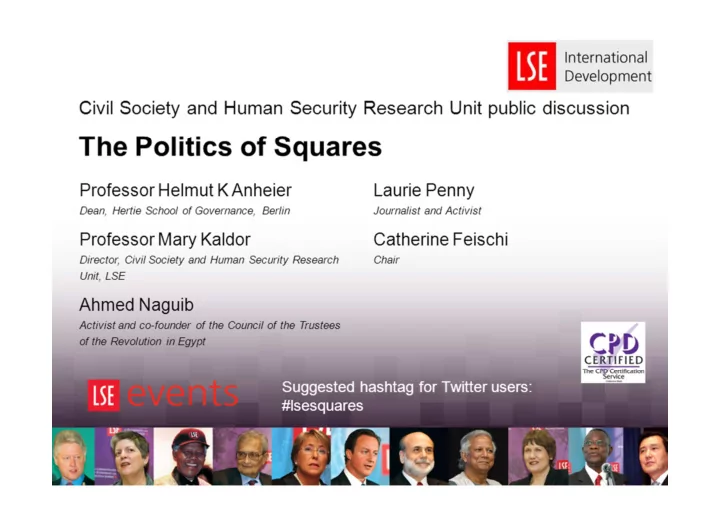
Civil Society and Human Security Research Unit public discussion The Politics of Squares Professor Helmut K Anheier Laurie Penny Dean, Hertie School of Governance, Berlin Journalist and Activist Professor Mary Kaldor Catherine Feischi


slide-1
SLIDE 1

The Politics of Squares

Professor Helmut K Anheier

Dean, Hertie School of Governance, Berlin

Professor Mary Kaldor

Director, Civil Society and Human Security Research Unit, LSE

Ahmed Naguib

Activist and co-founder of the Council of the Trustees

  • f the Revolution in Egypt

Civil Society and Human Security Research Unit public discussion

Laurie Penny

Journalist and Activist

Catherine Feischi

Chair

Suggested hashtag for Twitter users: #lsesquares

slide-2
SLIDE 2

Swarm Intelligence? Occupy & co. in Germany

Helmut K. Anheier

Hertie School of Governance, Berlin

The Politics of Squares Civil Society and Human Security Research Unit public discussion

Wednesday, 2 May 2012 London School of Economics and Political Science 2

slide-3
SLIDE 3

An Explorative Research Project

3

Phase I: Mustering and mapping the entire field of subterranean politics: weighing groups by set of criteria:

  • New or newly emerging
  • Subterranean, not affiliated
  • Relevance (google insight)

Phase II: In-depth Case Study: ‚Wutbürger‘ & Occupy

  • Extensive media content analysis & comprehensive research review
  • Structured interviews with Occupy activists
  • Participant observation in Berlin
slide-4
SLIDE 4

An Explorative Research Project

Are the recent European protest activities about austerity only? Or is there a subterranean crisis of (representative) democracy in Europe? Considering the German case:

  • Growth: 2011 by 3.0%; projection for 2012 is at 0.9%, higher for 2013
  • Budget deficit: 1.0% complying with Maastricht criteria for the 1st time

since the crisis.

  • Unemployment: 7.4% in February 2012; November 2011 was the best

month in employment figures since early 1990s

4

slide-5
SLIDE 5
  • „Word of the Year“ 2010 in Germany: Wutbürger – ‚angry citizen‘
  • What is it? spontaneous public expressions of opposition to formerly non-controversial infrastructure projects –

train station in Stuttgart; airport in Berlin. Subsequent organisation and politisation, media resonance

  • Legitimacy through administrative process being challenged; how much popular vote needed?

Example: Stuttgart 21

  • Who they are: educated (more than 70% hold university qualifying high-school degree); not that young (75%

were older than 35 years); dominantly male (59,7%)

  • A new generation? 60% have rarely participated in protests prior to Stuttgart21, 16 % never at all. When they

protest, they protest a lot (80% at least once a week)

  • Why they turn out: 66.3% feel not adequatly included in decision-making;
  • 80% are dissatisfied with the current political and social situation eventhough they are satisfied with their own
  • Note: Popular Referendum approved Stuttgart 21!

Findings: Wutbürger

5

slide-6
SLIDE 6

Findings: Swarm Intelligence Groups

Swarm Intelligence online Example: Guttenplag

  • Forced resignation by Minister of Defense Theodor zu Guttenberg after uncovering

that his doctoral thesis was full of plagiarism;

  • Guttenplag was website established to systematically track sections of plagiarism in

the thesis: decentralized, nonhierarchical and transparent

6

slide-7
SLIDE 7

Occupy: Swarm Intelligence on the street – Movement without crisis?

  • Activists have ascended on the public stage since 15 Oct. 2011 (international action day)
  • Occupy is label for various groups: Echte Demokratie Jetzt, Campact, alex11, aCAMPada

Forms of protest:

  • demonstration marches
  • asambleas in public places / occupation of public spaces (incl. camping)
  • Carnival of the disgusted: ironic 1% protests / rich people’s flash mobs,
  • Political education for empowerment
  • Frankfurt activists founded European Occupy Central Bank

Findings: Occupy

7

slide-8
SLIDE 8
  • Actors
  • Majority is between 25-35 years old, in some groups majority is male
  • Diverse background: mostly educated, students and self-employees, retirees, employees and

unemployed people – also: homeless, student activists, employees

  • App. half of activists had been active before: for peace, against nuclear energy, for a basic income,
  • r for global justice
  • Motivations
  • Consistent message: No sense of adequate political representation in established institutions;
  • Strong disapproval of political actors, processes and institutions
  • Sense of urgency, desire to participate and practice alternatives

Findings: Occupy

8

slide-9
SLIDE 9
  • Issue Framing
  • No coherent agenda formulation – seems presumptuous to many
  • “There is no need to come up with specific topics, since there are enough pressing issues

as it is”

  • Europe does not feature prominently in discussions
  • Modes of Interaction
  • Adhere to strictly democratic procedures
  • Three pillars: non-violence, transparency and the absence of hierarchies
  • The swarm: “Occupy rejects the concept of a small circle protecting their knowledge
  • “everything works based on the division o labor: everyone participated the way they

could and wanted to”

Findings: Occupy

9

slide-10
SLIDE 10

− A debate on Europe is absent in many groups and activities − Among activists: EU viewed as proxy for a disdainful style of politics – but solidarity across Europe − Global and European governance challenges vs. conspicous localism A Debate on Europe?

10

slide-11
SLIDE 11
  • Germany is a strong case for Subterranean Politics: it goes beyond traditional social

conflicts and captures sense of alienation and discomfort with regards to established actors, processes and institutions

  • The practices of subterranean politics in Germany aim at more participatory,

transparent, basis-democratic and web-based modes of governance, which activists are eager to employ themselves.

  • The debate on Europe is at a critical turning point: conspicuous localism should worry

supporters of the European project and policy makers

  • Scope and scalability of Occupy and ‚Wutbürger‘: new activists, but small numbers?
  • Is this a social movement after all?
  • Swarm intelligence as a genuinely new feature?

Summary And Questions

11

slide-12
SLIDE 12

The Politics of Squares

Professor Helmut K Anheier

Dean, Hertie School of Governance, Berlin

Professor Mary Kaldor

Director, Civil Society and Human Security Research Unit, LSE

Ahmed Naguib

Activist and co-founder of the Council of the Trustees

  • f the Revolution in Egypt

Civil Society and Human Security Research Unit public discussion

Laurie Penny

Journalist and Activist

Catherine Feischi

Chair

Suggested hashtag for Twitter users: #lsesquares