SLIDE 16 ACTION IDENTIFICATION 315 i:i1f;\
"CREATING ART" IDENTIFICATION FEEDBACK
45 .
1m SUCCESS i
4 CJ FAILURE
.;~~"
3
~,,~,
'"
f~\
I&r
3 ffi
..!~:\
.~t
~1
:~
2 ;,~ ~~
2
f\'
:.\
"I":,
1 1~
I,t\':
V~'\'.'
1~ 1 ,"
~~ ~
:~\
, '..
BASELINE MODEST BOASTFUL
SELF-PRESENTATION GOAL ;
FIGURE 2 ;
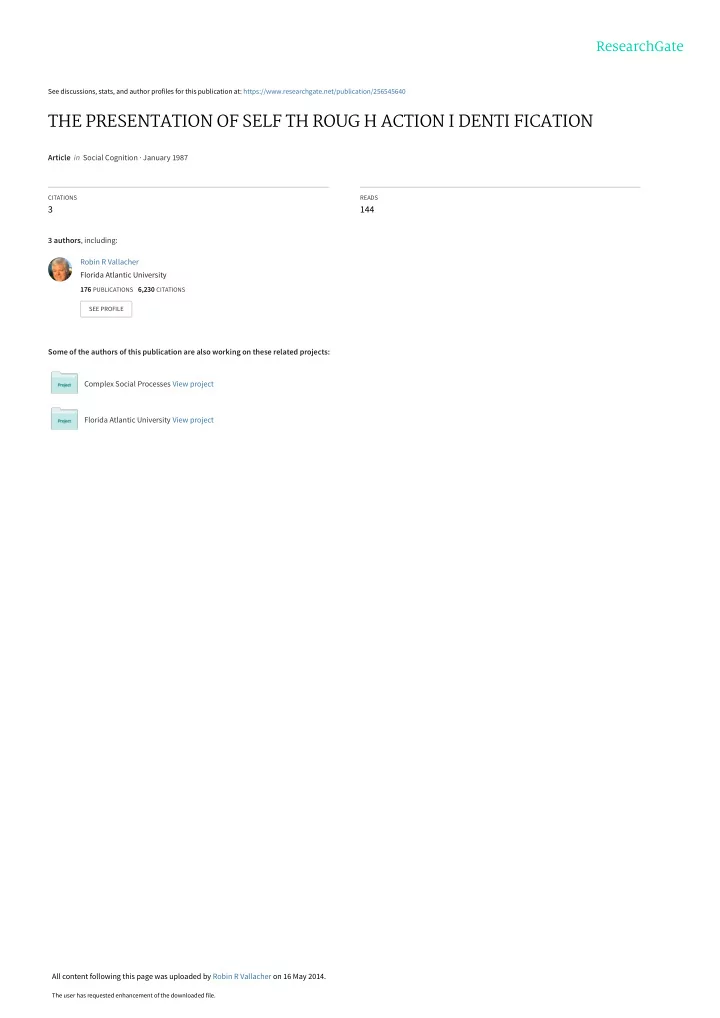
"Creating art" by self-presentation goal and performance feedback. ; (M=ll.ll) was lower than that
in the success/modesty con- dition (M=33.33), t (13)=3.38, p< .004; in the failure/boastful condi- tion (M=34.43), t (14)=2.64, p< .02; and in the failure/baseline desir- ability condition (M=33.56), t (16)=2.97, p< .009. "Creating art" is a ", very flattering way
presenting
artistic efforts, and apparently ; it took both failure feedback and a self-presentation goal
modesty for subjects to forego this description in favor
less flattering descrip- tions. Even failure subjects endorsed this identity if they thought that their interaction partner liked
who were boastful
that he
she was simply not concerned with modesty. "Demonstrating talent" is also a flattering depiction
ef- forts, but it is more explicitly self-descriptive in nature than is "creat- ing art:' The latter action identity, after all,
implies the manifesta- tion
personal qualities, but" demonstrating talent" specifies a particular feature
the self that is revealed in
action. The re- sults for "demonstrating talent" revealed
a marginally reliable effect for self-presentation goal, F (2, 45)=2.54, p< .09. As in the case
~,