The Problem Distributed Denial of Service Attacks and Defenses CS - - PDF document

the problem distributed denial of service attacks and
SMART_READER_LITE
LIVE PREVIEW

The Problem Distributed Denial of Service Attacks and Defenses CS - - PDF document

The Problem Distributed Denial of Service Attacks and Defenses CS 239 Advanced Topics in Network Security Peter Reiher May 3, 2006 Lecture 9 Lecture 9 Page 1 Page 2 CS 239, Spring 2006 CS 239, Spring 2006 Distributed Denial of Service


slide-1
SLIDE 1

1

Lecture 9 Page 1 CS 239, Spring 2006

Distributed Denial of Service Attacks and Defenses CS 239 Advanced Topics in Network Security Peter Reiher May 3, 2006

Lecture 9 Page 2 CS 239, Spring 2006

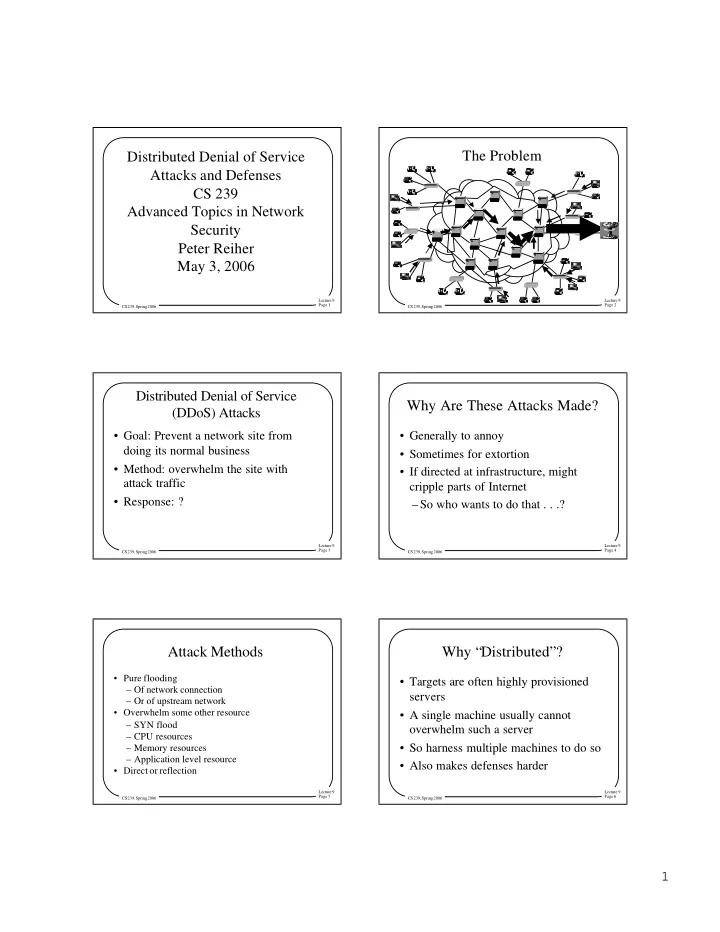
The Problem

Lecture 9 Page 3 CS 239, Spring 2006

Distributed Denial of Service (DDoS) Attacks

  • Goal: Prevent a network site from

doing its normal business

  • Method: overwhelm the site with

attack traffic

  • Response: ?

Lecture 9 Page 4 CS 239, Spring 2006

Why Are These Attacks Made?

  • Generally to annoy
  • Sometimes for extortion
  • If directed at infrastructure, might

cripple parts of Internet –So who wants to do that . . .?

Lecture 9 Page 5 CS 239, Spring 2006

Attack Methods

  • Pure flooding

– Of network connection – Or of upstream network

  • Overwhelm some other resource

– SYN flood – CPU resources – Memory resources – Application level resource

  • Direct or reflection

Lecture 9 Page 6 CS 239, Spring 2006

Why “Distributed”?

  • Targets are often highly provisioned

servers

  • A single machine usually cannot
  • verwhelm such a server
  • So harness multiple machines to do so
  • Also makes defenses harder
slide-2
SLIDE 2

2

Lecture 9 Page 7 CS 239, Spring 2006

Yahoo Attack

  • Occurred in February 2000
  • Resulted in intermittent outages for

nearly three hours

  • Attacker caught and successfully

prosecuted

  • Other companies (eBay, CNN,

Microsoft) attacked in the same way at around the same time

Lecture 9 Page 8 CS 239, Spring 2006

DDoS Attack on DNS Root Servers

  • Concerted ping flood attack on all 13 of

the DNS root servers in October 2002

  • Successfully halted operations on 9 of

them

  • Lasted for 1 hour

–Turned itself off, was not defeated

  • Did not cause major impact on Internet

–DNS uses caching aggressively

Lecture 9 Page 9 CS 239, Spring 2006

How to Defend?

  • A vital characteristic:

–Don’t just stop a flood –ENSURE SERVICE TO LEGITIMATE CLIENTS!!!

  • If you deliver a manageable amount of

garbage, you haven’t solved the problem

Lecture 9 Page 10 CS 239, Spring 2006

Complicating Factors

  • High availability of compromised machines

– At least tens of thousands of zombie machines

  • ut there
  • Internet is designed to deliver traffic

– Regardless of its value

  • IP spoofing allows easy hiding
  • Distributed nature makes legal approaches hard
  • Attacker can choose all aspects of his attack

packets – Can be a lot like good ones

Lecture 9 Page 11 CS 239, Spring 2006

Basic Defense Approaches

  • Overprovisioning
  • Dynamic increases in provisioning
  • Hiding
  • Tracking attackers
  • Legal approaches
  • Reducing volume of attack

Lecture 9 Page 12 CS 239, Spring 2006

Overprovisioning

  • Be able to handle more traffic than

attacker can generate

  • Works pretty well for Microsoft and

Google

  • Not a suitable solution for Mom and

Pop Internet stores

slide-3
SLIDE 3

3

Lecture 9 Page 13 CS 239, Spring 2006

Dynamic Increases in Provisioning

  • As attack volume increases, increase your

resources

  • Dynamically replicate servers
  • Obtain more bandwidth
  • Not always feasible
  • Probably expensive
  • Might be easy for attacker to outpace you

Lecture 9 Page 14 CS 239, Spring 2006

Hiding

  • Don’t let most people know where your

server is

  • If they can’t find it, they can’t overwhelm it
  • Possible to direct your traffic through other

sites first – Can they be overwhelmed . . .?

  • Not feasible for sites that serve everyone

Lecture 9 Page 15 CS 239, Spring 2006

Tracking Attackers

  • Almost trivial without IP spoofing
  • With IP spoofing, more challenging
  • Big issue:

– Once you’ve found them, what do you do?

  • Not clear tracking actually does much good
  • Loads of fun for algorithmic designers,

though

Lecture 9 Page 16 CS 239, Spring 2006

Legal Approaches

  • Sic the FBI on them and throw them in jail
  • Usually hard to do
  • FBI might not be interested in

“smal fry”

  • Slow, at best
  • Very hard in international situations
  • Generally only feasible if extortion is

involved – By following the money

Lecture 9 Page 17 CS 239, Spring 2006

Reducing the Volume of Traffic

  • Addresses the core problem:

– Too much traffic coming in, so get rid of some of it

  • Vital to separate the sheep from the goats
  • Unless you have good discrimination

techniques, not much help

  • Most DDoSdefense proposals are variants
  • f this

Lecture 9 Page 18 CS 239, Spring 2006

Approaches to Reducing the Volume

  • Give preference to your “friends”
  • Require “proof of work” from

submitters

  • Detect difference between good and

bad traffic –Drop the bad –Easier said than done

slide-4
SLIDE 4

4

Lecture 9 Page 19 CS 239, Spring 2006

D-WARD

  • Source-end, inline defense system
  • Compares observed flows with protocol-based

models: – Mismatching flow statistics indicate attack

  • Dynamic and selective rate-limit algorithm:

– Fast decrease to relieve the victim – Fast increase when the attack stops and on false alarms – Detects, forwards legitimate connection packets

  • Major questions:

– Deployment incentives – Partial deployment issues

Lecture 9 Page 20 CS 239, Spring 2006

D-WARD in Action

requests replies D-WARD D-WARD attacks

Lecture 9 Page 21 CS 239, Spring 2006

DefCOM

alert generator classifier classifier core core

DefCOM instructs core nodes to apply rate limits Core nodes use information from classifiers to prioritize traffic Classifiers can assure priority for good traffic