The Proton-Electron Atom A Proposal for a Structured Atomic Model - - PowerPoint PPT Presentation

the proton electron atom
SMART_READER_LITE
LIVE PREVIEW

The Proton-Electron Atom A Proposal for a Structured Atomic Model - - PowerPoint PPT Presentation

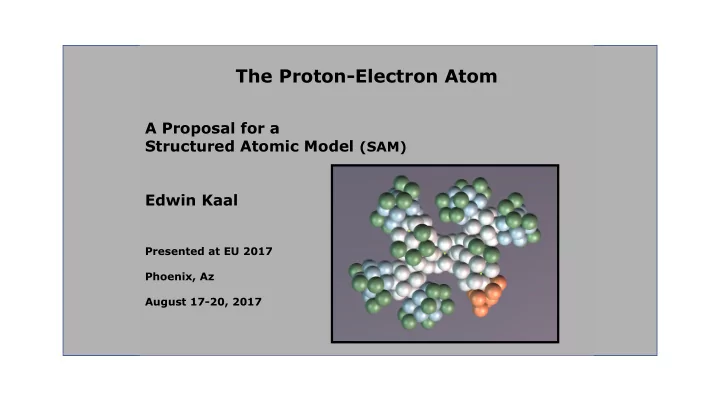
The Proton-Electron Atom A Proposal for a Structured Atomic Model (SAM) Edwin Kaal Presented at EU 2017 Phoenix, Az August 17-20, 2017 Standard Model Structured Atom Model Nitrogen Neon Nucleus of Neon 2 3 Presentation

slide-1
SLIDE 1

The Proton-Electron Atom

A Proposal for a Structured Atomic Model (SAM) Edwin Kaal

Presented at EU 2017 Phoenix, Az August 17-20, 2017

slide-2
SLIDE 2

2

Standard Model Structured Atom Model

Nitrogen Neon

Nucleus of Neon

slide-3
SLIDE 3

3

slide-4
SLIDE 4

Presentation Overview

  • I. Current Understanding of the Atom
  • II. A proposal for a structured atom model (SAM)
  • III. Implications of the New Model
  • IV. Conclusion
  • V. Animation of Atom Builder Application

4

slide-5
SLIDE 5

5

Dalton’s Periodic Table

slide-6
SLIDE 6

6

slide-7
SLIDE 7

7

Mendeleev wrote the definitive textbook of his time: Principles of Chemistry (two volumes, 1868–1870) Classified elements according to their chemical properties Noticed patterns that led to his periodic table

Periodic Table of the Elements According To Mendeleev (1897)

slide-8
SLIDE 8

Discovery of the Electron

8

ü “Plum Pudding Model” by J.J. Thomson

ü Performed experiments with cathode ray tubes ü Discovery of electrons also meant atoms are no longer indivisible ü Named “electrons”, they proved to be identical to particles from photoelectric and radioactive materials

slide-9
SLIDE 9

9

slide-10
SLIDE 10

Classical Model of the Nucleus

ü Two types of nucleons: ü Protons and Neutrons ü Undeterministic nature ü Postulated “strong force”

Bohr Atomic Model of a Nitrogen Atom

10

slide-11
SLIDE 11

11

Periodic Table of the Elements

slide-12
SLIDE 12

Understanding the Standard Model Requires Us to Believe These Things:

ü A Strong Force: Protons “stuck together” ü Electrons “mysteriously” stay at a certain distance from the nucleus ü The existence of four “fundamental forces” that are not unified ü The neutron is a fundamental particle, but it decays to (p + e) ü There is no real agreement on anything, and if professors in QM cannot

agree among themselves, how can we understand anything they present?

ü Scientists should not have to believe certain things in order to do science!

slide-13
SLIDE 13

13

13

üShows a logical construction of the atom in accordance with observations üExplains why the atom has a positive nucleus with negative electrons around it üExplains why the electrons do not fall into the positive nucleus üExplains in a logical manner how chemistry arises üExplains the periodicity of the PTE üOpen Question: Why do electrons and protons not annihilate each other?

slide-14
SLIDE 14

14

slide-15
SLIDE 15
  • II. A Proposal for a Structured Atom Model

Major Postulations:

ü There are only two fundamental"particles“: ü Proton and Electron, are a duality, or opposites ü Yet, they do not annihilate each other

15

Attribute Proton Electron

Mass Heavy Light Size Large Small Charge Positive Negative

slide-16
SLIDE 16
  • II. A Proposal for a Structured Atom Model

More Postulations:

16

ü There is only one fundamental force: the electrostatic attraction force ü The atom must have a definitive organization which is responsible for all attributes of a particular element ü The neutron is not a fundamental particle, but is redefined as a connection between a nuclear electron and its neighboring protons ü A stable element has a stable nucleus, i.e. no movement, without cause, in the structure of the nucleus ü A sphere (proton) must always be part of one of the 3 identified geometrical structures, namely the tetrahedron, the pentagonal bi-pyramid, or the icosahedron ü The inner structure of the atom (nucleus) dictates the outer electron structure (orbitals)

slide-17
SLIDE 17

The “New” Neutron

ü Plus and minus combine to neutral status ü Field of connection of the proton and electron ü Connection on both sides yields “outer electron state” ü Connection on one side only yields the neutron state (inner electron) ü No “external” field: no interaction, hence neutral character of the neutron ü Inner electron leaves no room for another electron ü The latter relocates at some distance from the nucleus: goes “orbital”

slide-18
SLIDE 18

18

Paper by Carl Johnson

Statistical Analysis of Isotope Masses

Analysis of the measured masses of all known atomic isotopes contained in the NIST data base, done from 1996 to 2003 (published privately at: http://mb-soft.com/public2/nuclei6.html)

Major conclusions of this paper:

Neutrons do not exist inside atomic nuclei as distinct particles The only fundamental particles are the electron and the proton The accurate accounting (AMU accuracy to 10 decimal places) of mass and energy of all known isotopes leaves no room for the 0.7 MeV binding energy of any neutrons Provides precise predictions of mass, lifetime before decay, modes of decay and the energy released by that decay Data plots point to isotopes which have not yet been discovered

slide-19
SLIDE 19

19

slide-20
SLIDE 20

20

slide-21
SLIDE 21

Research in Progress

slide-22
SLIDE 22

22

Platonic Solids in Spherical Geometry

Octahedron Cube Tetrahedron Dodecahedron Icosahedron

slide-23
SLIDE 23

3-08-17

slide-24
SLIDE 24

Integrated Geometry of the Atomic Nucleus

Krypton

Magnesium: 3 Geometric Shapes

Krypton

slide-25
SLIDE 25

Carbon: Icosahedron

Centerpiece of the Elements

25

Carbon with 6 inner electrons Carbon with 6 inner & 6 outer electrons

slide-26
SLIDE 26

The Noble Gas Configuration

26

Neon with 20 electrons 10 inner & 10 outer Nucleus of Neon

slide-27
SLIDE 27

Main Structure of the Nucleus

27

slide-28
SLIDE 28

Recurring Geometric Shapes in the Periodic Table Carbon Group

slide-29
SLIDE 29

29

Carbon

(12) Germanium (70) Silicon (28)

Recurring Geometric Shapes in the Periodic Table: Carbon group

slide-30
SLIDE 30

Recurring Geometric Shapes in the Periodic Table Alkali Metal Group

slide-31
SLIDE 31

31

Potassium (39)

Recurring Geometric Shapes in the Periodic Table – Alkali metal group

Lithium

(7) Sodium (23)

slide-32
SLIDE 32

Recurring Geometric Shapes in the Periodic Table Noble Gas Group

slide-33
SLIDE 33

33

Neon (22)

Argon (38)

Krypton (80)

Recurring Geometric Shapes in the Periodic Table Noble Gas Group

slide-34
SLIDE 34

34

Aluminum +3 Carbon +4/-4 Nitrogen -3 Oxygen -2 Fluorine -1 Neon 0 Silicon +4/-4 Sodium +1 Magnesium +2 Etc, etc

The Cycle of Eight (8)

slide-35
SLIDE 35

ü An Inner Carbon electron is “booted out” and assumes an orbital position, becoming an

  • uter electron

ü The two extra “neutrons” have changed to a “neutron-proton“ pair ü I.e. the element # has increased by one, becoming Nitrogen

35

Carbon 14 decays to Nitrogen 14 “densest packing at work”

slide-36
SLIDE 36

SAM Atom Builder Current Status

ü Focus on structure ü Creation of a PTE ü 40% of elements created ü Leaving the other 60% to be done ü Undisovered elements ü Progression of the elements

36

slide-37
SLIDE 37

37

slide-38
SLIDE 38

Summary of the New Atomic Model

ü We have defined a duality: the proton-electron pair ü Operating between proton and electron is the electrostatic force ü This force is the causal factor for the principle of densest packing that creates geometric shapes ü These geometric shapes in a specific order and number are able to create all elements in the PTE ü The model shows the observed nature and properties of the atom such as:

  • The reason why the nucleus is positively charged
  • Explains why the outer electrons stay at a distance from the nucleus
  • Shows the causal factor for chemistry

ü There are many more implications and consequences of SAM

38

slide-39
SLIDE 39

39

Potential Implications

Plasma Physics, Astrophysics and Cosmology; Better understanding of the nuclear structure; Better Understanding of chemistry; Nuclear Fission & Fusion Nanotechnology (even smaller?) Radiometric dating Transmutations and New elements?

slide-40
SLIDE 40

40

Susan Schirott – EU Support Mark Spann – EU Support James Sorensen – Atom builder & Website Jean Haffner – EU Support Jan Emming – Text Editing Karen Elkins – Graphic Presentation & Feedback

Thank You...

Edwin Kaal

slide-41
SLIDE 41
  • IV. Animation of Atom Builder Application

The imagery showing the atomic nuclei were provided by the Atom builder, Ethereal Matters LLC 3-08-17 41