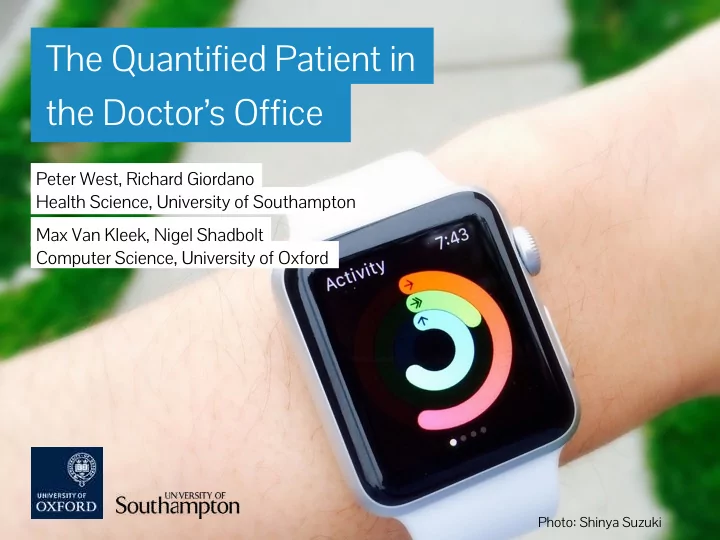
SLIDE 1 the Doctor’s Office
Peter West, Richard Giordano Health Science, University of Southampton Max Van Kleek, Nigel Shadbolt Computer Science, University of Oxford
The Quantified Patient in
Photo: Shinya Suzuki
SLIDE 2 Photo: iFixIt HTC One M9
High quality sensors, pervasive, easy to self-log.
We are quantified patients.
SLIDE 3
How could self-logged data be useful?
Fill the gaps between visits Contextualise clinical data Greater patient participation What are the challenges?
SLIDE 4
Pre-study: Literature review
Number of results: 2340 → 429 → 22 Themes: Data capture: relevance, quality, completeness Data access: selective disclosure, representation, interoperability Clinical practice: data literacy, doctor-patient relationship, legal issues Situational constraints: time, information overload
SLIDE 5 Pre-study: Literature review
Chung et al (2015). More Than Telemonitoring: Health Provider Use and Nonuse of Life-Log Data in Irritable Bowel Syndrome and Weight Management Ancker et al (2015). The Invisible Work of Personal Health Information Management Among People With Multiple Chronic Conditions: Qualitative Interview Study Among Patients and Providers
SLIDE 6
Many parts of the care pathway Focused on differential diagnosis.
SLIDE 7
How would doctors judge patient-supplied data? Would doctors use patient-supplied data? How does patient-supplied data align with current workflows and work practices?
Key questions
SLIDE 8
Role-play interviews Method:
Patient narratives, drawn from real cases in the “Think Like A Doctor” column of The New York Times Modified to describe patient self-logging. Supplied self-logged data.
SLIDE 9
analysis Data collection and
Transcribed Thematic analysis Think-aloud protocol
SLIDE 10
3 General Practitioners in the UK 7 Hospital Specialists in the US (various specialities)
10 Participants
SLIDE 11
Narrative 1:
Male, middle aged. Legs won’t stop moving, sleepy, out of breath. On anticoagulants due to stroke. Plots pulse three times a day, normally 85bpm, spikes 130bpm. Cause: Vitamin B12 deficiency
SLIDE 12 Narrative 2:
Female university student. Blueish lips, headaches, blurry vision, fainting. Had infection after back surgery. Worried about caffeine intake. Logs it daily,
- ccasionally exceeds 1000mg.
Cause: Postural Tachycardia Syndrome (POTS)
SLIDE 13
6 main themes
SLIDE 14
“What's the worst possible thing the person could have and work backwards from there.”
Specialist 5
Theme 1: Diagnostic workflow
Rule out high-risk conditions first, patient safety is key.
SLIDE 15 “I've chopped, chopped, chopped, and we come to
- here. And now I think, ‘we've pruned off all of that, now
I've got the bare tree.’ [...] “And it's very easy to see, this is my path now. It's your heart, mate. And I need to do just one or two tests to
- show. Otherwise the trunk of this tree becomes
thicker, and I will go that way. That's how I think.”
General practitioner 1
Theme 1: Diagnostic workflow
Chopping down the decision tree, eliminating hypotheses systematically Need to gather data to support hypothesis
SLIDE 16 Theme 2: Representation
Need for unit conversion, adding cognitive load
“Right! This could be a coffee headache. Well if you stop drinking coffee you get a headache. If you start drinking coffee you get a
- headache. Daily consumption - wow - above 400mg, 150mg per
- cup. Yeah, so this could be a coffee withdrawal headache.”
General practitioner 1
SLIDE 17
“I couldn't help but read it, and then reorganise information in a way that we are all sort of classically trained, history, present illness, past medical, and surgical medications, social and so forth.”
Specialist 2
Theme 2: Representation
Need to reorganise information according to clinical training
SLIDE 18 “I want to use my machine, which has been pre-calibrated, not off the shelf, because I don't know about this machine's calibration. “Can I trust all the data? No. “Can I assume all the data is correct? No.”
General practitioner 1
Theme 3: Confidence in the measurements
Uncertainty about the quality
to a lack of trust.
SLIDE 19
“He's having episodes where his heart rate is abnormal, or at least abnormal depending on what he's doing - that's the bit I would want to know more about - what happened on those dates when his heart rate spiked, what symptoms was he having?”
Specialist 2
Theme 3: Confidence in the measurements
Need to understand what the patient was doing or experiencing at the time.
SLIDE 20
Theme 4: Patient Motivation
Patient’s motives questioned because self-logging is an unusual thing to do.
“I would ask a bit more about this caffeine chart and why she's done this anyway, just to have an understanding of the reasons. Because not everyone charts their caffeine.”
General practitioner 3
SLIDE 21
Theme 4: Patient Motivation
“Usually you can predict what kind of job they have, people who do they would typically be an engineer… Engineers always bring in stuff like this ”
Specialist 3
Certain groups may be inclined to bring in self- logged data
SLIDE 22
Theme 4: Patient Motivation
“It's typical that patients like this come in and they give you stuff, you get this whole story, and then they want you to focus on it.”
Specialist 1
Does the patient already know something? Data used as communication
SLIDE 23
Theme 4: Patient Motivation
Questioning underlying psychological reasons
“They're faking it! “If someone brought this chart to me, there's a red flag that this guy's got psych issues.”
Specialist 4
SLIDE 24
“The layers of information, data assessment - it's ramping up and up, and all of these devices are certainly adding, or will add, yet more of this. [...] “At some point you have to ask yourself, what is efficient here and what is not?”
Specialist 1
Theme 5: Constraints
Questioning if it’s efficient to use data within time constraints
SLIDE 25 “Well one thing that struck me is how little variability there was in the heart rate during the time of the day. “I would need to ask a cardiologist, but I thought there was greater variability in heart rate.”
Specialist 2
Outside the doctor’s domain
Theme 6: Expertise
SLIDE 26
Challenges & Design Implications
SLIDE 27 Challenge 1: Can the data be admitted?
Universitetssykehuset Nord-Norge
Doctors need confidence in data for higher-risk decisions. Make it easier for doctors to have confidence in the data. Reduce need for additional, potentially invasive, tests.
SLIDE 28
Challenge 1: Can the data be admitted?
Provide metadata about device parameters, firmware, medical compliance Record contextual data, such as how the measurement was taken (e.g. body placement and device orientation), time of day, location and recent activity of patient.
SLIDE 29
Challenge 2: Representation
Use standardized formats to reduce need to rearrange information
Admissions forms are succinct and quick to interpret
SLIDE 30
Challenge 2: Representation
SLIDE 31
Challenge 2: Representation
Normal levels for reference
SLIDE 32 Challenge 3: Design for the diagnostic process
Gather evidence Evaluate evidence
Discover hypotheses
Identify knowledge gaps
Refine hypotheses
Construct safe care pathway
Supporting diagnostic workflow is important Not an area explored by Quantified Self
SLIDE 33 Peter West University of Southampton p.west@soton.ac.uk
We wanted to identify challenges & opportunities in the use of self-logged data in differential diagnosis. Challenges we found pertained to: confidence in data quality, clinical workflow, data representation, motivations for self logging, use constraints, and expertise. Addressing these challenges may start to make self-logged data admissible & useful to clinicians. Requires a joint exploration
designers, doctors, &
patients.
Summary
Photo: Hine on Flickr