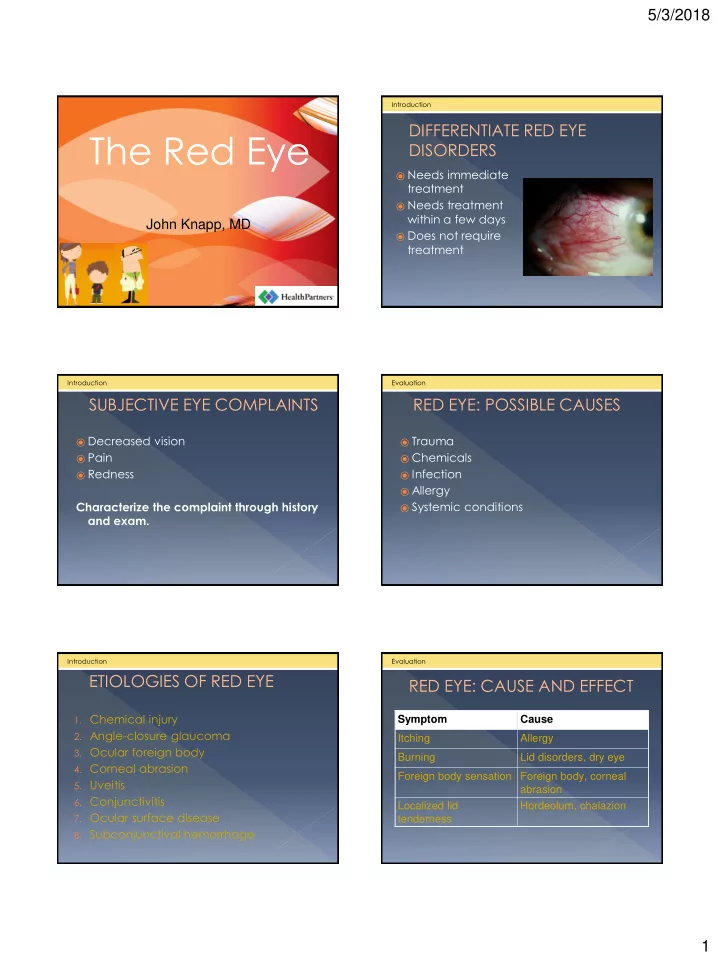
The Red Eye DISORDERS Needs immediate treatment Needs treatment - - PDF document

the red eye
SMART_READER_LITE
LIVE PREVIEW

The Red Eye DISORDERS Needs immediate treatment Needs treatment - - PDF document

5/3/2018 Introduction DIFFERENTIATE RED EYE The Red Eye DISORDERS Needs immediate treatment Needs treatment within a few days John Knapp, MD Does not require treatment Introduction Evaluation SUBJECTIVE EYE COMPLAINTS RED EYE:


slide-1
SLIDE 1

5/3/2018 1

The Red Eye

John Knapp, MD

⦿ Needs immediate

treatment

⦿ Needs treatment

within a few days

⦿ Does not require

treatment

Introduction

DIFFERENTIATE RED EYE DISORDERS SUBJECTIVE EYE COMPLAINTS

⦿ Decreased vision ⦿ Pain ⦿ Redness

Characterize the complaint through history and exam.

Introduction

RED EYE: POSSIBLE CAUSES

⦿ Trauma ⦿ Chemicals ⦿ Infection ⦿ Allergy ⦿ Systemic conditions

Evaluation

ETIOLOGIES OF RED EYE

  • 1. Chemical injury
  • 2. Angle-closure glaucoma
  • 3. Ocular foreign body
  • 4. Corneal abrasion
  • 5. Uveitis
  • 6. Conjunctivitis
  • 7. Ocular surface disease
  • 8. Subconjunctival hemorrhage

Introduction

RED EYE: CAUSE AND EFFECT

Symptom Cause Itching Allergy Burning Lid disorders, dry eye Foreign body sensation Foreign body, corneal abrasion Localized lid tenderness Hordeolum, chalazion

Evaluation

slide-2
SLIDE 2

5/3/2018 2 RED EYE: CAUSE AND EFFECT (Continued)

Symptom Cause Deep, intense pain Corneal abrasions, scleritis, iritis, acute glaucoma, sinusitis, etc. Photophobia Corneal abrasions, iritis, acute glaucoma Halo vision Corneal edema (acute glaucoma, uveitis)

Evaluation Evaluation

Equipment needed to evaluate red eye

Evaluation

Often don’t need or can’t get a refraction, but definitely obtain “pinhole” visual acuity.

RED EYE DISORDERS: AN ANATOMIC APPROACH

⦿Face ⦿Adnexa › Orbital area › Lids › Ocular movements ⦿Globe › Conjunctiva, sclera › Anterior chamber (using slit lamp if possible) › Intraocular pressure (with tono-pen is fine)

Evaluation Disorders of the Ocular Adnexa Meibomian Glands located in tarsal plate in upper and lower eyelids Disorders of the Ocular Adnexa

Hordeolum

slide-3
SLIDE 3

5/3/2018 3

Disorders of the Ocular Adnexa

Chalazion

Eyelid lesions – “Stye”

Chalazion: A painless (usually, but acutely painfull), slowly enlarging bump, usually chronic, formed by inflammation (not infection) of the meibomian glands. Hordeolum: A localized infection or inflammation, usually acute, involving hair follicles of the eyelashes or meibomian glands.

13

Chalazion Hordeolum Disorders of the Ocular Adnexa

HORDEOLUM/CHALAZION: TREATMENT

⦿ Goal › To promote drainage ⦿ Treatment › Acute/subacute: Warm-hot compresses and

eyelid massage (try to gently express the MG) › Chronic: incision and currettage or steroid injection or can try topical gtt like Azasite or steroid gtts

Disorders of the Ocular Adnexa

BLEPHARITIS

⦿ AKA anterior blepharitis (lashes mostly) ⦿ Inflammation of lid margin ⦿ Associated with dry eyes ⦿ Seborrhea causes dried skin and wax on

base of lashes

⦿ May have Staphylococcal infection ⦿ Symptoms: lid burning, lash mattering

Disorders of the Ocular Adnexa

Meibomian Gland Dysfunction

⦿ Probably most common cause

  • f chronic eye irritation

⦿ Inadequate quantity and/or

quality of meibomian gland secretions / oil

⦿

Can also have inflammatory component, hence AKA posterior blepharitis

16

Disorders of the Ocular Adnexa

Collarettes on eyelashes of patient with blepharitis

slide-4
SLIDE 4

5/3/2018 4

How the Eye Works

Blepharitis and Meibomian Gland Dysfunction

These are very commonly seen together (anterior + posterior blepharitis) and treatment is similar and overlaps

Treatment

⦿

Blepharitis › Cleaning the eyelid margins (i.e. warm water with baby shampoo or commercial eyelid cleaner e.g. Ocusoft or Sterilid - http://www.dryeyezone.com/encyclopedia/lidscrubs.html › Antibiotic ointment or antibiotic & steroid combination › Demodex blepharitis – TTO or Cliradex (4-Terpineol) › Hypochlorous acid - NEW (Avenova or Ocusoft)

⦿

Meibomian gland dysfunction › Warm compresses 2-3 times daily and eyelid massage (new: Lipiflow - in-office thermal treatment) › Omega-3 FA’s ฀ Diet: Fish, walnuts, etc ฀ Supplement: Fish oil tablets › Oral antibiotics in severe cases (ocular rosacea) i.e. Doxycycline

⦿

Both › Artificial tears, best choices are name-brand and preservative- free

19

Disorders of the Ocular Adnexa

Preseptal cellulitis

Disorders of the Ocular Adnexa

Orbital cellulitis ⦿ External signs: redness,

swelling (same as preseptal cellulitis)

⦿ How to distinguish from

preseptal:

› Motility impaired, painful › ± Proptosis › Often fever and leukocytosis › ± Optic nerve: decreased vision, afferent pupillary defect, disc edema Disorders of the Ocular Adnexa

ORBITAL CELLULITIS: SIGNS AND SYMPTOMS ORBITAL CELLULITIS: MANAGEMENT

⦿ ID consultation possibly ⦿ Orbital CT scan (r/o subperiosteal

abcess)

⦿ CBC +/- Blood culture ⦿ ENT consult if pre-existing sinus disease ⦿ Hospitalization for IV abx (especially for

kids), in select adult cases may manage as outpt under close supervision

Disorders of the Ocular Adnexa

slide-5
SLIDE 5

5/3/2018 5

ORBITAL CELLULITIS: TREATMENT

⦿ IV antibiotics stat: Staphylococcus,

Streptococcus, H. influenzae

⦿ Surgical debridement if fungus, no

improvement, or subperiosteal abscess

⦿ Complications: cavernous sinus

thrombosis, meningitis

Disorders of the Ocular Adnexa Lacrimal System Disorders

Lacrimal system

Lacrimal System Disorders

Dacryocystitis

NASOLACRIMAL DUCT OBSTRUCTION: CONGENITAL

⦿ Massage tear sac daily ⦿ Probing, irrigation, if chronic ⦿ Systemic antibiotics if infected

Lacrimal System Disorders

NASOLACRIMAL DUCT OBSTRUCTION: ACQUIRED

⦿ Trauma a common cause ⦿ Systemic antibiotics if infected ⦿ Surgical procedure after one episode of

dacryocystitis (dacryocystorhinostomy or DCR) prn

Lacrimal System Disorders Ocular Surface Disorders

slide-6
SLIDE 6

5/3/2018 6

Ocular Surface Disorders

Dilated conjunctival blood vessels

ADULT CONJUNCTIVITIS: MAJOR CAUSES

⦿ Viral ⦿ Bacterial ⦿ Allergic

Ocular Surface Disorders

CONJUNCTIVITIS: DISCHARGE

Discharge Cause Purulent Bacterial Clear Viral* Watery, with stringy; white mucus Allergic**

Ocular Surface Disorders * Preauricular lymphadenopathy signals viral infection ** Itching often accompanies

BACTERIAL CONJUNCTIVITIS: COMMON CAUSES

⦿ Staphylococcus (skin) ⦿ Streptococcus (respiratory) ⦿ Haemophilus (respiratory)

Ocular Surface Disorders

BACTERIAL CONJUNCTIVITIS TREATMENT

⦿ Topical antibiotic: qid x 7 days

(aminoglycoside, erythromycin, fluoroquinolone, or trimethoprim- polymyxin)

⦿ Artificial tears

Ocular Surface Disorders Ocular Surface Disorders

Copious purulent discharge: Suspect Neisseria gonorrhoeae.

slide-7
SLIDE 7

5/3/2018 7

Ocular Surface Disorders

Viral conjunctivitis

VIRAL CONJUNCTIVITIS

⦿ Watery discharge ⦿ Highly contagious ⦿ Palpable preauricular

lymph node

⦿ History of URI, sore

throat, fever common

Ocular Surface Disorders Ocular Surface Disorders

Allergic conjunctivitis

ALLERGIC CONJUNCTIVITIS

⦿Associated conditions: hay fever, asthma,

eczema

⦿Contact allergy: chemicals, cosmetics,

pollen

⦿Treatment: topical antihistamine drops,

rarely need NSAID or steroid drops (Ketotifen great drop to start with)

⦿Systemic antihistamines may help

Ocular Surface Disorders

NEONATAL CONJUNCTIVITIS: CAUSES

⦿ Bacteria (N. gonorrhoeae, 2–4 days) ⦿ Bacteria (Staphylococcus,

Streptococcus, 3–5 days)

⦿ Chlamydia (5–12 days) ⦿ Viruses (eg, herpes, from mother)

Ocular Surface Disorders Ocular Surface Disorders

Neonatal gonococcal conjunctivitis

slide-8
SLIDE 8

5/3/2018 8

Ocular Surface Disorders

Neonatal chlamydial conjunctivitis

NEONATAL CHLAMYDIAL CONJUNCTIVITIS: TREATMENT

⦿ Erythromycin ointment: qid x 4 weeks ⦿ Erythromycin po x 2–3 weeks

40–50 mg/kg/day or even single dose of po azithromycin may be effective

Ocular Surface Disorders Ocular Surface Disorders

Subconjunctival hemorrhage

TEARS AND DRY EYES

⦿ Tear functions: › Lubrication › Bacteriostatic and immunologic functions ⦿ Dry eye (keratoconjunctivitis sicca) is a

tear deficiency state

Ocular Surface Disorders

TEAR DEFICIENCY STATES: SYMPTOMS

⦿ Burning ⦿ Foreign-body sensation ⦿ Paradoxical reflex tearing ⦿ Symptoms can be made worse by

reading, computer use, television, driving, lengthy air travel (decreased blink rate…)

Ocular Surface Disorders

TEAR DEFICIENCY STATES: ASSOCIATED CONDITIONS

⦿ Aging ⦿ Rheumatoid arthritis ⦿ Stevens-Johnson syndrome ⦿ Chemical injuries ⦿ Ocular pemphigoid ⦿ Systemic medications

Ocular Surface Disorders

slide-9
SLIDE 9

5/3/2018 9

Newer Dry Eye Diagnostics, examples- Tear Osmolarity and InflammaDry (MMP-9), more on the way

Ocular Surface Disorders

DRY EYES: TREATMENT

⦿ Artificial tears ⦿ Preservative-free artificial tears ⦿ Lubricating ointment at bedtime ⦿ Punctal occlusion ⦿ Warm compresses to eyelids ⦿ Counseling about activities that make

dry eyes worse

⦿ Cyclosporine drops (Restasis) ⦿ Lifitegrast (Xiidra) - NEW

Ocular Surface Disorders Ocular Surface Disorders

Thyroid exophthalmos: one cause of exposure keratitis

EXPOSURE KERATITIS: CAUSES AND MANAGEMENT

⦿ Due to incomplete lid closure ⦿ Manage with lubricating

solutions/ointments

⦿ Tape lids shut at night ⦿ Careful about patching without taping –

may cause a corneal abrasion

Ocular Surface Disorders Ocular Surface Disorders

Pinguecula

Ocular Surface Disorders

Pterygium

slide-10
SLIDE 10

5/3/2018 10

INFLAMED PINGUECULA AND PTERYGIUM: MANAGEMENT

⦿ Artificial tears, something short course of

topical steroids

⦿ Counsel patients to avoid irritation ⦿ If documented growth decreased vision

may need surgery

Ocular Surface Disorders Anterior Segment Disorders Anterior Segment Disorders

ACUTE CORNEAL DISORDERS: SYMPTOMS

⦿ Eye pain › Foreign-body sensation › Deep and boring ⦿ Photophobia ⦿ Blurred vision

Anterior Segment Disorders Anterior Segment Disorders

Irregular corneal light reflex and central corneal opacity

Anterior Segment Disorders

Fluorescein dye strip applied to the conjunctiva

slide-11
SLIDE 11

5/3/2018 11

Anterior Segment Disorders

Corneal abrasion, stained with fluorescein and viewed with cobalt blue light

CORNEAL ABRASION

⦿ Signs and symptoms: redness, tearing,

pain, photophobia, foreign-body sensation, blurred vision, small pupil

⦿ Causes: injury, welder’s arc, contact lens

  • verwear

Anterior Segment Disorders

MANAGEMENT

⦿ Goals: › Promote rapid healing › Relieve pain › Prevent infections ⦿ Treatment: › 1% cyclopentolate (or another cycloplegic) › Topical antibiotics ฀ Drops polytrim, tobrex, fluoroquinolone, etc ฀ Ointment erythromycin, bacitracin/polymyxin, etc › ± Pressure patch or tape lids shut ok but not necessary

in all cases › Bandage contacts another option › ± Oral analgesics, usually OTC options enough

Anterior Segment Disorders Anterior Segment Disorders Applying a pressure patch reasonable, my preference is eyelid taping

Foreign body

Anterior Segment Disorders Remove with cotton tip, spud, needle tip, and/or use diamond burr for associated rust ring with metal FB

CHEMICAL INJURY

⦿A true ocular emergency ⦿Requires immediate irrigation with nearest source of water, can use Morgan Lens hooked up to normal saline

  • r ringers lactate, may need 8-10 liters,

pH should return to 7-7.4. ⦿Cederroth (sterile buffered isotonic sodium chloride) - buffer, even better than saline ⦿Management depends on offending agent

Anterior Segment Disorders

slide-12
SLIDE 12

5/3/2018 12

Anterior Segment Disorders

Chemical burn: acid – BAD!

Anterior Segment Disorders

Chemical burn: alkali – Worse!!! Corneal ulcer Giant papillary conjunctivitis

Anterior Segment Disorders

INFECTIOUS KERATITIS

⦿ Frequently result from mechanical

trauma (i.e. CL use, especially EW)

⦿ Can cause permanent scarring and

decreased vision

⦿ Early detection, aggressive therapy are

vital

Anterior Segment Disorders Anterior Segment Disorders

Bacterial infection of the cornea

Anterior Segment Disorders

Primary herpes simplex infection

slide-13
SLIDE 13

5/3/2018 13

Anterior Segment Disorders

Corneal herpes simplex dendrites, stained with fluorescein

Rx Topical Anesthetics

Anterior Segment Disorders

TOPICAL STEROIDS: SIDE EFFECTS

should only be prescribed by Ophthalmology

⦿ Always ask and document who started

patient on steroid therapy

⦿ Facilitate corneal penetration of herpes

virus

⦿ Elevate IOP (steroid-induced glaucoma) ⦿ Cataract formation and progression ⦿ Potentiate fungal corneal ulcers

Anterior Segment Disorders Anterior Segment Disorders

Hyphema – most important thing is to look for signs of open globe i.e. peaked pupil and/or hypotony

INFLAMMATORY CONDITIONS CAUSING A RED EYE:

⦿ Episcleritis ⦿ Scleritis ⦿ Anterior uveitis (iritis)

Anterior Segment Disorders

Episcleritis Scleritis

Anterior Segment Disorders

slide-14
SLIDE 14

5/3/2018 14

Anterior Segment Disorders

IRITIS

Signs and Symptoms

  • Circumlimbal redness
  • Pain
  • Photophobia
  • Decreased vision
  • Miotic pupil

Rule Out

  • Systemic

inflammation

  • Trauma
  • Autoimmune disease
  • Systemic infection

UVEITIS: SLIT LAMP FINDINGS

White cells in anterior chamber Hypopyon Keratic precipitates

Anterior Segment Disorders

ACUTE GLAUCOMA: SIGNS AND SYMPTOMS

⦿ Red eye ⦿ Severe pain in, around eye ⦿ Frontal headache ⦿ Blurred vision, halos seen around lights ⦿ Nausea, vomiting ⦿ Pupil fixed, mid-dilated, slightly larger than

contralateral side

⦿ Elevated IOP (IF NOT ELEVATED IT IS NOT

ACUTE ANGLE CLOSURE GLAUCOMA!!!)

⦿ Corneal haze

Anterior Segment Disorders Anterior Segment Disorders

Acute angle-closure glaucoma

ACUTE GLAUCOMA:

INITIAL TREATMENT – Goal break attack

⦿ Pilocarpine ⦿ Timolol ⦿ Brimzolamide or dorzolamide ⦿ Apraclonidine or brimonidine ⦿ Consider steroid drop and even prostaglandin analogue ⦿ Acetazolamide 500 mg po or IV (not Sequel until IOP

down)

⦿ IV mannitol 20% 300–500 cc (or other osmotic, rarely used) ⦿ Also: ocular massage, compression gonioscopy, and LPI,

rarely may need Laser iridoplasty or even surgical PI

Anterior Segment Disorders

slide-15
SLIDE 15

5/3/2018 15

COMMON RED EYE DISORDERS: TREATMENT INDICATED

⦿ Hordeolum ⦿ Chalazion ⦿ Blepharitis ⦿ Conjunctivitis ⦿ Subconjunctival hemorrhage ⦿ Dry eyes ⦿ Corneal abrasions (most) Summary

VISION-THREATENING RED EYE SIGNS & SYMPTOMS: Telephone triage for same day add-on in Eye clinic

⦿ Decreased vision ⦿ Severe ocular pain not relieved by topical proparacaine ⦿ Severe photophobia ⦿ Circumlimbal redness (this classic picture of “ciliary flush” in

ACG is rarely seen though…)

⦿ Severe corneal edema ⦿ Corneal ulcers (> 2mm) / dendrites ⦿ Abnormal pupil (assuming not chronic) ⦿ Elevated IOP (nl IOP 10-22 mmHg… mild elevation i.e. high

20’s is not that urgent vs IOP of 50 is a big deal)

Summary

VISION-THREATENING RED EYE DISORDERS: URGENT EVALUATION

⦿ Orbital cellulitis ⦿ Scleritis (very painful, not relieved at all by

proparacaine)

⦿ Chemical injury (except very mild cases of course) ⦿ Severe corneal infection (visible without slit lamp) ⦿ Hyphema (need to r/o open globe) ⦿ Iritis (decreased vision and severe photophobia) ⦿ Acute glaucoma (significantly increased IOP) Summary

⦿ Questions?

Summary

THE RED EYE

Summary

Matthew and Alexander