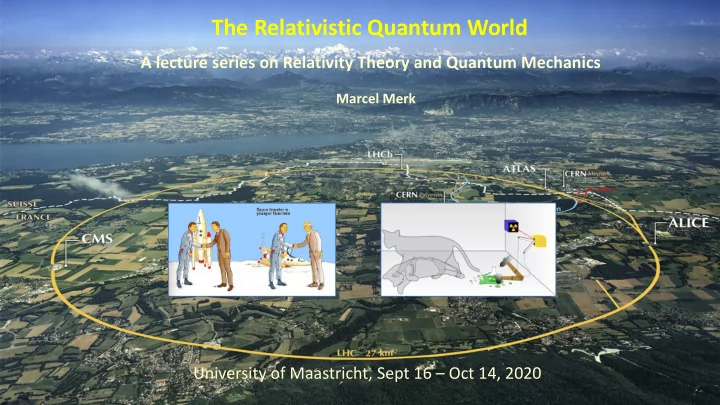
SLIDE 1
A lecture series on Relativity Theory and Quantum Mechanics
The Relativistic Quantum World
University of Maastricht, Sept 16 – Oct 14, 2020
Marcel Merk
SLIDE 2 The Relativistic Quantum World
Relativity Quantum Mechanics Standard Model
Lecture notes, written for this course, are available: www.nikhef.nl/~i93/Teaching/ Prerequisite for the course: High school level physics & mathematics.
Lecture 1: The Principle of Relativity and the Speed of Light Lecture 2: Time Dilation and Lorentz Contraction Lecture 3: The Lorentz Transformation and Paradoxes Lecture 4: General Relativity and Gravitational Waves Lecture 5: The Early Quantum Theory Lecture 6: Feynman’s Double Slit Experiment Lecture 7: Wheeler’s Delayed Choice and Schrodinger’s Cat Lecture 8: Quantum Reality and the EPR Paradox Lecture 9: The Standard Model and Antimatter Lecture 10: The Large Hadron Collider
- Sept. 16:
- Sept. 23:
- Sept. 30:
- Oct. 7:
- Oct. 14:
1
SLIDE 3 Quantum Mechanics
Light is a stream
Isaac Newton
Light is emitted in quanta
Max Planck
The nature of light is quanta
Albert Einstein
Yes, because photons collide!
Arthur Compton
Particles are probability waves
Niels Bohr
No, similar to sound light consists
Christiaan Huygens
Yes, because it interferes
Thomas Young Louis de Broglie
Particles have a wave nature: l = h/p 2
SLIDE 4 Quantum Mechanics
Light is a stream
Isaac Newton
Light is emitted in quanta
Max Planck
The nature of light is quanta
Albert Einstein
Yes, because photons collide!
Arthur Compton
Particles are probability waves
Niels Bohr
No, similar to sound light consists
Christiaan Huygens
Yes, because it interferes
Thomas Young Louis de Broglie
Particles have a wave nature: l = h/p
“Particle” and “Wave” are complementary aspects.
2
SLIDE 5
Uncertainty Relation
It is not possible to determine position and momentum at the same time: A particle does not have well defined position and momentum at the same time.
Werner Heisenberg Erwin Schrödinger Dp
Δ𝑦 Δ𝑞 ≥ ℏ 2
𝑞 = ℎ 𝜇 = ℎ𝑔 𝑑
3
SLIDE 6
The wave function y
Momentum badly known Position fairly known
4
SLIDE 7
The wave function y
Momentum badly known Position fairly known Position badly known Momentum fairly known
4
SLIDE 8 Lecture 6 Feynman’s Double Slit Experiment
“It doesn’t matter how beautiful your theory is, it doesn’t matter how smart you are. If it doesn’t agree with experiment it’s wrong.”
5
SLIDE 9
Richard Feynman (1918 – 1988) .
Nobelprize 1965: Quantum Electrodynamics (Path Integral formulation of quantum mechanics)
Challenger disaster Feynman diagram ・Feynman diagrams ・Challenger investigation ・Popular books Mostly known from:
6
SLIDE 10
Richard Feynman (1918 – 1988) .
Nobelprize 1965: Quantum Electrodynamics (Path Integral formulation of quantum mechanics)
Challenger disaster Feynman diagram
7
SLIDE 11
Richard Feynman and the double slit experiment
The double slit experiment demonstrates the fundamental aspect of the quantum world.
8
SLIDE 12
The Double Slit Experiment
Case 1: An Experiment with Bullets
9
SLIDE 13
Case 1: Experiment with Bullets
A gun fires bullets in random direction. Slits 1 and 2 are openings through which bullets can pass. A moveable detector “collects” bullets and counts them.
P1 is the probability curve when only slit 1 is open P2 is the probability curve when only slit 2 is open
Observation: Bullets come in “lumps”. What is the probability curve when both slit 1 and slit 2 are open?
10
SLIDE 14
Case 1: Experiment with Bullets
A gun fires bullets in random direction. Slits 1 and 2 are openings through which bullets can pass. A moveable detector “collects” bullets and counts them.
P1 is the probability curve when only slit 1 is open P2 is the probability curve when only slit 2 is open
When both slits are open: P12 = P1 + P2 We can just add up the probabilities.
11
SLIDE 15
The Double Slit Experiment
Case 2: An Experiment with Waves
12
SLIDE 16
Waves & Interference : water, sound, light
Sound: Active noise cancellation: Light: Thomas Young experiment: Water: Interference pattern: light + light can give darkness! Waves: Interference principle: 13
SLIDE 17
Case 2: Experiment with Waves
The intensity of a wave is the square of the amplitude… We replace the gun by a wave generator: think of water waves. Slits 1 and 2 act as new wave sources. The detector measures now the intensity (energy) in the wave. Observation: Waves do not Come in “lumps”.
I1 = |h1|2 I2 = |h2|2 I12 = ??
14
SLIDE 18
Intermezzo: Wave Oscillation & Intensity
𝑆 𝑢 = ℎ cos 2𝜌𝑔𝑢 + 𝜚
Energy in the oscillation (up-down) movement of the molecules: 𝐹678 = 9 : ⁄ 𝑛𝑤: and 𝑤 is proportional to the amplitude or height: 𝑤 ≈ ℎ So that the intensity of the wave is: 𝐽 ≈ ℎ:
h
Formula for the resulting oscillation of a water molecule somewhere in the wave: and the Intensity: 𝐽 = ℎ:
h v
𝑔 = frequency 𝜚 = phase
15
SLIDE 19
Case 2: Experiment with Waves
When both slits are open there are two contributions to the wave the oscillation at the detector: 𝑆 𝑢 = 𝑆9 𝑢 + 𝑆: 𝑢
𝐽9 = ℎ9 : 𝐽: = ℎ: : 𝐽9: = ? ?
First combine: 𝑆 𝑢 = 𝑆9 𝑢 + 𝑆: 𝑢 Afterwards look at the amplitude and intensity of the resulting wave!
𝜚9 and 𝜚: depend on distance to 1 and 2
𝑆9 𝑢 = ℎ9 cos 2𝜌𝑔 𝑢 + 𝜚9 𝑆: 𝑢 = ℎ: cos 2𝜌𝑔 𝑢 + 𝜚:
16
SLIDE 20 Mathematics for the die-hards
Interference!
𝑺𝟐𝟑 𝒖 = 𝒊𝟐 𝐝𝐩𝐭 𝟑𝝆𝒈𝒖 + 𝝔𝟐 + 𝒊𝟑 𝐝𝐩𝐭 𝟑𝝆𝒈 𝒖 + 𝝔𝟑 With 𝒊L = 𝟑𝒊 𝐝𝐩𝐭
𝟐 𝟑 𝝔𝟐 − 𝝔𝟑
Assume equal size waves: 𝒊𝟐 = 𝒊𝟑 = 𝒊 First find amplitude of sum wave 𝑺𝟐𝟑 𝒖 . Use this to find: Resulting wave has the intensity: 𝑱𝟐𝟑 = 𝒊L𝟑 = 𝟓𝒊𝟑 𝐝𝐩𝐭𝟑 𝟐 𝟑 𝝔𝟐 − 𝝔𝟑 Use math textbook: cos: 𝐵 = 9
: + 9 : cos 2𝐵, so:
𝑱𝟐𝟑 = 𝟑𝒊𝟑 + 𝟑𝒊𝟑 𝐝𝐩𝐭 𝝔𝟐 − 𝝔𝟑
cos 𝐵 + cos 𝐶 = 2 cos 1 2 𝐵 − 𝐶 cos 1 2 𝐵 + 𝐶
From math textbook: 𝑺𝟐𝟑 𝒖 = 𝒊′ 𝐝𝐩𝐭 𝟑𝝆𝒈𝒖 +
𝟐 𝟑 𝝔𝟐 + 𝝔𝟑
17
SLIDE 21 Interference of Waves
Interfering waves: 𝐽9: = 𝑆9 + 𝑆: : = ℎ9
: + ℎ: : + 2ℎ9ℎ: cos Δ𝜚
ℎ9 Regions of constructive interference: 𝐽9: = 2× 𝐽9 + 𝐽: Regions of destructive interference: 𝐽9: = 0
cos Df = 1 cos Df = -1
ℎ:
18
SLIDE 22
Case 2: Experiment with Waves
First combine: 𝑆 𝑢 = 𝑆9 𝑢 + 𝑆:(𝑢)
Afterwards look at the amplitude and intensity of the resulting wave!
When both slits are open there are two contributions to the wave the oscillation at the detector: 𝑆 𝑢 = 𝑆9 𝑢 + 𝑆: 𝑢
19
SLIDE 23 Case 2: Experiment with Waves
Interference pattern: 𝐽9: = 𝑆9 + 𝑆: : = ℎ9
: + ℎ: : + 2ℎ9ℎ: cos Δ𝜚
Regions where waves are amplified and regions where waves are cancelled. Contrary to “bullets” we can not just add up Intensities. When both slits are open there are two contributions to the wave the oscillation at the detector: 𝑆 𝑢 = 𝑆9 𝑢 + 𝑆: 𝑢
20
SLIDE 24
Double Slit Experiment with Light (Young)
21
SLIDE 25
The Double Slit Experiment
Case 3: An Experiment with Electrons
22
SLIDE 26
Case 3: Experiment with Electrons
Observation: Electrons come in “lumps”, like bullets From the detector counts deduce again the probabilities P1 and P2 To avoid confusion use single electrons: one by one! What do we expect when both slits are open?
|y2|2 |y1|2 23
SLIDE 27
Case 3: Experiment with Electrons
|y2|2 |y1|2 24
SLIDE 28
Case 3: Experiment with Electrons
|y2|2 |y1|2 24
SLIDE 29
Case 3: Experiment with Electrons
|y2|2 |y1|2 24
SLIDE 30
Case 3: Experiment with Electrons
|y2|2 |y1|2 24
SLIDE 31
Case 3: Experiment with Electrons
|y2|2 |y1|2 24
SLIDE 32
Case 3: Experiment with Electrons
|y2|2 |y1|2 29
SLIDE 33 Case 3: Experiment with Electrons
Add the wave amplitudes: y12 = y1 + y2 An Interference pattern! The electron wave function behaves exactly like classical waves. The probability is the square of the sum: P12 = |y12|2 = |y1 + y2|2 = |y1|2 + |y2|2 + 2y1y2
*
De Broglie waves
|y1 + y2|2 |y2|2 |y1|2
Just like “waves” we can not just add up Intensities.
30
SLIDE 34
Case 3: Experiment with Electrons
Perhaps the electrons interfere with each other. Reduce the intensity, shoot electrons one by one: same result.
P.S.: Classically, light behaves light waves. However, if you shoot light, photon per photon, it “comes in lumps”, just like electrons. Quantum Mechanics: for photons it is the same story as for electrons.
|y1 + y2|2 |y2|2 |y1|2 31
SLIDE 35
Case 3: Experiment with Electrons
Perhaps the electrons interfere with each other. Reduce the intensity, shoot electrons one by one: same result.
P.S.: Classically, light behaves light waves. However, if you shoot light, photon per photon, it “comes in lumps”, just like electrons. Quantum Mechanics: for photons it is the same story as for electrons.
|y1 + y2|2 |y2|2 |y1|2
Although the electron is detected as a “lump” on the screen, apparently it has gone through both slits!
31
SLIDE 36
The Double Slit Experiment
Case 4: A Different Experiment with Electrons
32
SLIDE 37
Case 4: Watch the Electrons
D1 D2
Let us try to out-smart the electron: just watch through which slit it goes! D1 and D2 are two “microscopes” looking at the slits 1 and 2, respectively.
33
SLIDE 38
Case 4: Watch the Electrons
If you watch half the time; you only get the interference for the cases you did not watch.
It requires an observation to let the quantum wave function “collapse” into reality. As long as no measurement is made the wave function keeps “all options open”. When we watch through which slit the electrons go, we destroy the interference! Now the electron behaves just like a classical particle (“bullet”).
D1 D2
34
SLIDE 39
Case 3: Don’t Watch the Electrons
|y1 + y2|2 |y2|2 |y1|2
It requires an observation to let the quantum wave function “collapse” into reality. As long as no measurement is made the wave function keeps “all options open”. When we don’t watch through through which slit the electrons go, the electron is an object that interferes with itself!
If you watch half the time; you only get the interference for the cases you did not watch.
35
SLIDE 40
Wave Particle Duality
Next lecture we will try to out-smart nature one step further… … and face the consequences.
36
SLIDE 41 Next Lecture: Wheeler’s Delayed Choice
John Wheeler (1911 – 2008): Famous for work on gravitation (Black holes – quantum gravity)
Replace detectors D1 and D2 with telescopes T1 and T2 which are focused on slits 1 and 2
What happens if we afterwards would reconstruct whether the electron went through slit 1 or slit 2?
T1# T2#
T1 T2
Try to out-smart nature one step further… and face the consequences: Schrödinger’s cat.
37
SLIDE 42
Next Lecture…
38