
SLIDE 1
The remarkable cardiovascular system of giraffes
Christian Aalkjær
Aarhus University
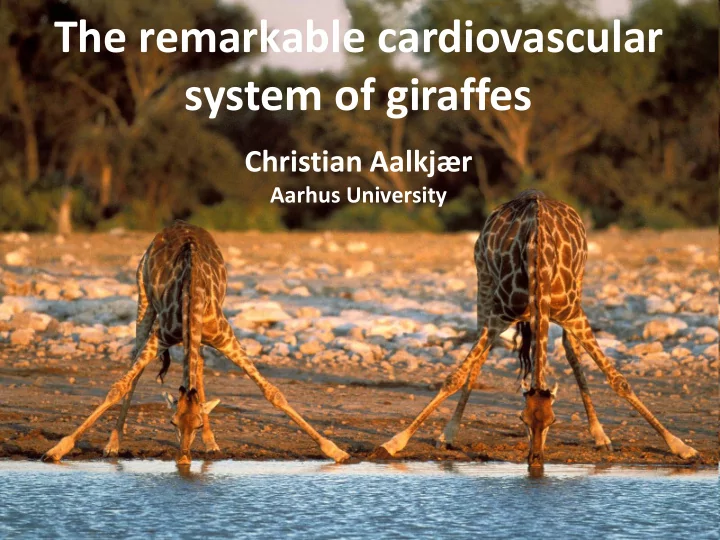
The remarkable cardiovascular system of giraffes Christian Aalkjr - - PowerPoint PPT Presentation
The remarkable cardiovascular system of giraffes Christian Aalkjr Aarhus University Why giraffes? Danish Giraffe Research Expedition 2010 Wildlife Assignments International Hammanskraal, South Africa The big four 1. How are leg
Aarhus University
prevented?
200 mmHg?
against the 200+ mmHg?
catastrophes avoided?
prevented?
200 mmHg?
against the 200+ mmHg?
catastrophes avoided?
1 cm
1 c m
Structural changes in a newborn giraffe? 2 c m Femoral artery from a newborn giraffe
2 cm between each slice
10 µg 100 µg noradrenaline
proximal
mmHg
distal
Resistance artery structure
Equivalent pressure
10 20 30 40 1 2 3 4 5 6
Interstitial fluid pressure (mmHg)
Position along the giraffe
Near ground Upper neck 25 50 75 100 125 150 175 1 2 3 4 5 6
∆interstital fluid pressure (mmHg)
Position along the giraffe
Near ground Upper neck
46 48 50 52 54
50 100 150 200
2 min Interstitial fluid pressure (mmHg)
N = 6 giraffes
prevented?
200 mmHg?
against the 200+ mmHg?
catastrophes avoided? 1.Sphincter 2.Resistance in conduit arteries 3.Thick media in small arteries 4.High interstitial pressure (strong fascia)
prevented?
200 mmHg?
against the 200+ mmHg?
catastrophes avoided?
The human heart is 0.54 % of the bodyweight
(de la Grandmaison GL, 2001)
The giraffe's heart is an enormous two feet long and twenty-five pounds huntingsociety.org Heartweight 1.9 ± 0.40 kg or ~0.5 % of bodyweight (n=6)
Brøndum et al., Am J Physiol 2011
Based on Seymour and Blaylock, Phyiol Biochem Zool 2000;73:389-405
Comparison of stroke volume/body mass for different mammals and giraffes
prevented?
200 mmHg?
against the 200+ mmHg?
catastrophes avoided? 1.By compromizing on the stroke volume, which is small. This presumably means that giraffes are “unfit”
prevented?
200 mmHg?
against the 200+ mmHg?
catastrophes avoided?
Where the pressure catheter was placed
prevented?
200 mmHg?
against the 200+ mmHg?
catastrophes avoided? 1.A high capsular hydrostatic pressure 2.Presumably a high afferent arteriolar resistance.
prevented?
200 mmHg?
against the 200+ mmHg?
catastrophes avoided?
330/? mmHg 110/70 mmHg 220/180 mmHg
(n=5)
50 100 150 200
mmHg
Venous return stops!
time (min)
63 64 65 66
l min-1
2 4 6 8 10 12 14
venous return at the base of the neck
Time (min) Flow (l/min) Venous return at the base of neck Is there an accumulation of blood in the neck??? Estimated accumulation ~2 L
Tobias Wang
Blood pressure changes buffer arterial pressure excursions near the head
Head pressure mmHg Central pressure mmHg
50 100 150 200
5 min
G7
50 100 150 200
75 125 175 225
Central pressure mmHg
No water in the pond!
75 125 175 225
10 20 30
10 20 30
Central jugular pressure mmHg
20 40 60 80 20 40 60 80
Heart rate
G5
25 sec
Now with water
Tobias Wang - modified
50 150 250 350 450
Head pressure mmHg
50 100 150 200
The giraffe gets to its feet after anaesthesia
G7
50 150 250 350 450 1 min
Central pressure mmHg
50 150 250 350 450
Beats per min
80 mmHg 160 mmHg 260 mmHg 80 mmHg 10 µM noradrenaline
400 500 Artery diameter µm
3 min
50 µm
260 mmHg 80 mmHg 80 mmHg 160 mmHg
300 350
80 mmHg 160 mmHg 260 mmHg 80 mmHg 10 µM noradrenaline
400 500 Artery diameter µm Artery diameter µm
3 min 2 min
Myogenic tone %
Myogenic tone in different small arteries at the giraffe head
50 100 150 200 250
Muscle
200 250 50 40 30 20 10 150 50 100
Transmural pressure, mmHg
muscle
Myogenic tone %
Myogenic tone in different small arteries at the giraffe head
50 100 150 200 250
200 250 50 40 30 20 10 150 50 100
Transmural pressure, mmHg
muscle tongue
Myogenic tone %
Myogenic tone in different small arteries at the giraffe head
50 100 150 200 250
200 250 50 40 30 20 10 150 50 100
Transmural pressure, mmHg
cerebral muscle tongue
20 30 40 50 60 70 80
30 min
CSF pressure
head down head up
Hydrodynamic resistance when drinking?
Pressure
150 200 250 300 350
Mean pressure prox carotis
Resistance
1.0 1.5 2.0
Relative resistance
Velocity
10 15 20 25 30
Flowvelocity prox carotis (cm/sec)
(Flow)
Up Drinking Pressure Up Drinking Flow
prevented?
200 mmHg?
against the 200+ mmHg?
catastrophes avoided? 1.Removing blood from the circulation (in the neck veins) 2.Precapillary vasoconstriction (myogenic and possibly nervous) 3.High CSF pressure 4.Valves in the jugular veins