THE RESIDUAL STRENGTH TEST AND ANALYSIS OF COMPOSITE RUDDER AFTER - - PDF document

the residual strength test and analysis of composite
SMART_READER_LITE
LIVE PREVIEW

THE RESIDUAL STRENGTH TEST AND ANALYSIS OF COMPOSITE RUDDER AFTER - - PDF document

18 TH INTERNATIONAL CONFERENCE ON COMPOSITE MATERIALS THE RESIDUAL STRENGTH TEST AND ANALYSIS OF COMPOSITE RUDDER AFTER LIGHTNING STRIKE X.Chen 1 *, G.Liu 1, H.Wang 1 1 School of Aeronautics and Astronautics, Shanghai JiaoTong University, 800


slide-1
SLIDE 1

18TH INTERNATIONAL CONFERENCE ON COMPOSITE MATERIALS

1 Introduction

During the past decade years, the use of advanced composites to build civil aerocraft components became an attractive topic of research for many structural engineers. Composite laminate structures provide several attractive features including its lightweight, high specific stiffness and strength, compared to current aluminum materials, as well as its superior corrosion resistance properties that is preferred in harsh environmental conditions. However, from the recent research work, the most critical disadvantage of the resistance to widely use in primary aero structures is the interface crack, especially the delamination after impact or strike. From the federal airworthiness regulation [1], part 25.581. “The airplane must be protected against catastrophic effects from lightning and designing the components so that a strike will not endanger the airplane.” In this paper, we present an analysis and test project for a composite rudder for ARJ21. Internal damage in composites is often initiated as delamination due to strike impact. The delamination is very complex and usually reduces the compressive strength. Since the rudder is designed with rigid structure principle, even though there are some local damage area in the rudder, it still work functionally, thus the rigid degradation of the laminates after strike impact is more necessary. The rigid degradation factor of ply is calibrated with the coupon test results with parametric calculation method. Then use the equivalent rigid result for the finite element analysis of the composite rudder structure. The FEM result shows good match with the test results.

2 Specimen of the Static Test

A light strike test was simulated with high voltage electrical method to prefabricate the

  • damages. After the light strike, there are nine

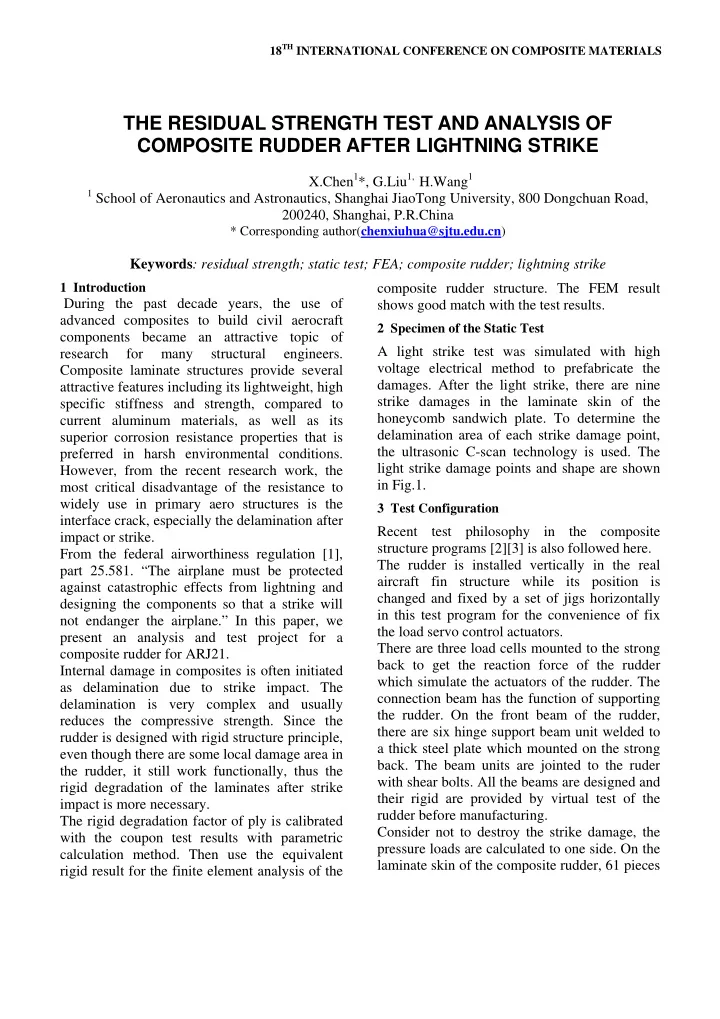
strike damages in the laminate skin of the honeycomb sandwich plate. To determine the delamination area of each strike damage point, the ultrasonic C-scan technology is used. The light strike damage points and shape are shown in Fig.1.

3 Test Configuration

Recent test philosophy in the composite structure programs [2][3] is also followed here. The rudder is installed vertically in the real aircraft fin structure while its position is changed and fixed by a set of jigs horizontally in this test program for the convenience of fix the load servo control actuators. There are three load cells mounted to the strong back to get the reaction force of the rudder which simulate the actuators of the rudder. The connection beam has the function of supporting the rudder. On the front beam of the rudder, there are six hinge support beam unit welded to a thick steel plate which mounted on the strong

  • back. The beam units are jointed to the ruder

with shear bolts. All the beams are designed and their rigid are provided by virtual test of the rudder before manufacturing. Consider not to destroy the strike damage, the pressure loads are calculated to one side. On the laminate skin of the composite rudder, 61 pieces

THE RESIDUAL STRENGTH TEST AND ANALYSIS OF COMPOSITE RUDDER AFTER LIGHTNING STRIKE

X.Chen1*, G.Liu1, H.Wang1

1 School of Aeronautics and Astronautics, Shanghai JiaoTong University, 800 Dongchuan Road,

200240, Shanghai, P.R.China

* Corresponding author(chenxiuhua@sjtu.edu.cn)

Keywords: residual strength; static test; FEA; composite rudder; lightning strike

slide-2
SLIDE 2

adhesive tape are used to simulate the local aerodynamic pressure load. Five levels traditional load leverage devices are used. At the end of the lever, two servo actuators are installed in the reaction ground for the design limit load of the composite rudder. Fig.2 shows the schema and real installation of the static test.

4 Test Control and Data Acquisition Systems

Loading signals are generated in a powerful and flexible multi-channel control system, MTS FlexTest 200, under the defined load spectrum. The data acquisition system is provided by VXI EX1629 instrument. In this static strength test, 210 strain channels and 14 displacement channels are provided. The strain gages are laid

  • n the surface around the strike damage which

defined by the C scanner. The string displacement transducers is place on the ground position where it defined by a laser position instrument under the rudder structures. The load forces and the three reaction forces obtained by load cells through the feedback of the control channels. Loads are applied to the test article with two hydraulic actuators attached to the leverage

  • device. Each actuator is individually controlled

with MTS FlexTest 200 digital control system. The closed loop system uses both load cell feedback to command hydraulic pressure via servo valve and monitor the LVDT feedback to see whether the specimen is safe. The spectrum is provided by the AeroPro Software and the data comes from the aerodynamic calculation which already considered about the jigs weight and the installation preload. Fig.3 shows the load spectrum.

5 FEA and Test results of the Composite Rudder

FEA(Finite Element Analysis) method is used to predict the deformation and residue strength

  • f the composite rudder structure after lighting
  • stroke. MSC.Nastran and MSC.Patran are used

as solver and pre/post processor for the virtual

  • test. The CQUAD4 shell elements are used to

simulate the composite laminates. The CBEAM and CBAR elements are used for the jig models and the ribs of the rudder. Damage introduced by lightning stroke is simulated by stiffness reduction method during the process of constructing the finite element model, and the coefficient of reduction is determined by FEA results with the data from the C scan and calibrated with coupon test results. The finite element model is shown in Fig.4, which indicates the load vectors and the constraint conditions. The loading on the rudder represents the load case which is same with the testing conditions. 3 load cells and 14 displacement transducers make up the instrumentation suite used during testing

  • perations. Comparison between the analysis

results and testing results of load cells and displacement transducers is presented in the following sections. There are 14 testing channels of displacement transducers along the rudder beam, which are used to measure the rudder’s stiffness. A static loads analysis

  • f

the structure using MSC.Nastran and the loads presented above yielded a maximum displacement of 31.49mm at Point 14. Fig.5 visually depicts the contour of the X-direction deformation of the analysis

  • results. Comparison between the testing data

from the displacement transducers and FEA numerical analysis results is shown in Fig.6 in

  • detail. Analysis results are well accordance with

the test results at all points obviously. Simultaneously, the analysis results validates that testing data of the points at the root of the rudder is nearly zero and points with the same Y-coordinates have the similar deformation. Internal force results are extracted from the rod element force corresponding with the load cells. Comparison between the testing data from the displacement transducers and FEA numerical analysis results are shown in Fig.7 in detail. From the FEA results compared with the test results, all the strains, displacements, the gross load and proportion of the load distribution

slide-3
SLIDE 3

3 THE RESIDUAL STRENGTH TEST AND ANALYSIS OF COMPOSITE RUDDER AFTER LIGHTNING STRIKE

match well. Fig.8, Fig.9 and Fig.10 present the change curves of strain, displacement and load versus load from FEA results.

6 Conclusions

The static test proved that the composite rudder can undertake the design limit load considering the environment after light strike. The design and manufacture process are successful and meet the requirement of the airworthiness. After the static test of the composite rudder, a C scan process is carried out again, and it make sure that the damage of the light strike area is no more extend under design limit load.

7 Acknowledgments

The authors gratefully acknowledge the support under contract from the Shanghai Aircraft Research Institute, COMAC.

Fig.1. Light strike point and damage shape of the composite rudder Fig.2. Picture of the real static test

1 2 3 4 5 6 7 8 100 200 300 400 500 600 700 kN Time (sec) arj21_profiles_114% 53: 0% arj21_test 1: start_0% No29:CMD No32:CMD

Fig.3. Load spectrum of the two actuators

Fig.4 Finite element model of the rudder Fig.5. FEA displacement results contour

2000 4000

2000 4000

Displacement(mm) Testing Value Analysis Value Undeformed Value Z(mm) Y(mm)

Fig.6. Comparison between the analysis and testing results of the displacement

slide-4
SLIDE 4

1 2 3 5 10 15 20

Internal Force Load Cell Test results Analysis results

Fig.7. Comparison between the analysis and testing results of the internal force at the root of the rudder

20 40 60 80 100 120

  • 40
  • 35
  • 30
  • 25
  • 20
  • 15
  • 10
  • 5

5 10 15 20 25

Strain/ Load/%

5311043 5321043 5331043 5311044 5321044 5331044 5311045 5321045 5331045 5311046 5321046 5331046

Fig.8. Strain result around the light strike point

9#

20 40 60 80 100 120

  • 2

2 4 6 8 10 12 14 16 18 20 22 24 26 28 30

Displacement/mm Percent of Design Limit Load/%

101 102 103 104 105 106 107 108 109 110 111 112 113 114

Fig.9. Test displacement results

0.2 0.4 0.6 0.8 1.0 1.2 2 4 6 8 10 12 14 16 18 20 22 24 26

Reaction Force/KN Load/%

No.1 No.2 No.3

Fig.10. Reaction force of the composite rudder References

[1] “Federal Airworthiness Regulations Part 25”, US Federal Aviation Administration, Washington, DC, USA. [2] M.Karal “AST composite wing program –executive summary”, NASA/CR-2001-210650, The Boeing Company, Long Beach, California,2001. [3] T.Ishikawa, Y.Hayasi, S.Sugimoto, M.Matsushima and K.Amaoka “Development and test results of full CF/PEEK (APC-2) horizontal stabilizer models – basis for SST structure”. 1st AIAA Aircraft Engineering, Technology, and Operations Congress, Los Angeles, CA,USA, AIAA 95-3931,1995.