
2/19/2016 1
Distributed Computing Systems
Overview of Distributed Systems
Andrew Tanenbaum and Marten van Steen, Distributed Systems – Principles and Paradigms, Prentice Hall, c2002.
The Rise of Distributed Systems
- Computer hardware prices falling, power increasing
– If cars did same, Rolls Royce would cost 1 dollar and get 1 billion miles per gallon (with 200 page manual to open door)
- Network connectivity increasing
– Everyone is connected with “fat” pipes, even when moving
- It is easy to connect hardware together
– Layered abstractions have worked very well
- Definition: a distributed system is
“A collection of independent computers that appears to its users as a single coherent system”
Why Distributed Systems?
A. Big data continues to grow:
- In mid-2010, informationuniverse 1.2 zettabytes
- 2020 predictions 44x more at 35 zettabytes
B. Applications are becoming data-intensive.
- Big data - large pools of data
captured, communicated, aggregated, stored, and analyzed
- Google processes 20
petabytes of data per day
- E.g., data-intensive app:
astronomical data parsing
Ying Lu, UNL, CSCE990 Advanced Distributed Systems Seminar http://cse.unl.edu/~ylu/csce990/notes/Introduction.ppt
Why Distributed Systems?
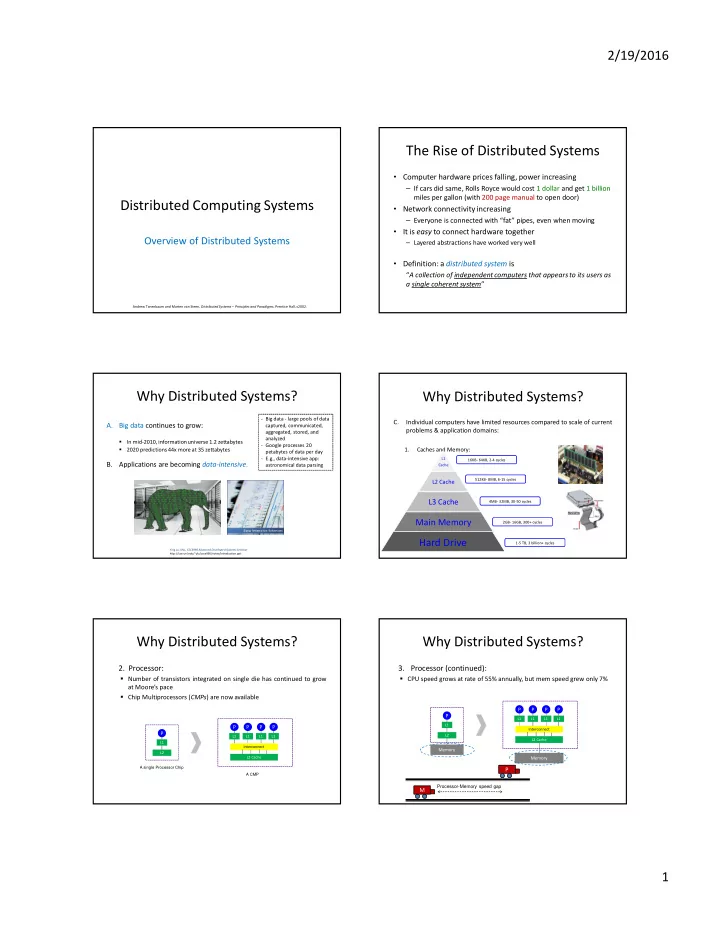
C. Individual computers have limited resources compared to scale of current problems & application domains:
1. Caches and Memory:
L1 Cache
L2 Cache
L3 Cache
Main Memory
16KB- 64KB, 2-4 cycles 512KB- 8MB, 6-15 cycles 4MB- 32MB, 30-50 cycles 2GB- 16GB, 300+ cycles 1-5 TB, 3 billion+ cycles
Hard Drive
Why Distributed Systems?
P
L1 L2
P
L1 L2 Cache
P
L1
P
L1
P
L1 Interconnect
- 2. Processor:
Number of transistors integrated on single die has continued to grow at Moore’s pace Chip Multiprocessors (CMPs) are now available
A single Processor Chip A CMP
Why Distributed Systems?
- 3. Processor (continued):
CPU speed grows at rate of 55% annually, but mem speed grew only 7%
Memory Memory
P M
P
L1 L2
P
L1 L2 Cache
P
L1
P
L1
P
L1 Interconnect
Processor-Memory speed gap