
SLIDE 1
(a.k.a. Trying Really Hard to Forget World War I)
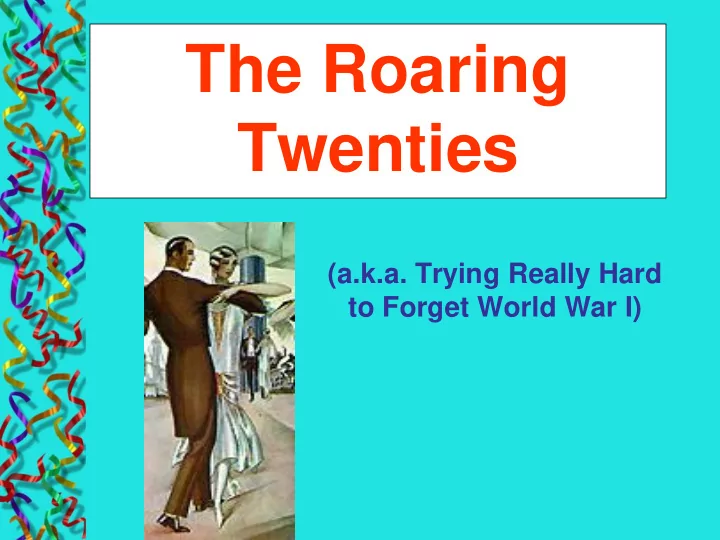
The Roaring Twenties (a.k.a. Trying Really Hard to Forget World - - PowerPoint PPT Presentation
The Roaring Twenties (a.k.a. Trying Really Hard to Forget World War I) Technology Changes Technology extended progress into all areas of American life. Transportation Results of Improved Transportation Brought by Affordable Automobiles
(a.k.a. Trying Really Hard to Forget World War I)
Technology extended progress into all areas of American life.
Results of Improved Transportation Brought by Affordable Automobiles
industries
Oil…Steel…
…and more brands of automobiles
The first successful flight of a motorized airplane was on December 17, 1903.
The Wright Brothers – Orville and Wilbur
Henry Ford Inventor of the conveyor belt
Allowed for lower production costs It is a long, moving belt that carries materials past workers in a factory.
Communication Changes
Early wireless apparatus in 1896 by Guglielmo Marconi
The broadcast industry developed…
By David Sarnoff
In 1920, RCA, manufacturers of radios, agreed to put up $2,500 to explore Sarnoff's idea of radios and broadcasting.
faster and to a larger audience.
the president, the World Series, radio shows, and music.
The movie projector or movie machine By Thomas Edison
Even before sound, movies
through romance and comedy. First sound movie: Jazz Singer (1927) First animated movie with sound: Steamboat Willie (1928) By 1930, millions of Americans went to the movies each week.
Walt Disney's animated Steamboat Willie marked the debut of Mickey
minute-long black and white cartoon.
Ways Electrification Changed American Life
washing machines,
…electric stoves and water pumps
Lighting
US II.6b, c
The 1920s and 1930s was a time of change in manners, culture, and morals in the United States.
During the 1920s, urbanization continued to grow. For the first time, more Americans lived in cities than in rural areas. New York City was home to over 5 million people in 1920. Chicago had nearly 3 million.
Urban vs. Rural
Throughout the 1920s, Americans found themselves caught between urban (city) and rural (country) cultures. Urban life was considered a world of anonymous crowds, strangers, moneymakers, and pleasure seekers. Rural life was considered to be safe, with close personal ties, hard work and morals.
Cities were impersonal. Farms were innocent.
As the 1920s unfolded, many features of the modern family came about. Marriage was based on romantic love, women managed the household and finances, and children were not considered laborers/ wage earners but developing children who needed nurturing and education.
Americans were also happy because the difficult years of World War I were
bought lots of stuff!
consumerism = belief that buying and using lots of products and services is good for people and society How did they pay for it? credit = money you promise to pay later
They also used credit in the stock market.
where a piece of a company can be bought or sold
to buy stock (little bits of corporations) was called buying “on margin”
90% later
potential problem with this?
New technology and consumerism helped create a mass culture. In a mass culture (or mass society), people throughout the society live very similarly. This is because most people depend on big business for food, clothes, entertainment, and other parts of life. Example: From Virginia and Tennessee, country music goes national. Example: From Harlem, New York, jazz goes national.
what was popular.
The new mass culture included the rise of national celebrities.
People crowded into baseball games to see their heroes. Babe Ruth was a larger- than-life American hero who played for the Yankees. He hit 60 homers in 1927. The golfer Bobby Jones was admired for his talent and gentlemanly manners.
Famed composers George Gershwin and Aaron Copland merged traditional elements with American Jazz.
Gershwin
Music & Arts
Copland
Georgia O’Keeffe captured the grandeur
intensely colored
painted city life, desert scenes, and flowers. Georgia O’Keeffe lived part of her early life in Virginia.
Radiator Building, Night, New York , 1927 Georgia O'Keeffe
WRITERS OF THE 1920s
Writer F. Scott Fitzgerald coined the phrase “Jazz Age” to describe the 1920s. Fitzgerald wrote Paradise Lost and The Great Gatsby. The Great Gatsby reflected the emptiness of New York elite society.
John Steinbeck wrote about migrant workers and their struggles during the Dust Bowl.
WRITERS OF THE 1920s
US II.6b, c
The 19th Amendment to the Constitution was passed giving women the right to vote.
US II.6b, c
Change: In the 1920s prosperity and leisure time increased, and so young women led the youth craze by dressing in a different fashion…
…and were nicknamed “Flappers” 1. How did they dress differently? 2. How were their hairstyles different? 3. How were their behaviors and attitudes different?
The Great Migration and Harlem Renaissance began the rebirth of African- American culture.
US II.6b, c
Harlem in New York City was a place where African American artists, writers, and musicians revealed the freshness and variety of their culture.
US II.6b, c
The leaders of the Harlem Renaissance drew upon the heritage of black culture…to establish themselves as powerful forces for cultural change.…
US II.6b, c
The Cotton Club was a famous place in Harlem during this time…
US II.6b, c
…and people from everywhere filled the club every night to listen to the African-American jazz bands.
MUSIC
Duke Ellington and Louis Armstrong were two of the jazz musicians of the
also a jazz composer and band leader.
Louis Armstrong (“Satchmo”) was a famous trumpet player and singer…
US II.6b, c
…and Bessie Smith was a famous jazz and blues singer. Her nickname was “the Empress of Blues.” She was one of the first major female African American recording artists.
US II.6b, c
The popularity of these artists spread to the rest of society.
US II.6b, c
ART - Jacob Lawrence was a painter who…
US II.6b, c
…chronicled the experiences of the Great Migration north through art
LITERATURE
Langston Hughes… a famous poet who wrote about the African American experience in the U.S. Wanted Equality
I, Too, Sing America I, too, sing America I am the darker brother. They send me to eat in the kitchen When company comes, But I laugh, And eat well, and grow strong. Tomorrow, I’ll be at the table When company comes. Nobody’ll dare Say to me, “Eat in the kitchen,” Then. Besides, They’ll see how beautiful I am And be ashamed I, too, am America.
“Democracy” by Langston Hughes
Democracy will not come Today, this year Nor ever Through compromise and fear. I have as much right As the other fellow has To stand On my two feet And own the land. I tire so of hearing people say, Let things take their course. Tomorrow is another day. I do not need my freedom when I'm dead. I cannot live on tomorrow's bread. Freedom Is a strong seed Planted In a great need. I live here, too. I want freedom Just as you. from http://famouspoetsandpoems.com/poets/langston_hughes/poems/16957
The Temperance Movement convinced Congress and the United States that the country would be better off with NO alcohol to drink.
USII.6b
What was the Temperance Movement? It was a campaign against the sale
USII.6b
The 18th Amendment
Prohibition was imposed by the 18th Amendment of the U.S. Constitution…
…that made it illegal to manufacture, transport, and sell alcoholic beverages.
Prohibition was intended as a “noble experiment”…
USII.6b
…to reduce poverty, unemployment, and violence in the home.
Drugstores could legally sell alcohol to people with a doctor's prescription. Those stores that sold alcohol illegally could be shut down .
USII.6b
Explain or describe this cartoon
Prohibition Led to Problems
USII.6b
people to drink alcoholic beverages. What were speakeasies? illegal bars
clubs
USII.6b
People started to make “bathtub gin”…
USII.6b
…or “homemade” alcohol
alcohol illegally and promoted
USII.6b
People like Al “Scarface” Capone began to smuggle alcohol in from Canada and the Caribbean. He was the Chicago crime boss.
(like the business version of political bosses…except they
bosses)
USII.6b
were only 1,500 agents.
USII.6b
USII.6b
The 21st Amendment This amendment repealed or cancelled the 18th Amendment.
Reforms could not legislate how people behaved.
USII.6b