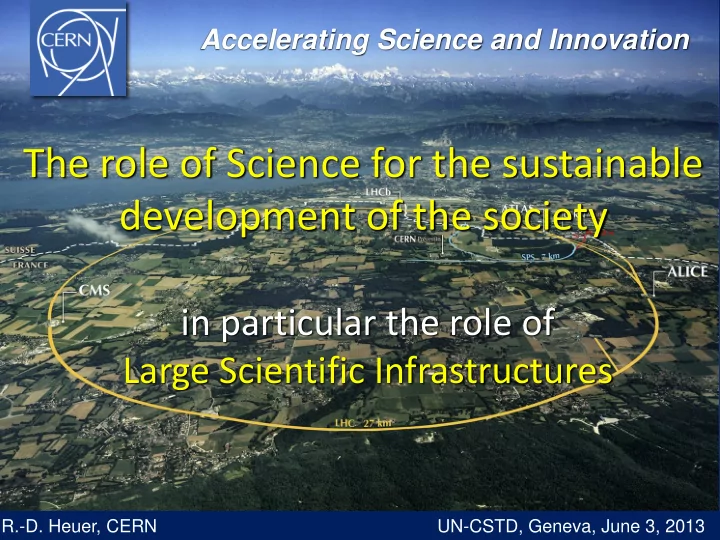
SLIDE 1 Accelerating Science and Innovation
R.-D. Heuer, CERN UN-CSTD, Geneva, June 3, 2013
The role of Science for the sustainable development of the society
in particular the role of Large Scientific Infrastructures
SLIDE 2
Key Message
In today’s challenging period, all regions need to step up support for research and innovation in order to ensure, in a global competitive environment, the sustainable development of science and technology necessary for the upturn and growth of everybody’s economy. Research Infrastructures (RIs) are important ‘tools’ for this are vital for large scale projects
SLIDE 3 Mission of Research Infrastructures
Research
Push forward the frontiers of knowledge
Innovation
Develop new, cutting-edge technologies
Education
Train scientists and engineers of tomorrow
Outreach
Promote Science in Society
SLIDE 4
Research
generates Knowledge generates Innovation can generate Disruptive Innovation thereby changing society Example from CERN: World Wide Web
SLIDE 5 The Virtuous Circle
basic research ↔ innovation ↔ applied research
- Synergy between research and innovation
results not only in societal and economic impact but also, and very importantly, in the creation of enhanced opportunities for further developments.
- This circle needs to remain strong, to be
unbroken and to be supported over long term.
SLIDE 6
- Objective - strive for excellence
– Aspects of excellence
- In individuals, co-operation, infrastructure (including
intellectual challenges);
- National - Regional - International.
– Excellence is not (necessarily) ‘being unique’; Competition promotes excellence. – Excellence will be attractive and inspiring to all region’s research and innovation communities and to society at large.
Excellence
SLIDE 7
- International scientific cooperation is vital
CERN: European Infrastructure, globally used
- International scientific cooperation is vital
for all countries: developed, emerging, developing scientific research needs to benefit everybody
- International scientific cooperation
provides successful models for peaceful cooperation
Cooperation
SLIDE 8
- Address
- fundamental science questions
at the forefront of research and technology
- Need
- large and sustained infrastructures
- global collaboration on long time scales
- Provide
- unique equipment
- challenging requests for high technology and innovation
- stimulating ideas which in turn attract good people
- occasion to bring people together
Large-scale Science Projects
SLIDE 9
Large International Collaborations
– a place where people learn to work together – collaboration and competition – diversity: good opportunity to recognize differences, accept them and learn to use them – influence the way of thinking, planning at general level – information sharing: role of computing in internationalization and communication – experience can be used by individuals and in other fields management through ‘common goals’ management by ‘convincing partners’
Sociology
SLIDE 10
- All countries need more scientists, engineers, staff, . . .
- targeted outreach activities
- encourage interest in careers in science
- Society needs to realize and appreciate science
- bring innovative science and exciting results (achieved at
RIs), and their application to societal challenges, to the notice of society
- need more imaginative and ambitious outreach activities
Key Issue: Outreach
SLIDE 11
- circulation of scientific knowledge needs to be improved
- huge, strongly increasing amount of data and information
- data preservation
- open access to scientific publications
- open access to data
Key Issue: Access to Results
Everybody, independent of region, country, culture
has to be able to access scientific results but also to make his/her available to everybody else
SLIDE 12
Key Message
Governments and decision-makers should not cut on scientific research, as this would reduce the perspectives of growth for the society, and for the welfare of its citizens.
SLIDE 13
The role of Large Scientific Infrastructures: – innovate, discover, publish, share
… and bring the world together