THE SEMIMICROSCOPIC DESCRIPTION OF THE SIMPLEST PHOTONUCLEAR - - PDF document

the semimicroscopic description of the simplest
SMART_READER_LITE
LIVE PREVIEW

THE SEMIMICROSCOPIC DESCRIPTION OF THE SIMPLEST PHOTONUCLEAR - - PDF document

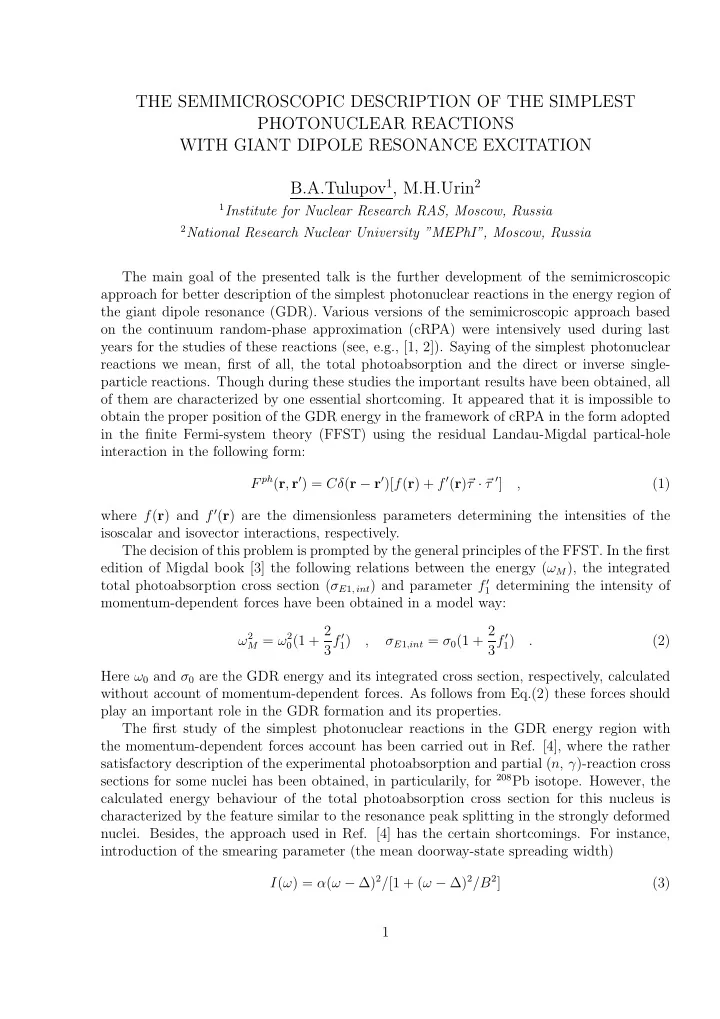
THE SEMIMICROSCOPIC DESCRIPTION OF THE SIMPLEST PHOTONUCLEAR REACTIONS WITH GIANT DIPOLE RESONANCE EXCITATION B.A.Tulupov 1 , M.H.Urin 2 1 Institute for Nuclear Research RAS, Moscow, Russia 2 National Research Nuclear University MEPhI,


slide-1
SLIDE 1

THE SEMIMICROSCOPIC DESCRIPTION OF THE SIMPLEST PHOTONUCLEAR REACTIONS WITH GIANT DIPOLE RESONANCE EXCITATION B.A.Tulupov1, M.H.Urin2

1Institute for Nuclear Research RAS, Moscow, Russia 2National Research Nuclear University ”MEPhI”, Moscow, Russia

The main goal of the presented talk is the further development of the semimicroscopic approach for better description of the simplest photonuclear reactions in the energy region of the giant dipole resonance (GDR). Various versions of the semimicroscopic approach based

  • n the continuum random-phase approximation (cRPA) were intensively used during last

years for the studies of these reactions (see, e.g., [1, 2]). Saying of the simplest photonuclear reactions we mean, first of all, the total photoabsorption and the direct or inverse single- particle reactions. Though during these studies the important results have been obtained, all

  • f them are characterized by one essential shortcoming. It appeared that it is impossible to
  • btain the proper position of the GDR energy in the framework of cRPA in the form adopted

in the finite Fermi-system theory (FFST) using the residual Landau-Migdal partical-hole interaction in the following form: F ph(r, r′) = Cδ(r − r′)[f(r) + f ′(r) τ · τ ′] , (1) where f(r) and f ′(r) are the dimensionless parameters determining the intensities of the isoscalar and isovector interactions, respectively. The decision of this problem is prompted by the general principles of the FFST. In the first edition of Migdal book [3] the following relations between the energy (ωM), the integrated total photoabsorption cross section (σE1, int) and parameter f ′

1 determining the intensity of

momentum-dependent forces have been obtained in a model way: ω2

M = ω2 0(1 + 2

3f ′

1)

, σE1,int = σ0(1 + 2 3f ′

1)

. (2) Here ω0 and σ0 are the GDR energy and its integrated cross section, respectively, calculated without account of momentum-dependent forces. As follows from Eq.(2) these forces should play an important role in the GDR formation and its properties. The first study of the simplest photonuclear reactions in the GDR energy region with the momentum-dependent forces account has been carried out in Ref. [4], where the rather satisfactory description of the experimental photoabsorption and partial (n, γ)-reaction cross sections for some nuclei has been obtained, in particularily, for 208Pb isotope. However, the calculated energy behaviour of the total photoabsorption cross section for this nucleus is characterized by the feature similar to the resonance peak splitting in the strongly deformed

  • nuclei. Besides, the approach used in Ref. [4] has the certain shortcomings. For instance,

introduction of the smearing parameter (the mean doorway-state spreading width) I(ω) = α(ω − ∆)2/[1 + (ω − ∆)2/B2] (3) 1

slide-2
SLIDE 2

(its form is similar to that proposed in Ref. [5]) leads in calculations to the appearance of the additional terms ∓(i/2)I(ω)I(r) in the potential U(x) used for the calculations of the cRPA certain ingredients (Green’s functions and continuum-state wave functions). As I(r) is usually used the Woods-Saxon function fW S(r, R∗, a). In the mentioned approach [4] the cutoff radius R∗ was chosen as R∗ = 2R in the calculations of the Green’s functions and R∗ = R in the calculations of the partial reaction amplitudes. Such choice of R∗ is not quite justified and makes the used approach rather inconsistent. It is necessary to notice also that the smearing parameter I(ω) is an imaginary part of the polarization operator Π(ω) = −(i/2)I(ω) + ReΠ(ω), which determines the relaxation of the particle-hole degree of

  • freedom. The quantity Re Π(ω) which can be determined through I(ω) with the help of the

certain dispersion relation [6] also gives a contribution Re Π(ω)I(r) to the potential U(x). Therefore the account of the above made remarks has been chosen as the first step to improve the approach of Ref. [4]. As it is well known in the FFST the effective fields V satisfy to the following equations (in symbolic form): V = V0 + FAV , (4) where V0 is the external field, A is the response function and F is the residual particle-hole

  • interaction. In the presented approach the isovector part of this interaction is chosen in the

form having the separable momentum-dependent part [7]: F(1, 2) →

  • F ′δ(

r1 − r2) + k′ mA( p1 p2)

  • (

τ1 τ2) , (5) where F ′ = f ′ · 300 MeV fm3, k ′ is the dimensionless intensity of the momentum-dependent separable forces, m is the nucleon mass and A is the number of nucleons. In the case of the GDR excitation the external field V0(x) is taken as following: V0(x) = −1 2rY1(Ω)τ (3) , (’x’ means the set of space, spin and isospin variables). Assuming the operator equality

  • p = md

r/dt, in the cRPA from Eqs. (4),(5) the following relations may be obtained after separation of isobaric and spin-angular variables: ˜ V (r, ω) = V (r, ω) + Vk(r, ω) , (6) V (r, ω) = r + 2F ′ r2

  • [A(r, r′, ω) + Ak(r, r′, ω)]V (r′, ω)dr′

, (7) Vk(r, ω) = kω2 1 + k′ − ω2k

rA(r, r′, ω)r′drdr′ · r

  • rA(r, r′, ω)V (r′, ω)drdr′

, (8) Ak(r, r′, ω) = kω2 1 + k′ − ω2k

rA(r, r′, ω)r′drdr′

  • A(r, r′, ω)r′dr′
  • rA(r, r′, ω)dr

. (9) Here k = 8πm

3¯ h2Ak′. The small correction to the equality

p = md r/dt caused by the spin-orbit part of the nuclear mean field can be neglected [7]. All ω-dependent single -particle quantities in Eqs. (6)-(9) are determined by the potential, including the above mentioned additional terms. 2

slide-3
SLIDE 3

Using Eqs. (6)-(9) it is possible to find the dipole strength function S(ω) = −1 πIm

  • rA(r, r′, ω) ˜

V (r′, ω)drdr′ , (10) where ω is a photon energy and, hence, the total photoabsorption cross section in the energy region of the GDR: σ(ω) = 8π3 3 e2 ¯ hc ωS(ω) (11) Unfortunately the results for photoabsorption cross section in 208Pb isotope obtained in this version of the presented approach happened to be practically similar to those obtained in Ref. [4] (Fig. 1). Fig 1.

The total photoabsorption cross section in 208Pb calculated in the first version of the presented approach (solid line) in comparison with corresponding results of Ref.[4] (dotted line) and the available experimental data [8].

Due to that an attempt has been made to reconsider one of the principal foundation of the approach: to change the potential used for the calculations of all cRPA ingredients. This procedure has been carried out in Ref. [9] on the base of new phenomenological potential proposed in Ref. [10]. In this potential the mean field U(x) consists of pure nuclear parts, containing the isoscalar and isovector spin-orbit interaction, Coulomb field, the symmetry energy and is written in the following form: U(x) = U0(r) + (USO (r) + 1 2USO

1

(r)τ (3))

  • l

s + 1 2v(r)τ (3) + 1 2(1 − τ (3))UC(r) (12) The space dependences of central field U0(r) and spin-orbit interactions USO and USO

1

are determined by the Woods-Saxon function fW S(r, R∗, a) and its derivative d fW S(r)/dr, respec-

  • tively. As to the symmetry potential v(r) and Coulomb field UC(r), they are calculated in a

self-consistent way. The choice of all parameters determining every part of the potential U(x) is made by means of the minimization of the differences between calculated position of the energy levels and the experimental ones (for the details of the total procedure and obtained 3

slide-4
SLIDE 4

values of potential parameters see Ref. [9]). It is worthwhile to notice that obtained value of the isovector constant f ′ is equal to 1.09 in contrast to the previously used value 1.0 (see,e.g.,

  • Ref. [4]).

The approach developed on the base of this new potential includes only two parameters which should be treated as the adjustable ones: the intensity of the momentum-dependent forces k′ and the intensity of the smearing parameter α (the values of ∆ and B are taken to be the same as in Ref. [4]). To determine them the experimental data on the photoab- sorption cross section for 208Pb isotope [8] has been chosen as the most authentic ones. The corresponding calculations of the σ(ω) has been carried out on the base of Eqs. (6)-(11) using the newly defined potential. The comparison of the obtained results with the experimental data in Fig. 2 allows to define the values of α and k′: α = 0.1 MeV−1, k′ = 0.4. Fig 2.

The calculated total photoabsorption cross section for 208Pb (solid line) in comparison with available experimental data [8].

To check the possibilities of the presented approach the available partial (n, γ) reaction cross sections for 208Pb isotope have been also investigated in the energy region of the GDR. The reaction amplitude which has been calculated on the base of Eqs. (6)-(9) has the following form: Mc(ω) =< (λ)||Y1||(µ) >

  • χ(+)

ε(λ)(r) ˜

V (r, ω)χµ(r)dr , (13) where c = {ε(λ), µ} is the set of the reaction-channel quantum numbers, µ = {εµ, (µ)} is the set of quantum numbers for single-particle state, χµ(r) is the radial wave function of the populated bound state with energy εµ and χ(+)

ε(λ)(r) is the corresponding to this channel and

normalized to the δ–function of energy the scattering radial wave function of incident nucleon with energy ε = ω + εµ (for other notations see, e.g. [4]). The bound state wave function is calculated with new potential (12) while the scattering wave function - with potential (12) and additional terms connected with I(ω)I(r) and Π(ω)I(r) (see above). The cross sections

  • f these reactions can be then presented in the following form:

dσc(ε, θ) dΩ = 8 3π5/2 e2 ¯ hc ω · ω2 2mc 2ε

  • L

AL(ε, µ)PL(cosθ) , (14) 4

slide-5
SLIDE 5

AL(ε, µ) =

  • (λ)(λ′)

il−l′(−1)jµ+j(1 − 111|L0)W(jj′11; Ljµ) < (λ)||YL||(λ′) > Mc(ω)M∗

c′(ω)

. Here, PL(cosθ) are the Legendre polynomials, (1−111|L0) and W(jj′11; Ljµ) are the Clebsch- Gordan coefficient and Racah coefficient, respectively. The relults of these cross section calculations are shown in Figs. 3,4 in comparison with the available experimental data [11] and some results from Ref. [4]. As it is seen from

  • Figs. 3,4 the presented approach based on the use of new potential [9] allows us to describe

Fig 3.

The calculated on the base of the presented approach the partial (n,γ) reaction cross sections at 900 to some single-particle states in 209Pb in comparison with the available experimental data [11].

satisfactorily the studied photonuclear reactions: (i) the splitting of the GDR peak in 208Pb is absent; (ii) the obtained cross sections of partial (n, γ) reactions appreciably better agree with the available experimental data than those from Ref. [4]. The energy-averaged (due to the use of the smearing parameter I(ω)) differential cross sections for neutron radiative capture, dσµ/dΩ, are calculated without use of any adjustable parameters. Each calculation

  • f the cross section is carried out with account of the experimental spectroscopic factor

value, Sµ, of the final product-nucleus single-particle state populated after the capture. The corresponding experimental data are taken from Ref. [12]. As a conclusion one could say the following. In the presented approach a reasonable description of the experimental data on the total photoabsorption cross section and the partial (n, γ) reactions for 208Pb isotope is obtained. In the future it is planned to expand the such investigations on the other medium-heavy mass nuclei having the similar structure. Besides, it is supposed to carry out these studies on the base of the potential [9] using the new set of parameters. Finally, it is planned to perform in a framework of the presented approach some predictive investigations, for instance, of (γ, n) reactions where there are some appropriate experimental data. 5

slide-6
SLIDE 6

Fig 4. The calculated partial cross sections at 900 for neutron radiative capture (solid lines) to

some single-particle states in 209Pb in comparison with the corresponding results of Ref. [4] (dotted lines) and the available experimental data [11].

This work was supported in part by the Russian Foundation for Basic Research (project

  • no. 09-02-00926-a).

References

[1] S.E. Muraviev and M.H. Urin, Nucl. Phys. A572, 267 (1994). [2] S. Kamerdzhiev et al., Phys.Rep. 393, 1 (2004). [3] A.B. Migdal, Theory of Finite Fermi Systems and Properties of Atomic Nuclei (Nauka, Moscow, 1965) (in Russian) (English Translation: A.B. Migdal, Theory of Finite Fermi- Systems and Applications to Atomic Nuclei, Interscience, New York, 1967). [4] V.A. Rodin and M.H. Urin, Phys. Rev. C 66, 064608 (2002). [5] C. Mahaux and R. Sartor, Nucl. Phys. A503, 525 (1989). [6] B.A. Tulupov and M.H. Urin, Phys. At. Nucl. 72, 737 (2009). [7] V.A. Rodin and M.H. Urin, in: Contemporary Problems of Nucleus and Particle Physics, 33 (Edition of INR RAS, Moscow, 1999). [8] R. Berg` ere et al., Nucl. Phys. A159, 561 (1970). [9] S.Yu. Igashov and M.H. Urin, Bull.Rus.Acad.Sci.Phys., 70, 212 (2006). [10] V.I. Isakov et al., Phys. At. Nucl. 67, 1856 (2004). [11] I. Bergqvist, D.M. Drake and D.K. McDaniels, Nucl. Phys. A191, 641 (1972). [12] A. Likar and T. Vidmar, Nucl. Phys. A 637, 365 (1998). 6