
SLIDE 1
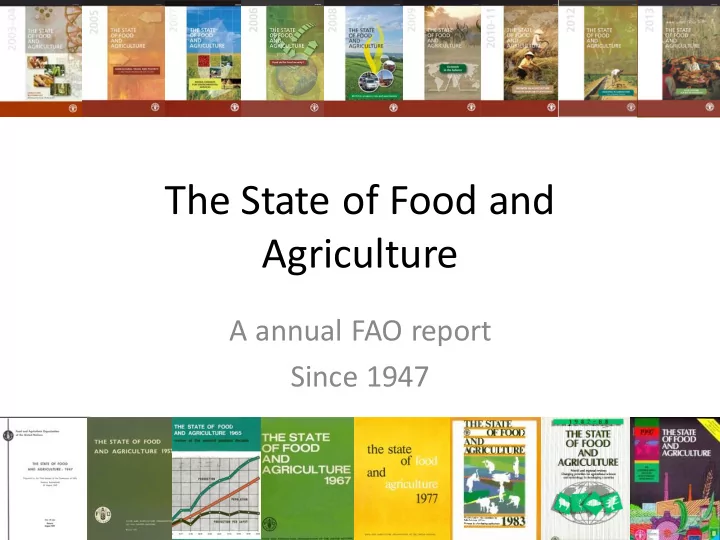
The State of Food and Agriculture A annual FAO report Since 1947 - - PowerPoint PPT Presentation
The State of Food and Agriculture A annual FAO report Since 1947 Characteristics of SOFA thematic reports Thematic focus Key audiences : Member governments FAO meetings; Media; Civil society; Researchers Characteristics :
Rural area Rural area City City Other countries The SOFA 2018 deals with migration flows from, to and between rural areas (blue arrows) It focuses on drivers and impacts in rural areas
Direction of domestic and international migration flows
International migrant stock at mid-year (both sexes) 1990 1995 2000 2005 2010 2015 WORLD 152 563 212 160 801 752 172 703 309 191 269 100 221 714 243 243 700 236 Developed regions 82 378 628 92 306 854 103 375 363 117 181 109 132 560 325 140 481 955 Developing regions 70 184 584 68 494 898 69 327 946 74 087 991 89 153 918 103 218 281 Africa 15 690 623 16 352 814 14 800 306 15 191 146 16 840 014 20 649 557 Sub-Saharan Africa 14 690 319 15 324 570 13 716 539 13 951 086 15 496 764 18 993 986 Asia 48 142 261 46 548 225 49 340 815 53 371 224 65 914 319 75 081 125 Europe 49 219 200 52 842 663 56 271 885 64 086 824 72 374 755 76 145 954 Latin America and the Caribbean 7 169 728 6 694 640 6 578 428 7 233 098 8 238 795 9 233 989 Northern America 27 610 542 33 341 147 40 351 848 45 363 387 51 220 996 54 488 725 Oceania 4 730 858 5 022 263 5 360 027 6 023 421 7 125 364 8 100 886 Region of destination Source: United Nations, Department of Economic and Social Affairs (2015). Trends in International Migrant Stock: The 2015 rev ision (United Nations database, POP/DB/MIG/Stock/Rev.2015).
50 100 150 200 250 300 1990 1995 2000 2005 2010 2015
Millions
International migrants in developed and developing regions
Developed regions Developing regions
Source: United Nations, Department of Economic and Social Affairs (2015). Trends in International Migrant Stock: The 2015 revision (United Nations database, POP/DB/MIG/Stock/Rev.2015).
0.0 2.0 4.0 6.0 8.0 10.0 12.0 1990 1995 2000 2005 2010 2015
Share of international migrants in the total population
WORLD Developed regions Developing regions
Source: United Nations, Department of Economic and Social Affairs (2015). Trends in International Migrant Stock: The 2015 revision (United Nations database, POP/DB/MIG/Stock/Rev.2015).
0.0 5.0 10.0 15.0 20.0 25.0 Sub-Saharan Africa Africa Asia Europe Eastern Europe Latin America and the Caribbean Northern America Oceania
Share of migrants in the total population in different regions in 1990, 1995, 2000, 2005, 2010 and 2015
1990 1995 2000 2005 2010 2015
Direction Millions Percent Developed to developed 58.4 24 Developed to developing 14.7 6 Developing to developed 80.1 33 Developing to developing 90.4 37 World 243.7 100 Stock of international migrants by origin and destination - 2015
Source: Authors’ calculations based on United Nations, Department of Economic and Social Affairs (2015). Trends in International Migrant Stock: The 2015 revision (United Nations database, POP/DB/MIG/Stock/Rev.2015).
Estimated refugee stock at mid-year (both sexes) 1990 1995 2000 2005 2010 2015 WORLD 18 836 571 17 853 840 15 827 803 13 276 733 15 370 755 19 577 474 Developed regions 2 014 564 3 609 670 2 997 256 2 361 229 2 046 917 1 954 224 Developing regions 16 822 007 14 244 170 12 830 547 10 915 504 13 323 838 17 623 250 Africa 5 687 352 5 949 953 3 609 138 2 750 644 2 413 917 4 022 363 Sub-Saharan Africa 5 516 042 5 747 830 3 421 165 2 555 099 2 215 890 3 638 433 Asia 9 937 007 7 937 682 9 175 210 8 109 615 10 532 033 13 214 240 Europe 1 321 884 2 746 090 2 283 959 1 760 748 1 586 396 1 478 315 Latin America and the Caribbean 1 197 198 352 256 44 088 47 186 375 771 384 005 Northern America 583 450 775 419 633 376 526 511 430 123 423 941 Oceania 109 680 92 440 82 032 82 029 32 515 54 610 Region of destination Source: United Nations, Department of Economic and Social Affairs (2015). Trends in International Migrant Stock: The 2015 revision (United Nations database, POP/DB/MIG/Stock/Rev.2015).
5 000 000 10 000 000 15 000 000 20 000 000 25 000 000 1990 1995 2000 2005 2010 2015
Stock of refugees in selected years from 1990 to 2015
Developed regions Developing regions
Source: United Nations, Department of Economic and Social Affairs (2015). Trends in International Migrant Stock: The 2015 revision (United Nations database, POP/DB/MIG/Stock/Rev.2015).
Refugees as a percentage of the international migrant stock 1990 1995 2000 2005 2010 2015 WORLD 12.3 11.1 9.2 6.9 6.9 8.0 Developed regions 2.4 3.9 2.9 2.0 1.5 1.4 Developing regions 24.0 20.8 18.5 14.7 14.9 17.1 Africa 36.2 36.4 24.4 18.1 14.3 19.5 Sub-Saharan Africa 37.5 37.5 24.9 18.3 14.3 19.2 Asia 20.6 17.1 18.6 15.2 16.0 17.6 Europe 2.7 5.2 4.1 2.7 2.2 1.9 Latin America and the Caribbean 16.7 5.3 0.7 0.7 4.6 4.2 Northern America 2.1 2.3 1.6 1.2 0.8 0.8 Oceania 2.3 1.8 1.5 1.4 0.5 0.7 Region of destination Source: United Nations, Department of Economic and Social Affairs (2015). Trends in International Migrant Stock: The 2015 revision (United Nations database, POP/DB/MIG/Stock/Rev.2015).
0.0 5.0 10.0 15.0 20.0 25.0 30.0 1990 1995 2000 2005 2010 2015
Share of refugees in total number of international migrants in the period 1990 – 2015 (percent)
WORLD Developed regions Developing regions
Source: United Nations, Department of Economic and Social Affairs (2015). Trends in International Migrant Stock: The 2015 revision (United Nations database, POP/DB/MIG/Stock/Rev.2015).
Region Five-year migration Lifetime migration Migrants Intensity Migrants Intensity (Millions) (Percent) (Millions) (Percent) Africa 39.7 4.6 113.5 12.5 Asia 109.8 2.9 282.1 7.2 Latin America and the Caribbean 21.9 4.1 100.2 18.0 Europe 34.8 5.0 166.0 22.7 North America 21.2 6.8 91.5 27.8 Oceania 1.8 5.7 9.3 Global 229.2 3.7 762.6 11.7
Source: Bell, Martin and Charles-Edwards, Elin. 2013. Cross-national comparisons of internal migration: An update on global patterns and trends. United Nations Department of Economic and Social Affairs. Population Division. Technical Paper No 2013/1. United Nations New York.
Global estimates of the number of internal migrants in 2005 – five-year and lifetime data
10 20 30 40 50 60 70 80 90 100 Albania 2005 Armenia 2013 Georgia 2013-2014 Cameroon 2014 Ghana 2012-2013 Mali 2014 Senegal 2011 Uganda 2013-2014 Cambodia 2009 India 2005 India 2012 Nicaragua 2014 Europe and Central Asia Sub Saharan Africa East and Sout h East Asia South Asia Centr al Amer ica
Share of households that have at least one migrant - internally or abroad - in selected countries: at national level
International migrant Internal migrant Source: Authors’ calculations based on Nicaragua Encuesta Nacional de Hogares sobre Mediciónde Nivelde Vida (EMNV), 2015; India, National Survey of Household Income and Expenditure (NSHIE), 2006 and 2013; Albania, Living Standards Measurement Survey, 2006; Armenian Integrated Living condition Survey, 2013; Cambodia Socio Economic Survey, 2013; Uganda National Panel Survey (UNPS), 2013-14; Mali, Enquête Agricole de Conjoncture Intégréeaux conditions de vie des ménages 2014 (EAC-I 2014); Senegal Household Survey, 2010; Cameroon, Household Consumption and Expenditures Surveys (HCES), 2014; Ghana Living Standards Survey 2012-2013.
5 10 15 20 25 30 35 40 Albania 2005 Armenia 2013 Cameroon 2014 Ghana 2012-2013 Mali 2014 Senegal 2011 Uganda 2013-2014 Cambodia 2009 India 2005 India 2012 Nicaragua 2014 Europe and Central Asia Sub Saharan Africa East and South East Asia South Asia Central Americ a
Share of households that have at least a migrant- internally or abroad- in selected developing countries in urban and rural areas
International migrant in Rural Areas Internal migrant in Rural Areas International migrant in Urban Areas Internal migrant in Urban Areas
Source: Authors’ calculations based on Nicaragua Encuesta Nacional de Hogares sobre Mediciónde Nivelde Vida (EMNV), 2015; India, National Survey of Household Income and Expenditure (NSHIE), 2006 and 2013; Albania, Living Standards Measurement Survey, 2006; Armenian Integrated Living condition Survey, 2013; Cambodia Socio Economic Survey, 2013; Uganda National Panel Survey (UNPS), 2013-14; Mali, Enquête Agricole de Conjoncture Intégréeaux conditions de vie des ménages 2014 (EAC-I 2014); Senegal Household Survey, 2010; Cameroon, Household Consumption and Expenditures Surveys (HCES), 2014; Ghana Living Standards Survey 2012-2013.
Source: Pandey, A.K., "Spatio-temporal changes in internal migration in India during post reform period". Journal
ALB ARG ARM AUS AUT AZE BEL BGR BIH BLR BLZ BMU BOL BRA BRB BRN BTN CAN CEB CHE CHL CHN CIV COL CRI CUB CYP CZE DEU DNK DOM DZA EAP EAS ECA ECS ECU EGY EMU ESP EST ETH EUU FIN FRA GBR GEO GMB GRC GTM HIC HND HRV HUN IBD IDN IRL IRN ISL ISR ITA JAM JPN KAZ KGZ KOR LAC LCA LCN LKA LTE LTU LUX LVA MAC MAR MDA MDG MDV MEA MEX MKD MLT MNA MNE MNG MUS MYS NAC NAM NLD NOR NZL OED PAN PER PHL POL PRT PRY PSE PST QAT ROU RUS RWA SAU SLV SRB SUR SVK SVN SWE SYC TEA TEC THA TLA TMN TTO TUN TUR TZA UGA UKR UMC URY USA VEN VNM WSM XKX ZAF ZMB ZWE
4 6 8 10 12 20 40 60 80 Share of Workforce in Agriculture
Correlation between GDP per capita and the Share of the Workforce in Agriculture, by country, 2015
Source: World Development Indicators (2016), adopted from background paper for The State of Food and Agriculture 2018 prepared by Alan De Brauw.
0% 10% 20% 30% 40% 50% 60% 70% 80% 90% 100% 1950 1960 1970 1980 1990 2000 2010 2020 2030 2040 2050 Central Asia ESA LAC NENA Southern Asia SSA North America Europe World
Evolution of urbanization as decline of shares of rural population in the world, by region
Source: UNDESA, 2017