THE STATE OF PSYCHOLOGY AT THE STATE OF PSYCHOLOGY AT THE STATE OF - - PowerPoint PPT Presentation

the state of psychology at the state of psychology at the
SMART_READER_LITE
LIVE PREVIEW

THE STATE OF PSYCHOLOGY AT THE STATE OF PSYCHOLOGY AT THE STATE OF - - PowerPoint PPT Presentation

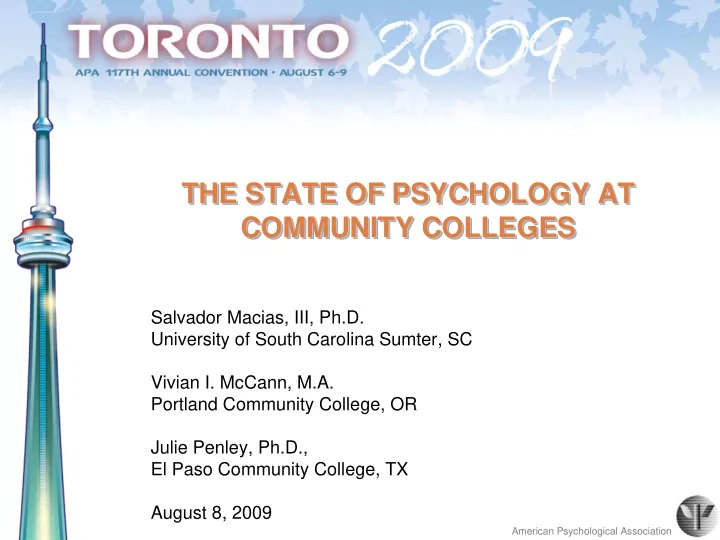
THE STATE OF PSYCHOLOGY AT THE STATE OF PSYCHOLOGY AT THE STATE OF PSYCHOLOGY AT COMMUNITY COLLEGES COMMUNITY COLLEGES COMMUNITY COLLEGES Salvador Macias, III, Ph.D. University of South Carolina Sumter, SC Vivian I. McCann, M.A. Portland


slide-1
SLIDE 1

American Psychological Association

THE STATE OF PSYCHOLOGY AT COMMUNITY COLLEGES THE STATE OF PSYCHOLOGY AT THE STATE OF PSYCHOLOGY AT COMMUNITY COLLEGES COMMUNITY COLLEGES

Salvador Macias, III, Ph.D. University of South Carolina Sumter, SC Vivian I. McCann, M.A. Portland Community College, OR Julie Penley, Ph.D., El Paso Community College, TX August 8, 2009

slide-2
SLIDE 2

American Psychological Association

Acknowledgements:

PT@CC Committee Members: Wynn Call, Ph.D., Mesa Community College, AZ (2008-10) Susan M. Franz, M.A., Highline Community College, WA (2009-11) Vince Granito, Ph.D. (Chair, 2008) Loraine County Community College, OH (2006-08) Salvador Macias, III, Ph.D. (Chair, 2009) University of South Carolina Sumter, SC (2007-09) Vivian I. McCann, M.A. Portland Community College, OR (2006-08) Julie Penley, Ph.D., El Paso Community College, TX (2008-10) Nancy Schaab, Ph.D. Delta College, MI (2007-09) Larry Venuck, Ph.d., Naugatuck Valley Community College, CT (2009-11) APA Staff: Martha Boenau Robin Hailstorkes, Ph.D. Jewell Beamon PT@CC Survey Sponsored in part by a Grant from APA

slide-3
SLIDE 3

American Psychological Association

Abstract

In 2007-2008 APA’s Committee for PT@CC conducted a survey

  • f community college faculty in the US. We utilized electronic

listserves, addresses provided by the American Association of Community Colleges, APA’s data base, etc., to secure as wide a potential data pool as possible. Our survey sought information about faculty status (full time, adjunct status, other employment), educational level,demographics, work load (courses per term, campus and community service), courses taught, professional activity, teaching “style” (distance education, service-learning, learning communities, technology used), etc. We received over 1,800 responses representing over 600 community colleges. This presentation is a summary of these findings.

slide-4
SLIDE 4

American Psychological Association

1,800 Responses to Survey

600 Colleges Represented 2500 Community Colleges in US

PT@CC Survey of Community College Faculty PT@CC Survey of Community College Faculty

slide-5
SLIDE 5

American Psychological Association

Gender Distribution

slide-6
SLIDE 6

American Psychological Association

Ethnicity/Racial Distribution

slide-7
SLIDE 7

American Psychological Association

Education Level

slide-8
SLIDE 8

American Psychological Association

Primary and Secondary Employment

slide-9
SLIDE 9

American Psychological Association

Teaching Experience

(Full time, years)

slide-10
SLIDE 10

American Psychological Association

Teaching “Facts”

  • 56% Teach 13 or more hours/week
  • 67% Classes with 20-40 students
  • 50% Teach distance courses
  • 36% Service learning
  • 25% Learning Communities
slide-11
SLIDE 11

American Psychological Association

Course Variability

  • 91% Introductory
  • 66% Developmental
  • 36% Abnormal
  • 20% Social
  • 15% Personality
  • 15% Human Sexuality
  • 14% Human Relations
  • 13% Educational
  • 11% Research Methods
slide-12
SLIDE 12

American Psychological Association

Professional Memberships

slide-13
SLIDE 13

American Psychological Association

Professional Activity

  • 90% Attend Professional Conferences
  • 43% Present at Conferences
  • 27% Research
  • 42% Professional Writing
slide-14
SLIDE 14

American Psychological Association

Community/Volunteer Involvement

  • 36% Community Presentations
  • 33% Public Schools
  • 31% Faith Based Organizations
  • 27% Special Populations
  • 22% Children/Youth Groups
  • 21% Boards of Directors
  • 9% Elderly/Hospice
slide-15
SLIDE 15

American Psychological Association

Community College Faculty Are:

  • Mostly White,
  • Mostly Female,
  • Relatively Young,
  • Teach a number of different psychology classes

A fair number of them per term In a wide variety of ways With a variety of technologies To relatively small number of students

  • Are very active professionally
  • Are very active in their communities
slide-16
SLIDE 16

American Psychological Association

Thank You

Salvador Macias, III, Ph.D. University of South Carolina Sumter, SC smacias@uscsumter.edu