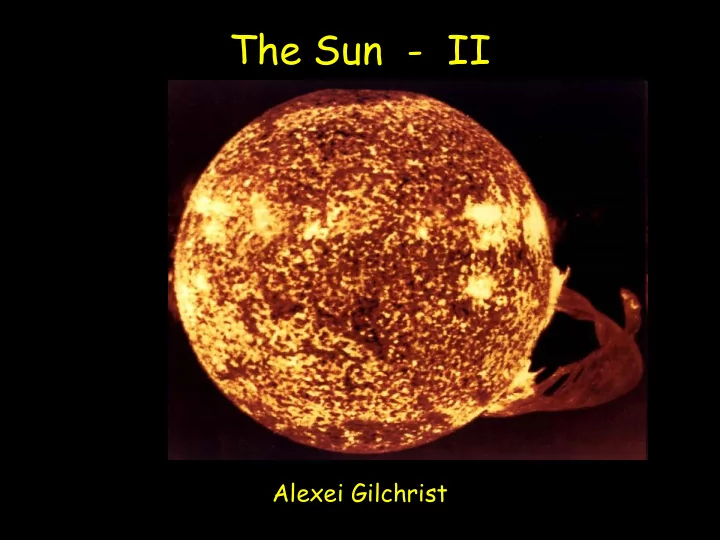
SLIDE 1
The Sun - II
Alexei Gilchrist
SLIDE 2 Some resources
- http://www.nineplanets.org/sol.html
- “The Universe: Secrets of the Sun” video
– Search on youtube
(references are to clips here http://www.youtube.com/view_play_list?p=4EEF5255D3EEF425 parts 1-5)
- Chp 14 of Voyages (references and links at end)
- References noted in these slides
Secrets of the Sun
SLIDE 3 Why does the sun shine?
Long and fascinating history involving
- geology
- evolution
- meteors
- E = mc2
- quantum mechanics
- particle physics
- two Nobel prizes
http://nobelprize.org/nobel_prizes/physics/articles/fusion/index.html http://www.cerritos.edu/ladkins/a106/sunshine.htm http://nobelprize.org/nobel_prizes/physics/articles/bahcall/ More detail:
SLIDE 4 How much energy does the sun put out?
Imagine an ice cube in the sun during summer ... takes about 30min to melt say That ice cube could be anywhere in a sphere with radius 150,000,000 km around the sun ... If you put all those ice cubes out there at same time – a shell 1cm thick and surrounding the sun it would all melt in about 30 min 1 calorie (=4.2 J) -> 1g water by 1 degree oC = 6.3 x10²
6 W
SLIDE 5
How much do we produce?
recommended daily dietary intake ~ 2000 Calories (food Calorie = 1000 calories) NB most of the energy we consume goes in heat
SLIDE 6 Age of the sun?
http://en.wikipedia.org/wiki/Image:KentGeologyWealdenDomeSimple.svg
In 1859 Charles Darwin estimated it at 300 million years based on the erosion of the Weald in south England (time enough for evolution to occur)
First edition of The Origin
Selection
SLIDE 7
Problem ... no fuel source known
Chemical?
The sun would burn out in only 3,000 years No source known that would supply that much energy
SLIDE 8 Problem ... no fuel source known
That some form of the meteoric theory is certainly the true and complete explanation of solar heat can scarcely be doubted, when the following reasons are considered: (1) No other natural explanation, except by chemical action, can be conceived. (2) The chemical theory is quite insufficient, because the most energetic chemical action we know, taking place between substances amounting to the whole sun's mass, would only generate about 3,000 years’ heat. (3) There is no difficulty in accounting for 20,000,000 years’ heat by the meteoric theory. ... What then are we to think of such geological estimates as [Darwin's] 300,000,000 years for the “denudation of the Weald”?
Meteoric impact?
Initially favored by Lord Kelvin
http://nobelprize.org/nobel_prizes/physics/articles/fusion/index.html
but a huge number should be hitting earth too ...
SLIDE 9 Problem ... no fuel source known
Gravitational Contraction?
Helmoltz & Kelvin Sun shrinking ~ 7inches / day 7000 miles in 10,000 years (recorded history) not noticeable at that time Estimated age of the sun at 18 million years (Not enough for evolution) Darwin removes mention of timescales in later editions
- f The Origin of The Species by Natural Selection
SLIDE 10 Fission
1896 Radioactivity discovered (Henri Becquerel)
http://fds.oup.com/www.oup.co.uk/images/oxed/children/yoes/atoms/fission.jpg
Heavy unstable nuclei split apart release of energy The discovery of the radio-active elements, which in their disintegration liberate enormous amounts of energy, thus increases the possible limit of the duration of life on this planet, and allows the time claimed by the geologist and biologist for the process of evolution. Rutherford, 1904 Problem – requires massive unstable elements ... inconsistent with sun’s density and composition
SLIDE 11 Fusion
1905 Albert Einstein: E = mc2
Difference in weight is released as energy ... a lot of energy Sun is mostly Hydrogen Fusion will form Helium Lots of energy released weight He < weight 2p +2n (Aston 1920 looking for isotopes of Neon)
Nucleus 2 protons 2 neutrons
SLIDE 12 but like charges repel...
protons will repel each other as they both have +ve charge Is the sun hot enough so that they slam into each and get close enough for fusion to occur? Eddington 1925: Sun not collapsing – hydrostatic equilibrium (pressure in = pressure out) for a gas (pressure) = (density) (temperature) working from surface down estimated core
Not hot enough!
SLIDE 13 Quantum again
Since matter has wave-like behaviour we can get “quantum mechanical tunneling” Even though the protons don’t have enough energy to fuse they can sort of leak into each other and fuse some of the time
http://hyperphysics.phy-astr.gsu.edu/Hbase/quantum/barr.html#c1
SLIDE 14
p-p cycle
Hans Bethe received the 1967 Nobel Prize in Physics
"for his contributions to the theory of nuclear reactions, especially his discoveries concerning the energy production in stars"
SLIDE 15
The p-p cycle
SLIDE 16
neutrinos
SLIDE 17 neutrinos
Hard to detect probability of hitting something in earth is < 1/1,000,000,000,000 100,000,000,000 pass through your thumbnail every second could travel through 100 light years of iron without hitting anything
Detection:
first:
- 100,000 gallons of cleaning
fluid (perchloroethylene)
- Occasional collision with
chlorine -> Argon
- Detect the Argon
- expect only a few atoms / week
e.g. super-Kamiokande:
- 50,000 tons of ultra pure water
- 11,000 tv-sized detectors
- detect flashes of light from a
neutrino collision
SLIDE 18 super-Kamiokande
http://www.oobject.com/ghost-particle-detectors/super-kamiokande/2172/
SLIDE 19 “solar neutrino problem”
"for pioneering contributions to astrophysics, in particular for the detection of cosmic neutrinos" Raymond Davis, Jr. & Masatoshi Koshiba, 2002 Nobel Prize in Phyics Required a modification of our basic understanding of particle physics
- neutrinos have mass
- can oscillate between other types
(electron neutrino, muon neutrino, tau neutrino)
- Only electron neutrino detected initially
Sudbury Neutrino Observatory too few neutrinos detected (factor of three) Energy correct; T of sun verified independently; rate depends on T2
5 ! x3 is particularly good
SLIDE 20
Secrets of the Sun (nuclear fusion) (1) 1:14 (5min)
SLIDE 21 http://www.lmsal.com/YPOP/Spotlight/Tour/tour07.html
Solar Cycle
- Solar activity goes on an 11 year cycle
- last maximum in 2001
http://www.lmsal.com/YPOP/Classroom/Lessons/Cycles/Images/butterfly.gif
SLIDE 22 http://www.lmsal.com/YPOP/Spotlight/Tour/images/cycle2.jpeg
SLIDE 23 http://www.nso.edu/gifs/minmax.gif
SLIDE 24
Secrets of the Sun (solar cycle) (4) 4:40 (2min)
SLIDE 25 Magnetic environment
- Can measure this through the Zeeman effect
- Suns activity is driven by magnetism (originating in movement
- f charged gasses)
Strong magnetic fields split the quantum energy levels and this can be seen in the spectra Sunspots are regions of strong magnetic fields
SLIDE 26 Magnetic Environment
- coronal loops align with magnetic field lines
http://stargazers.gsfc.nasa.gov/students/magnetism.htm
http://www.space.com/scienceastronomy/solarsystem/trace_update_000926.html
SLIDE 27 Magnetic Environment
- Suns magnetic field is enormously complex – the differential
rotation twists the field lines (~ million poles)
SLIDE 28 Prominences...
- usually originate near sunspots
(release of energy from twisted magnetic field lines)
- relatively cool: 60,000 K
- loops can remain stable for
hours or days
- eruptions faster 1,300 km/s
& heights of a million km
Plages...
bright clouds:
Sunspots ...
SLIDE 29
SLIDE 30 Solar flares
- Violent eruptions (some of the largest explosions in solar system)
a billion Mt of TNT
- usually 5-10 minutes (largest several hours)
- near solar maximum: several smaller flares a day; a large flare
every few weeks
- 10 million K ; lots of UV and X-rays
- can cause solar quakes
- can emit large amount of coronal material
e.g equivalent to mount everest (coronal mass ejections or CMEs) A solar quake from a flare
- bubble of 10s of millions of tons
gas blown into space
- can reach earch in a few days
- can change the orbits of
satellites
- distorts earths magnetic field
- disrupts communication satellites
SLIDE 31
Secrets of the Sun (magnetics; coronal loops; sun spots; solar flares; sun quakes; coronal mass ejections) (2) 2:50 – (3) 1:38 (11min)
SLIDE 32 Solar wind
- Discovered by observing comets tails
- stream of charged particles
- coronal gases are so hot particles can escape suns gravity
- 400km/s outward
- sun losing 10 million tons / year
- bright regions of corona – gases trapped by magnetic fields
- dark regions – magnetic field extends outwards
- solar wind predominantly from these “holes”
SLIDE 33 Effect on Earth - auroras
- interaction of solar wind with earths magnetic field
- complex!
http://science.nasa.gov/spaceweather/aurora/gallery_12oct01.html http://science.nasa.gov/spaceweather/aurora/gallery_12oct01.html aurora_img_2005254_sm
SLIDE 34 Effect on Earth - auroras
http://en.wikipedia.org/wiki/Aurora_(astronomy)
SLIDE 35 Effect on Earth - auroras
http://en.wikipedia.org/wiki/Aurora_(astronomy)
SLIDE 36 Effect on Earth - climate
- “little ice age” in europe during maunder minimum
(Thames froze at least 11 times) Why? Solar luminance change too small Recent model: UV changes 10x – 100x bigger More ozone produced Absorbs sunlight Warms stratosphere changes wind patterns transfer of heat around earth
SLIDE 37 Effect on Earth – 1
4C production
http://en.wikipedia.org/wiki/Image:Carbon14_with_activity_labels.svg http://en.wikipedia.org/wiki/Image:Carbon14-sunspot.svg
more longer term records
SLIDE 38
Effect on Earth – solar storms
Secrets of the Sun (CME; solar storms; effect on technology; auroras) (3) 1:38 – 9:55 (4) 0:00 – 4:42 (~13min)