the test case in turn, and training with the 1 2 D ( h , h - - PDF document

the test case in turn and training with the 1 2 d h h 1 2
SMART_READER_LITE
LIVE PREVIEW

the test case in turn, and training with the 1 2 D ( h , h - - PDF document

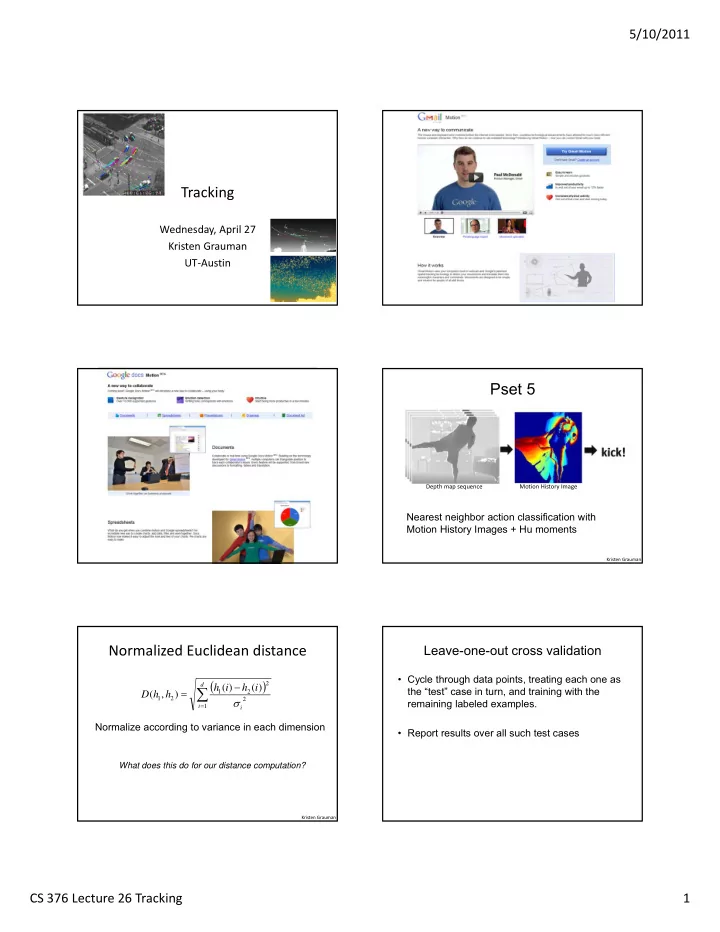
5/10/2011 Tracking Wednesday, April 27 Kristen Grauman UT Austin Pset 5 Depth map sequence Motion History Image Nearest neighbor action classification with Motion History Images + Hu moments Kristen Grauman Normalized Euclidean distance


slide-1
SLIDE 1

5/10/2011 CS 376 Lecture 26 Tracking 1

Tracking

Wednesday, April 27 Kristen Grauman UT‐Austin

Pset 5

Nearest neighbor action classification with Motion History Images + Hu moments

Depth map sequence Motion History Image

Kristen Grauman

Normalized Euclidean distance

 

 

d i i

i h i h h h D

1 2 2 2 1 2 1

) ( ) ( ) , ( 

Normalize according to variance in each dimension

What does this do for our distance computation?

Kristen Grauman

Leave-one-out cross validation

  • Cycle through data points, treating each one as

the “test” case in turn, and training with the remaining labeled examples.

  • Report results over all such test cases
slide-2
SLIDE 2

5/10/2011 CS 376 Lecture 26 Tracking 2

Outline

  • Today: Tracking

– Tracking as inference – Linear models of dynamics – Kalman filters – General challenges in tracking

Tracking: some applications

Body pose tracking, activity recognition Surveillance Video-based interfaces Medical apps Censusing a bat population

Kristen Grauman

Why is tracking challenging?

Optical flow for tracking?

If we have more than just a pair of frames, we could compute flow from one to the next: But flow only reliable for small motions, and we may have

  • cclusions, textureless regions that yield bad estimates

anyway…

… …

Motion estimation techniques

  • Direct methods
  • Directly recover image motion at each pixel from spatio-temporal

image brightness variations

  • Dense motion fields, but sensitive to appearance variations
  • Suitable for video and when image motion is small
  • Feature-based methods
  • Extract visual features (corners, textured areas) and track them
  • ver multiple frames
  • Sparse motion fields, but more robust tracking
  • Suitable when image motion is large (10s of pixels)

Feature-based matching for motion

Interesting point Best matching neighborhood Time t Time t+1 Search window Search window is centered at the point where we last saw the feature, in image I1. Best match = position where we have the highest normalized cross-correlation value.

Kristen Grauman

slide-3
SLIDE 3

5/10/2011 CS 376 Lecture 26 Tracking 3

Example: A Camera Mouse

Video interface: use feature tracking as mouse replacement

  • User clicks on the feature to

be tracked

  • Take the 15x15 pixel square
  • f the feature
  • In the next image do a

search to find the 15x15 region with the highest correlation

  • Move the mouse pointer

accordingly

  • Repeat in the background

every 1/30th of a second

James Gips and Margrit Betke http://www.bc.edu/schools/csom/eagleeyes/

Kristen Grauman

Example: A Camera Mouse

Specialized software for communication, games

James Gips and Margrit Betke http://www.bc.edu/schools/csom/eagleeyes/

Kristen Grauman

A Camera Mouse

Specialized software for communication, games

James Gips and Margrit Betke http://www.bc.edu/schools/csom/eagleeyes/

Kristen Grauman

Feature-based matching for motion

  • For a discrete matching search, what are the

tradeoffs of the chosen search window size?

  • Which patches to track?
  • Select interest points – e.g. corners
  • Where should the search window be placed?
  • Near match at previous frame
  • More generally, taking into account the expected

dynamics of the object

Kristen Grauman

Detection vs. tracking

t=1 t=2 t=20 t=21

Kristen Grauman

Detection vs. tracking

… Detection: We detect the object independently in each frame and can record its position over time, e.g., based on blob’s centroid or detection window coordinates

Kristen Grauman

slide-4
SLIDE 4

5/10/2011 CS 376 Lecture 26 Tracking 4

Detection vs. tracking

… Tracking with dynamics: We use image measurements to estimate position of object, but also incorporate position predicted by dynamics, i.e., our expectation of object’s motion pattern.

Kristen Grauman

Detection vs. tracking

… Tracking with dynamics: We use image measurements to estimate position of object, but also incorporate position predicted by dynamics, i.e., our expectation of object’s motion pattern.

Kristen Grauman

Tracking with dynamics

  • Use model of expected motion to predict where
  • bjects will occur in next frame, even before seeing

the image.

  • Intent:

– Do less work looking for the object, restrict the search. – Get improved estimates since measurement noise is tempered by smoothness, dynamics priors.

  • Assumption: continuous motion patterns:

– Camera is not moving instantly to new viewpoint – Objects do not disappear and reappear in different places in the scene – Gradual change in pose between camera and scene

Kristen Grauman

Tracking as inference

  • The hidden state consists of the true parameters

we care about, denoted X.

  • The measurement is our noisy observation that

results from the underlying state, denoted Y.

  • At each time step, state changes (from Xt-1 to Xt )

and we get a new observation Yt.

Kristen Grauman

State vs. observation

Hidden state : parameters of interest Measurement : what we get to directly observe

Kristen Grauman

Tracking as inference

  • The hidden state consists of the true parameters

we care about, denoted X.

  • The measurement is our noisy observation that

results from the underlying state, denoted Y.

  • At each time step, state changes (from Xt-1 to Xt )

and we get a new observation Yt.

  • Our goal: recover most likely state Xt given

– All observations seen so far. – Knowledge about dynamics of state transitions.

Kristen Grauman

slide-5
SLIDE 5

5/10/2011 CS 376 Lecture 26 Tracking 5

Time t Time t+1

Tracking as inference: intuition

Belief Measurement Corrected prediction

Kristen Grauman

  • ld belief

measurement Belief: prediction Corrected prediction Belief: prediction

Tracking as inference: intuition

Time t Time t+1

Kristen Grauman

Independence assumptions

  • Only immediate past state influences current state
  • Measurement at time t depends on current state

dynamics model

  • bservation model

   

1 1

, ,

 

t t t t

X X P X X X P 

   

t t t t t t

X Y P X Y X Y X Y P 

 

, , , ,

1 1

Kristen Grauman

  • Prediction:

– Given the measurements we have seen up to this point, what state should we predict?

  • Correction:

– Now given the current measurement, what state should we predict?

Tracking as inference

 

1

, ,

 t t

y y X P 

 

t t

y y X P , ,

0 

Kristen Grauman

Questions

  • How to represent the known dynamics that govern the

changes in the states?

  • How to represent relationship between state and

measurements, plus our uncertainty in the measurements?

  • How to compute each cycle of updates?

Representation: We’ll consider the class of linear dynamic models, with associated Gaussian pdfs. Updates: via the Kalman filter.

Kristen Grauman

Notation reminder

  • Random variable with Gaussian probability

distribution that has the mean vector μ and covariance matrix Σ.

  • x and μ are d-dimensional, Σ is d x d.

) , ( ~ Σ μ x N

d=2 d=1

If x is 1-d, we just have one Σ parameter -  the variance: σ2

Kristen Grauman

slide-6
SLIDE 6

5/10/2011 CS 376 Lecture 26 Tracking 6

Linear dynamic model

  • Describe the a priori knowledge about

– System dynamics model: represents evolution

  • f state over time.

– Measurement model: at every time step we get a noisy measurement of the state.

) ; ( ~

1 d t t

N Σ Dx x

) ; ( ~

m t t

N Σ Mx y

n x n n x 1 n x 1 m x n n x 1 m x 1

Kristen Grauman

Example: randomly drifting points

  • Consider a stationary object, with state as position
  • Position is constant, only motion due to random

noise term.

  • State evolution is described by identity matrix D=I

) ; ( ~

1 d t t

N Σ Dx x

Example: Constant velocity (1D points)

time

measurements states

1 d position 1 d position

Kristen Grauman

  • State vector: position p and velocity v
  • Measurement is position only

Example: Constant velocity (1D points)

       

   1 1 1

) (

t t t t t

v v v t p p       

t t t

v p x noise v p t noise x D x

t t t t t

                

   1 1 1

1 1

 

noise v p noise Mx y

t t t t

          1 ) ; ( ~

1 d t t

N Σ Dx x

) ; ( ~

m t t

N Σ Mx y

Kristen Grauman

Questions

  • How to represent the known dynamics that govern the

changes in the states?

  • How to represent relationship between state and

measurements, plus our uncertainty in the measurements?

  • How to compute each cycle of updates?

Representation: We’ll consider the class of linear dynamic models, with associated Gaussian pdfs. Updates: via the Kalman filter.

Kristen Grauman

The Kalman filter

  • Method for tracking linear dynamical models in

Gaussian noise

  • The predicted/corrected state distributions are

Gaussian

– Only need to maintain the mean and covariance – The calculations are easy

Kristen Grauman

slide-7
SLIDE 7

5/10/2011 CS 376 Lecture 26 Tracking 7

Kalman filter

Know prediction of state, and next measurement  Update distribution over current state. Know corrected state from previous time step, and all measurements up to the current one  Predict distribution over next state. Time advances: t++

Time update (“Predict”) Measurement update (“Correct”)

Receive measurement

 

1

, ,

 t t

y y X P 

  t t 

 ,

Mean and std. dev.

  • f predicted state:

 

t t

y y X P , ,

0 

  t t 

 ,

Mean and std. dev.

  • f corrected state:

Kristen Grauman

1D Kalman filter: Prediction

  • Have linear dynamic model defining predicted state

evolution, with noise

  • Want to estimate predicted distribution for next state
  • Update the mean:
  • Update the variance:

    1 t t

d 

   

2 1

) ( , , ,

  

t t t t

N y y X P   

 

2 1,

~

d t t

dx N X 

2 1 2 2

) ( ) (

  

 

t d t

d  

Lana Lazebnik

1D Kalman filter: Correction

  • Have linear model defining the mapping of state

to measurements:

  • Want to estimate corrected distribution given

latest meas.:

  • Update the mean:
  • Update the variance:

 

2

, ~

m t t

mx N Y 

   

2

) ( , , ,

 

t t t t

N y y X P   

2 2 2 2 2

) ( ) (

   

  

t m t t m t t

m my      

2 2 2 2 2 2

) ( ) ( ) (

  

 

t m t m t

m     

Lana Lazebnik

Prediction vs. correction

  • What if there is no prediction uncertainty
  • What if there is no measurement uncertainty

   t t

  ) (

2   t

2 2 2 2 2

) ( ) (

   

  

t m t t m t t

m my      

2 2 2 2 2 2

) ( ) ( ) (

  

 

t m t m t

m     

? ) ( 

m

 ? ) ( 

 t

m yt

t  

 ) (

2   t

The measurement is ignored! The prediction is ignored!

Lana Lazebnik

Kalman filter processing time

  • state

x measurement * predicted mean estimate + corrected mean estimate bars: variance estimates before and after measurements

Constant velocity model

position Time t Time t+1

Kristen Grauman

Kalman filter processing time

  • state

x measurement * predicted mean estimate + corrected mean estimate bars: variance estimates before and after measurements

Constant velocity model

position Time t Time t+1

Kristen Grauman

slide-8
SLIDE 8

5/10/2011 CS 376 Lecture 26 Tracking 8

Kalman filter processing time

  • state

x measurement * predicted mean estimate + corrected mean estimate bars: variance estimates before and after measurements

Constant velocity model

position Time t Time t+1

Kristen Grauman

Kalman filter processing time

  • state

x measurement * predicted mean estimate + corrected mean estimate bars: variance estimates before and after measurements

Constant velocity model

position Time t Time t+1

Kristen Grauman

  • http://www.cs.bu.edu/~betke/research/bats/

Kristen Grauman

A bat census

http://www.cs.bu.edu/~betke/research/bats/

Kristen Grauman

Video synopsis

  • http://www.vision.huji.ac.il/video-synopsis/

Kristen Grauman

Tracking: issues

  • Initialization

– Often done manually – Background subtraction, detection can also be used

  • Data association, multiple tracked objects

– Occlusions, clutter

slide-9
SLIDE 9

5/10/2011 CS 376 Lecture 26 Tracking 9

Tracking: issues

  • Initialization

– Often done manually – Background subtraction, detection can also be used

  • Data association, multiple tracked objects

– Occlusions, clutter – Which measurements go with which tracks?

Tracking: issues

  • Initialization

– Often done manually – Background subtraction, detection can also be used

  • Data association, multiple tracked objects

– Occlusions, clutter

  • Deformable and articulated objects

Recall: tracking via deformable contours

  • 1. Use final contour/model extracted at frame t as

an initial solution for frame t+1

  • 2. Evolve initial contour to fit exact object boundary

at frame t+1

  • 3. Repeat, initializing with most recent frame.

Visual Dynamics Group, Dept. Engineering Science, University of Oxford.

Tracking: issues

  • Initialization

– Often done manually – Background subtraction, detection can also be used

  • Data association, multiple tracked objects

– Occlusions, clutter

  • Deformable and articulated objects
  • Constructing accurate models of dynamics

– E.g., Fitting parameters for a linear dynamics model

  • Drift

– Accumulation of errors over time

Drift

  • D. Ramanan, D. Forsyth, and A. Zisserman. Tracking People by Learning their
  • Appearance. PAMI 2007.

Summary

  • Tracking as inference

– Goal: estimate posterior of object position given measurement

  • Linear models of dynamics

– Represent state evolution and measurement models

  • Kalman filters

– Recursive prediction/correction updates to refine measurement

  • General tracking challenges