The Three Categories of Rules of Validity Terminological - - PDF document

the three categories of rules of validity
SMART_READER_LITE
LIVE PREVIEW

The Three Categories of Rules of Validity Terminological - - PDF document

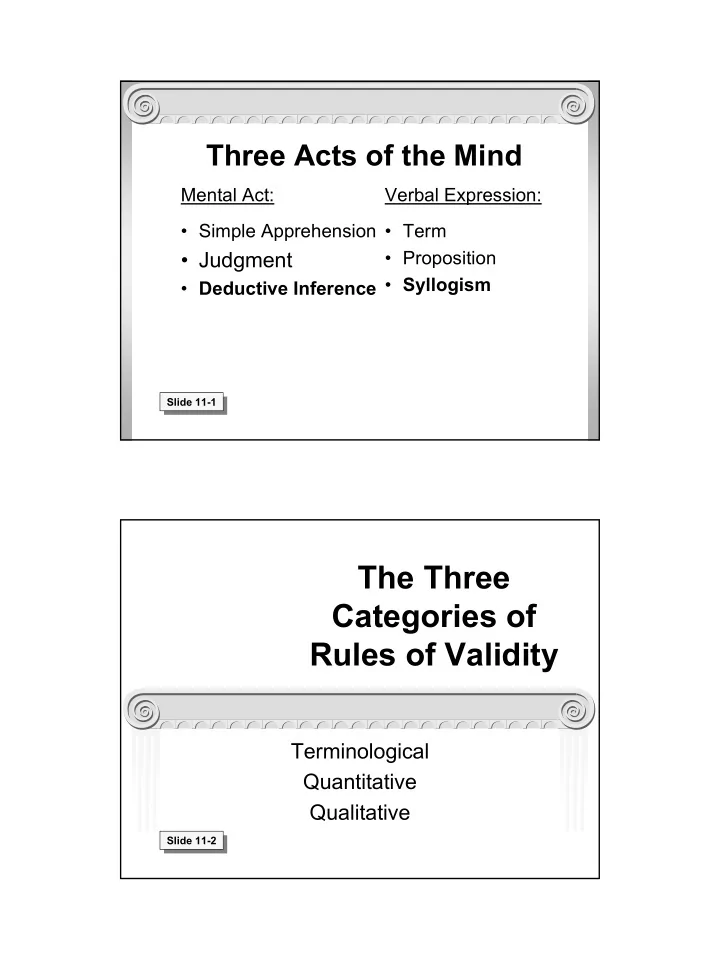
Three Acts of the Mind Mental Act: Verbal Expression: Simple Apprehension Term Proposition Judgment Syllogism Deductive Inference Slide 11-1 The Three Categories of Rules of Validity Terminological Quantitative


slide-1
SLIDE 1

1

Three Acts of the Mind

  • Simple Apprehension
  • Judgment
  • Deductive Inference
  • Term
  • Proposition
  • Syllogism

Mental Act: Verbal Expression:

Slide 11-1

The Three Categories of Rules of Validity

Terminological Quantitative Qualitative

Slide 11-2

slide-2
SLIDE 2

2

Terminological Rules of Validity

I.

There must be three and only three terms. II. The Middle Term must not occur in the conclusion.

Slide 11-3

Quantitative Rules of Validity

III. If a term is distributed in the conclusion, then it must be distributed in the premises. VI. The middle term must be distributed at least once.

Slide 11-4

slide-3
SLIDE 3

3

Qualitative Rules of Validity

  • V. No conclusion can follow from

two negative premises.

  • VI. If the two premises are

affirmative, the conclusion must also be affirmative.

  • VII. If either premise is negative,

the conclusion must be negative.

Slide 11-5

Terminological Rules of Validity

I.

There must be three and only three terms.

II.

The Middle Term must not occur in the conclusion

Slide 11-3

slide-4
SLIDE 4

4

Terminological Rules

Rules I and II are terminological rules because they have specifically to do with the terms in the syllogism.

Slide 11-6

Rule I: There must be three and only three terms

A syllogism must have three terms a major, minor and middle term. Each one will appear twice in the syllogism.

Slide 11-7

slide-5
SLIDE 5

5

The Fallacy of Four Terms

The Fallacy of Four Terms occurs when there are more than three clearly distinguishable terms.

Slide 11-8

The Fallacy of Four Terms

All mammals have hair All horses have manes Therefore, some horses have hair

Slide 11-9

slide-6
SLIDE 6

6

The fallacy fixed

All mammals have hair All horses are mammals Therefore, some horses have hair

Slide 11-10

The Fallacy of Equivocation

The Fallacy of Equivocation occurs when there is an ambiguous middle term. It also results in more than three terms, but the additional term usually looks the same as one of the other terms.

Slide 11-11

slide-7
SLIDE 7

7

The Fallacy of Equivocation

All planes are two-dimensional All 747s are planes Therefore, all 747s are two-dimensional

Slide 11-12 Slide 11-13

The Fallacy of Equivocation

All planes are two-dimensional All 747s are planes Therefore, all 747s are two-dimensional

slide-8
SLIDE 8

8

The Fallacy of Equivocation

(Example II)

Mortal is not a three-letter word Man is a three-letter word Therefore, no man is mortal

Slide 11-14

Terminological Rules of Validity

I.

There must be three and only three terms.

II.

The Middle Term must be distributed at least once.

Slide 11-15

slide-9
SLIDE 9

9

Rule II: The middle term must not occur in the conclusion

All plants are living things All animals are living things

Therefore, all living things are plants or animals

Slide 11-16

Terminological Rules of Validity

I.

There must be three and only three terms.

  • 1. The Fallacy of Four Terms
  • 2. The Fallacy of Equivocation
  • II. The Middle Term must be

distributed at least once.

Slide 11-17