The three faces of 6.081 Coping with complexity in software design - - PDF document

the three faces of 6 081
SMART_READER_LITE
LIVE PREVIEW

The three faces of 6.081 Coping with complexity in software design - - PDF document

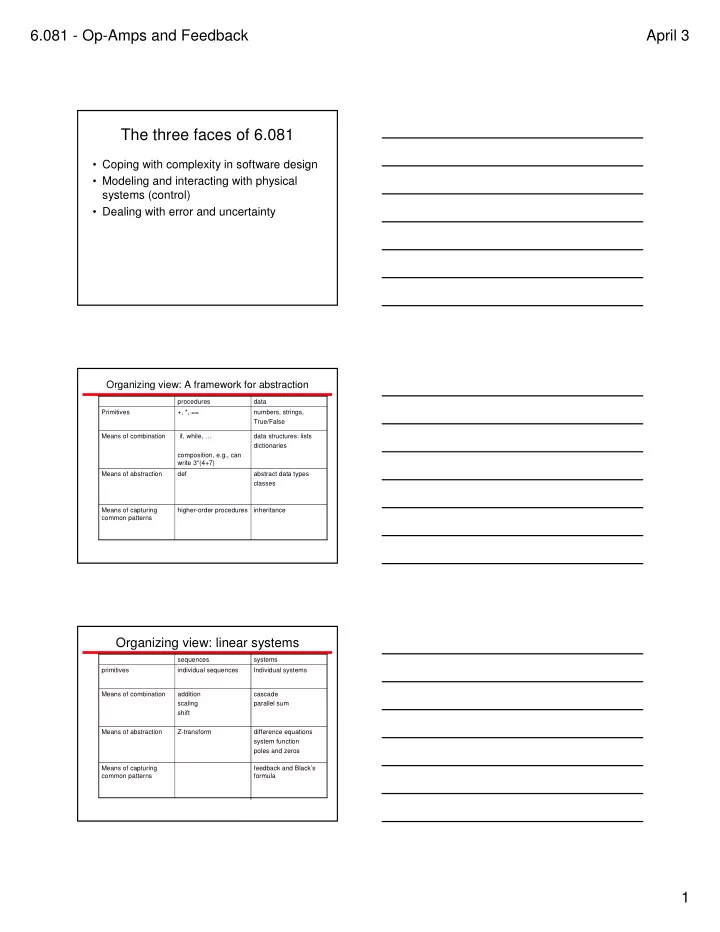
6.081 - Op-Amps and Feedback April 3 The three faces of 6.081 Coping with complexity in software design Modeling and interacting with physical systems (control) Dealing with error and uncertainty Organizing view: A framework for


slide-1
SLIDE 1

6.081 - Op-Amps and Feedback April 3 1

The three faces of 6.081

  • Coping with complexity in software design
  • Modeling and interacting with physical

systems (control)

  • Dealing with error and uncertainty

CIC Report on EECS1 & 2

inheritance abstract data types classes data structures: lists dictionaries numbers, strings, True/False data procedures higher-order procedures Means of capturing common patterns def Means of abstraction if, while, … composition, e.g., can write 3*(4+7) Means of combination +, *, == Primitives

Organizing view: A framework for abstraction

CIC Report on EECS1 & 2

feedback and Black’s formula difference equations system function poles and zeros cascade parallel sum Individual systems systems sequences Means of capturing common patterns Z-transform Means of abstraction addition scaling shift Means of combination individual sequences primitives

Organizing view: linear systems

slide-2
SLIDE 2

6.081 - Op-Amps and Feedback April 3 2

CIC Report on EECS1 & 2

Means of capturing common patterns Means of abstraction Means of combination primitives

Organizing view: circuits

2 1 3

R R R + =

2 1 3

1 1 1 R R R + =

Series combination Parallel combination

slide-3
SLIDE 3

6.081 - Op-Amps and Feedback April 3 3

Ideal independent voltage source Dependent voltage source 2-terminal devices

slide-4
SLIDE 4

6.081 - Op-Amps and Feedback April 3 4

CIC Report on EECS1 & 2

Means of capturing common patterns Means of abstraction

??

Means of combination resistors, sources, … primitives

Organizing view: circuits

CIC Report on EECS1 & 2

Means of capturing common patterns Means of abstraction wire things together at nodes Means of combination resistors, sources, … primitives

Organizing view: circuits

slide-5
SLIDE 5

6.081 - Op-Amps and Feedback April 3 5

  • Nodal analysis

– Constitutive relations

  • one for each element

– Conservation Law (Kirchhoff’s Current Law)

  • one for each node

“Modeling and Monitoring of Cardiovascular Dynamics in the Intensive Care Unit” Tushar Parlikar, Thomas Heldt, George Verghese, 2005

current in = current out

slide-6
SLIDE 6

6.081 - Op-Amps and Feedback April 3 6

1-port

Apply a voltage and measure the current. The 1-port is completely described by the relation of the between the voltage and the current. It doesn’t matter what’s in the box, so long as the relation holds. Analogy with software: An abstract data type is described by its API. Constitutive relations Conservation law in general

TH TH

iR V v + =

VTH is the voltage when there is an open circuit at the terminals RTH is v ÷ i when all the independent sources are set to zero

slide-7
SLIDE 7

6.081 - Op-Amps and Feedback April 3 7

Thévenin’s theorem

Any two-terminal network made up of resistors and voltage sources, when viewed from the terminals, is completely electrically equivalent to a network composed of a single resistor and a single voltage source.

TH TH

iR V v + =

Example: From the Wikipedia Step 1: The voltage VTH is the voltage we’d see at the terminals if we left them open

slide-8
SLIDE 8

6.081 - Op-Amps and Feedback April 3 8

The voltage at the terminals is 7.5V, so VTH is 7.5V Step 2: The resistance RTH is the resistance we’d see at the terminals when we set the independent source to zero The resistance seen from the terminals is 2k, so RTH is 2k

slide-9
SLIDE 9

6.081 - Op-Amps and Feedback April 3 9

B A

Net result: These two circuits are completely electrically equivalent when viewed from the terminals. (Analogy: Two different implementations of the same data abstraction.)

CIC Report on EECS1 & 2

Means of capturing common patterns 1-port Thévenin equivalent Means of abstraction wire things together at nodes Means of combination resistors, sources, … primitives

Organizing view: circuits

From: Margarida Jacome, UT Austin, EE411

slide-10
SLIDE 10

6.081 - Op-Amps and Feedback April 3 10

1-port 2-port … and in general, n-ports

Operational amplifier (op-amp)

5-terminal device

+

v

v

  • ut

v

+rail

  • rail

+

v

v

  • ut

v

+rail

  • rail
slide-11
SLIDE 11

6.081 - Op-Amps and Feedback April 3 11

Ideal op-amp model

K might be around 10,000

Ideal op-amp model

K might be around 10,000

+

v

v

  • ut

v

GND

v

slide-12
SLIDE 12

6.081 - Op-Amps and Feedback April 3 12

+

v

v

  • ut

v

GND

v

) (

  • ut

− + −

= v v K v ) (

  • ut
  • ut

v V K v

S −

=

  • ut
  • ut

Kv KV v

S −

=

S

KV Kv v = +

  • ut
  • ut

( )

S

KV K v = + 1

  • ut

K K V v

S

+ = 1

  • ut

1

  • ut ≈

S

V v

+

v

v

  • ut

v

GND

v

1

  • ut ≈

S

V v

Voltage follower (or buffer)

slide-13
SLIDE 13

6.081 - Op-Amps and Feedback April 3 13

+

v

v

  • ut

v

GND

v

An even simpler op-amp model

  • Draws no current,

that is, i1=i2=0

  • If K is very large, and

vout is finite, then v+=v-

Non-inverting amplifier

in F

  • v

v v R v R v v = = = −

+ − − − 1

slide-14
SLIDE 14

6.081 - Op-Amps and Feedback April 3 14

Black’s formula for negative feedback

Harold S. Black (1898-1983) Inventor of the negative feedback amplifier (1927)