The Traffic Conflicts Methodology revisited Richard van der Horst - - PDF document

the traffic conflicts methodology revisited
SMART_READER_LITE
LIVE PREVIEW

The Traffic Conflicts Methodology revisited Richard van der Horst - - PDF document

The Traffic Conflicts Methodology revisited Richard van der Horst Traffic Safety Assessment Traffic (un)safety Traffic Accidents limited reflection of traffic (un)safety Traffic Police reports Accident limited sample of


slide-1
SLIDE 1

ICTCT Workshop Karlsruhe 2014 1

The Traffic Conflicts Methodology revisited

Richard van der Horst

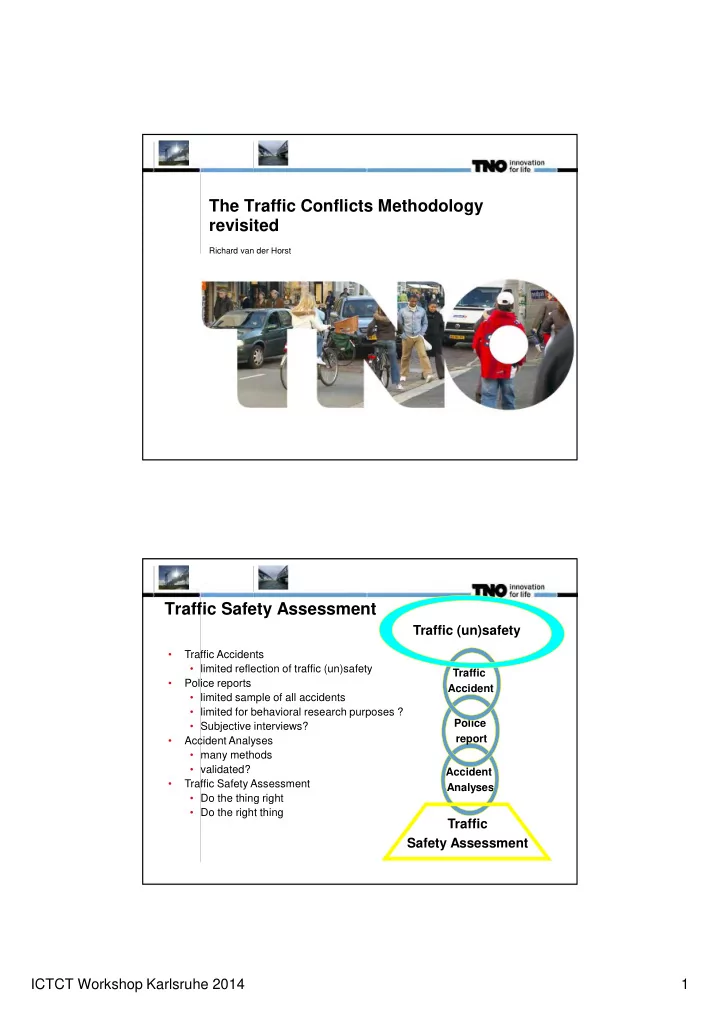
Traffic Safety Assessment

Accident Analyses Police report Traffic Accident

Traffic (un)safety Traffic Safety Assessment

  • Traffic Accidents
  • limited reflection of traffic (un)safety
  • Police reports
  • limited sample of all accidents
  • limited for behavioral research purposes ?
  • Subjective interviews?
  • Accident Analyses
  • many methods
  • validated?
  • Traffic Safety Assessment
  • Do the thing right
  • Do the right thing
slide-2
SLIDE 2

ICTCT Workshop Karlsruhe 2014 2

Traffic Safety Assessment

Accident Analysis

Traffic (un)safety Traffic Safety Assessment

Behavioural Analysis

Traffic safety vs. traffic process

(Hydén, 1987)

slide-3
SLIDE 3

ICTCT Workshop Karlsruhe 2014 3

Conflict method

Traffic safety research |------------------|-----------------| | | Serious conflicts Accidents | | Conflict analysis Accident analysis | | Process description Product description

Model of the accident process

Asmussen&Kranenburg (1982)

slide-4
SLIDE 4

ICTCT Workshop Karlsruhe 2014 4

Conflict technique development

  • Perkins & Harris (1967). GM
  • Hayward (1972). Time-to-Collision
  • 1st Workshop Conflict Techniques Oslo, 1977
  • 2nd Workshop+study, Rouen, 1979
  • 3rd Workshop, Leidschendam, 1982
  • 4th Workshop, Copenhagen, 1983
  • International Calibration study, Malmö, 1983
  • Trautenfels study, 1985
  • DOCTOR, 1986

ICTCT

Past:

  • International Committee on Traffic Conflict

Techniques Now:

  • International Cooperation on Theories and

Concepts in Traffic Safety http://www.ictct.org

slide-5
SLIDE 5

ICTCT Workshop Karlsruhe 2014 5

Definitions

  • Encounter
  • Critical situation
  • Conflict

– Conflict Severity (overall) – Probability of collision – Extent of consequences (injury severity)

Encounter

  • A traffic situation in which two road users

approach each other in time and space and may influence each other’s behaviour

slide-6
SLIDE 6

ICTCT Workshop Karlsruhe 2014 6

Critical situation

  • Detection of critical situations important

element in conflict observation

  • Encounter in which deviations from normal

behaviour occur

  • If the available manoeuvring space is smaller

than the space needed for a normal reaction

Conflict

  • Oslo definition:

“A traffic conflict is an observable situation in which two or more road users approach each other in space and time to such an extent that there is a risk of collision if their movements remain unchanged”

  • DOCTOR definition:

“A conflict is a critical traffic situation in which two (or more) road users approach each other in such a manner that a collision is imminent and a realistic probability of personal injury or material damage is present if their course and speed remain unchanged ”

slide-7
SLIDE 7

ICTCT Workshop Karlsruhe 2014 7

Conflict Severity (overall)

  • The severity of a conflict is determined by

both the probability of a collision and the extent of the consequences if a collision would have occurred

  • 1 and 2 slight conflicts
  • 3, 4 and 5 severe conflicts

Conflicts: DOCTOR Score form

Leading parameters:

  • Probability of a collision

TTC: Time-to-collision PET: Post-Encroachment -Time (resulting tijdmargin of near-miss)

  • Extent of consequences
slide-8
SLIDE 8

ICTCT Workshop Karlsruhe 2014 8

Probability of a collision

  • Defined by:

– Time-To-Collision (TTC) and/or – Post-Encroachment Time (PET)

Malmö study TTC versus Severity score

slide-9
SLIDE 9

ICTCT Workshop Karlsruhe 2014 9

Swedish Ta versus TTCmin

Time-To-Collision TTC and Braking

Start braking at the latest moment you think you are able to stop in front of the object

slide-10
SLIDE 10

ICTCT Workshop Karlsruhe 2014 10

Time-To-Collision (1)

Time-To-Collision (2)

slide-11
SLIDE 11

ICTCT Workshop Karlsruhe 2014 11

Time-To-Collision TTC (3) Time-To-Intersection TTI

slide-12
SLIDE 12

ICTCT Workshop Karlsruhe 2014 12

Post-Encroachment Time PET

  • The time between the moment t1 that the first road

user leaves the path of the second and the moment t2 the second road user reaches the path of the first

Extent of consequences (injury severity)

  • Conflict type (who -> who)
  • Speed
  • Evasive action

– No reaction – Controlled – Uncontrolled – Type of action

  • Braking
  • Accelerating
  • Swerving
slide-13
SLIDE 13

ICTCT Workshop Karlsruhe 2014 13 Long-term video observations

Observation of 4 blackspots in 2-yr period Pijnacker (T-junction) + Delft (3 signalized intersections) Rough data: 8 years of video material Selection: Collisions (# police-reported?) whole period Incidents when observed Conflicts (analyses ala ‘DOCTOR’ method) one day Methodology to determine driver behavior in the pre-crash phase Insight in the chain of elements of human behavior that either is resulting in, or avoiding an accident

Pijnacker T-junction rear-end + conflict C-C

slide-14
SLIDE 14

ICTCT Workshop Karlsruhe 2014 14 Pijnacker Right-angle C-C Analysis

VIDARTS (VIDeo-based Analysis of Road Traffic Scenes) collisions and conflicts Transformation from video to street Semi-automatic procedure

  • > V, DIST, TTC, TTCmin, PET, etc.

DOCTOR (Dutch Objective Conflict Technique for Operation and Research) Overall severity (scale 1-5)

  • probability of collision (TTC or PET)

extent of consequences if collision had occurred

slide-15
SLIDE 15

ICTCT Workshop Karlsruhe 2014 15 Conclusions (1) Long term video observation study

Traffic conflicts and analysing deviant behaviour together with road scene analyses give good insight in potential traffic safety problems at

  • intersections. Good resemblance with results analysis of collisions from

video. Remarkably, frequently, another road user (in)directly involved in pre-crash process Observing and scoring conflicts according to DOCTOR method from video feasible and advantageous compared to original method with

  • bservers on the street

Time-related measures such as TTC and PET promising surrogate safety measures for predicting accident risks by microscopic traffic simulation models

Conclusions (2)

We do not have to wait for accidents for improving road environment and traffic management Systematic observation of behaviour already gives you lots of clues for improving road safety at intersections Video observations rich source of information for natural traffic behaviour of road users (interactions mutually or in relation with road environment), in future additional to integral approach? -> Naturalistic driving studies (also on-site)

slide-16
SLIDE 16

ICTCT Workshop Karlsruhe 2014 16 Renewed interest in Traffic Conflict Technique DOCTOR

Bicycle- bicycle conflicts: a systematic observation of behaviour from video Evaluation of attention-increasing measures at a black spot intersection (Hillegersberg) PROLOGUE, combination of in-vehicle and site-based observations Evaluation of small-scale infrastructural measures at rural black spots in Bangladesh EU-proposal InDeV: In-Depth understanding of accident causation for Vulnerable road users

Background (1) Bicycle-bicycle conflicts

Increasing use of bicycle paths in the Netherlands Larger variety of type of users Large under-reporting of bicycle accidents without involvement motorised traffic In-depth study hospitalised bicycle victims by type of accident:

(ALVO, Stichting Consument en Veiligheid, N = 164)

Type % With motor vehicle 20 With moped 4 Single-bicycle accident 62 With other bicyclist 12 With pedestrian 2

slide-17
SLIDE 17

ICTCT Workshop Karlsruhe 2014 17 Background (2)

Type Number (%) 1 Victim and counterpart in same direction 113 (76) 1a

  • a. Front wheel against rear wheel other bicyclist

30 (20) 1b

  • b. Handlebars hitting each other

27 (18) 1c

  • c. Collision in flank

26 (18) 1d

  • d. Colliding with bicycle in front

24 (16) 1e

  • e. Colliding during overtaking

6 (4) 2 Victim and counterpart intersect 18 (12) 3 Victim and counterpart in opposite direction 17 (11) Total 148 (100)

Typology of bicycle-bicycle accidents (Schepers, 2010)

Background (3)

Often direct or indirect involvement of other road user IAAV study (2007), analysis pre-crash phase of real crashes SWOV (2012) Background document NOaF No collisions needed to solve traffic safety problems Systematic behavioural observations and –analyses -> insight in underlying process of interaction between road users and with infrastructure Conflict method DOCTOR (Dutch Objective Conflict Technique for Operation and Research) suitable, more practical from video Application potential for traffic safety bicycle paths?

slide-18
SLIDE 18

ICTCT Workshop Karlsruhe 2014 18

Bicyclist – pedestrian collision 1 Bicyclist – pedestrian collision 2

slide-19
SLIDE 19

ICTCT Workshop Karlsruhe 2014 19 Amsterdam - conflict analysis

  • Serious conflicts: in total 40
  • Type 2 (intersecting): 23 (mainly bicyclist – crossing pedestrian)

2 botsingen

  • Type 3 (oncoming traffic): 1 (moped/bicyclist overtaking manoeuvre of 1 (or 2) bicyclist(s))
  • Type 1 (same direction): 4

Black-spot intersection Hillegersberg

Before:

  • Continuing red asphalt
  • Smart studs
  • Conspicuous signing

After:

slide-20
SLIDE 20

ICTCT Workshop Karlsruhe 2014 20 Black-spot Hillegersberg

Video recordings, before and after Automatic selection of bicycle passages by Video Based Monitoring DOCTOR from video Total # of conflicts from 27 to 14 % of all bicycle passages, serious conflicts from 1.12 to 0.68% Blocking of bicycle path by cars most frequently occurring slight conflict Car drivers more aware of bicycle path, approach speed lower and earlier braking

  • Combination of site based observation (TNO) and in-vehicle
  • bservation (SWOV)
  • Focus on behavior at Intersections

– Speed – Interaction with vulnerable road users

The Dutch field trial

slide-21
SLIDE 21

ICTCT Workshop Karlsruhe 2014 21

Two complementary observation methods

In-vehicle observations

  • ver several intersections

Site-based observations Cases with complementary data from both observations

Research questions

Site based and in-car: What is the added value of the combination of these two methods? Is there a difference in behavior (looking behavior, speed, TTC and PET) of cars on signalized intersections that allow potential conflicts with cyclists when:

The vehicle turns right after red traffic light (stopped) and green traffic light (driving) There are cyclists present and there are no cyclists present

slide-22
SLIDE 22

ICTCT Workshop Karlsruhe 2014 22

Results

Stopped vs. driving:

  • # of glances >
  • Crossing speed lower
  • No situations with bicyclists

present

  • Crossing speed higher when no

bicyclist present

  • In driving situation turning cars

more involved in severe conflicts than turning from stopped situation Combining in-car and site-based:

  • Data from one study enriched with complementary data of other study
  • More in-depth understanding and to generalise and validate naturalistic

driving results to the behaviour of non-participants

  • Future applications: driving behaviour and specific infrastructure and the

interaction between drivers and vulnerable road users

Evaluation of small-scale infrastructural measures at rural black-spots Bangladesh

Location

# of days with accident registration # of accidents /year # of injuries /year # of fatalities /year

slide-23
SLIDE 23

ICTCT Workshop Karlsruhe 2014 23

Area of special interest for video

  • bservations

Bangladesh collision CNG-Motorbike

slide-24
SLIDE 24

ICTCT Workshop Karlsruhe 2014 24 TTC and Collision Avoidance Systems

Conflict studies and experimental research on driving behaviour in fog give input for the setting of in-car systems: TTCgas = -1.15+0.83*TTCstim TTCmin = -2.58+0.8*TTCstim TTCmin = -1.43+0.96*TTCgas Result: good trigger for CAS: TTCstim = 4.5 – 5 s Link between TTA (Lund) and TTCmin (NL)?

InDeV: In-Depth understanding of accident causation for

Vulnerable road users

Lunds University University of Aalborg UHasselt École Polytechnique de Montréal BAST TNO Ingenieria de Tráfico SL WUT Purdue University

slide-25
SLIDE 25

ICTCT Workshop Karlsruhe 2014 25 To conclude

We do not have to wait for accidents for improving road environment and traffic management Systematic observation of behaviour (including traffic conflicts) already gives you lots of clues for improving road safety at intersections Also good basis for the development of in-car systems Site-based observations complementary to naturalistic driving studies Strong need for automated video analysis of road user behaviour-> good progress, InDeV project next step? Link between TTCmin (NL) and TTA (Lund)? TTCmin = -1.43+0.96*TTCgas

Thank you!

slide-26
SLIDE 26

ICTCT Workshop Karlsruhe 2014 26

Car -> bicyclist collision