SLIDE 1
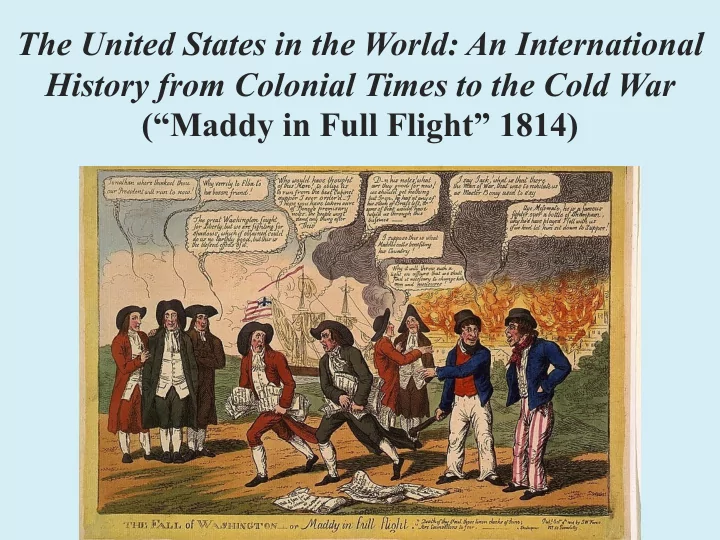
The United States in the World: An International History from Colonial Times to the Cold War (“Maddy in Full Flight” 1814)
SLIDE 2
Rough Course Schedule
v Week 1: Colonial Possessions in a World at War v Week 2: New Republic, Perilous World, 1787-44 v Week 3: Manifest Destiny, 1844-1898 v Week 4: Emerging Great Power, 1898-1914 v Week 5: United States in the Great War, 1914-18 v Week 6: Interwar Interregnum, 1919-1941 v Week 7: United States in World War II, 1941-45 v Week 8: From World War to Cold War, 1945-
SLIDE 3
Declaration of War
v June 1: Message to Congress,
justifying war with Britain
v June 4: House votes 79-49 for war v June 16: To avoid war with US,
Britain revokes Orders in Council
v News reaches US too late! v June 17: Senate votes 19-13 for
declaration of war (close votes!)
SLIDE 4
Napoleon Crosses the Nieman June 24, 1812
SLIDE 5
A Difficult Start to the War
v Jeffersonians thought war
with Britain would bring about annexation of Canada
v No Bank of the US v Army of only 7,000 v US faces dire economic and
military challenges
SLIDE 6
Jeffersonian Designs for Canada
v Jefferson, August 1812: v “The acquisition of Canada
this year … will be a mere matter of marching & will give us experience for … the final expulsion of England from the American continent.”
SLIDE 7
Historian Gordon Wood: “Mr. Madison’s Weird War”
v Like so many of America’s
wars, it was a “war of choice”
v We initiated it, it was not
forced upon us
v 1st Congressional declaration v Since WWII we have fought
five significant wars without any of them being formally declared!
SLIDE 8
Napoleonic Wars & War of 1812
v War of 1812 seen elsewhere
as merely a tiny, unknown theater of the Napoleonic Wars (1799-1815)
v Course of War of 1812 much
influenced by events abroad
v (Napoleonic Wars: 4 million
dead; War of 1812, 15,000)
SLIDE 9
War of 1812 was Peculiar: First, it was a very small war within a much larger global war, a “sideshow”
SLIDE 10
British & French had been engaged in an epic two-decade-long struggle for supremacy in Europe and the Atlantic world
SLIDE 11
War linked to Napoleonic Wars:
(5,000 British troops in 1812; 50,000 by 1815)
SLIDE 12
But no effort whatsoever to even passively coordinate with the French
SLIDE 13
Paradoxes, Role Reversals
v Jeffersonian “War Hawks”;
antiwar Federalists
v War of choice, but US
woefully unprepared for war
v No Bank of the US, no
preparedness (particularly the navy), small forces, reliance upon “militias”
SLIDE 14
Weird Timing, Sequencing, Communications (Both at the start & the end!) Regional Peculiarities (support & opposition)
SLIDE 15
Triumphalism of American rhetoric ill-suited to the realities of the war
SLIDE 16 Paradoxes and Weirdness
v Army fought poorly; tiny
navy fought well
v US lost more battles but
claimed “victory”
v That was enough for the
“Cult of Jackson”
v Opposition suffered
SLIDE 17
Only Six Clear Victories Over the British (3 Against Indians):
v Lake Erie, 1813 (naval) v York, 1813 v Talladega, 1813* v Autossee, 1813* v Horseshoe Bend, 1814* v Chippawa, 1814 v Baltimore, 1814 v Plattsburgh, 1814 (naval) v New Orleans, 1815
SLIDE 18 Defeats: 13
v Fort Mackinac, 1812 v Fort Dearborn, 1812 v Detroit, 1812 v Queenstown Heights, 1812 v Smyth’s debacle, 1812 v Rappahannock, 1813 v Frenchtown, 1813 v Fort Niagara, 1813 v Crysler’s Farm, 1813 v Fort Mims, 1813 v Lundy’s Lane, 1814 v Bladensburg, 1814 v Sacking of Washington, 1814
SLIDE 19
Napoleon’s Defeat at the Battle of the Nations Czar Alexander, Austria’s Francis II, Prussia’s Frederick William III, Leipzig, 1813
SLIDE 20
March 31, 1814: Napoleon Surrenders Paris April 4, 1814: Napoleon Abdicates May 30, 1814: Napoleon Arrives on Elba He remains on Elba for the next 300 days
SLIDE 21 British Burn Washington, August 24, 1814 setting the White House, the Capitol and
- ther federal buildings ablaze
SLIDE 22
“Maddy in Full Flight”
SLIDE 23
SLIDE 24
SLIDE 25
US & British sign Treaty of Ghent, December 24, 1814. News of treaty does not reach the US until February 1815.
SLIDE 26
A Very Bizarre Treaty No resolution of key issues (British do sell out their Indian allies) (Agreement to survey borders?)
SLIDE 27
Battle of New Orleans, January 8, 1815 Two weeks after the Treaty of Ghent (News of New Orleans & Ghent arrives)
Convinces Americans they Won the War!!
SLIDE 28
Irony of the Hartford Convention, 1814.
New England in distress, but timing is everything. New England had more cause for grievance than did the south in 1860.
SLIDE 29
James Monroe and Foreign Affairs
v One of the most qualified to
assume presidency (experience matters)
v Revolutionary War service v Congress, Senate; Gov. of VA v Numerous diplomatic posts v Secretary of State v Secretary of War
SLIDE 30
Monroe’s Presidency:
v 1818 Convention with
Britain
v Adams-Onis Treaty, 1819 v Monroe Doctrine, 1823
vAvoided a major war,
favored diplomacy
vActs of Prevention
SLIDE 31
Monroe Doctrine, December 2, 1823
v Avoided joint declaration
with the British
v Annual message to
Congress declares the “Monroe Doctrine”
v Repudiation of further
hemispheric colonization (France, Russia, Spain)
SLIDE 32
Young J.Q. Adams
v Accompanied father to
Europe at age 10
v Introduction to France,
Russia, Netherlands
v Secretary and translator
for Francis Dana, emissary to St. Petersburg, 1781-83
SLIDE 33
J.Q. Adams, Diplomat
v Netherlands, 1794-97 v Portugal, 1796-97 v Prussia, 1797-1801 v Russia, 1809-14 v Ghent, 1814-15 v Britain, 1815-17 v Sec. of State, 1817-24
SLIDE 34
In London, Adams visited Louisa Johnson’s family nightly. Always departed when the girls sat down at the piano to play and sing.
SLIDE 35
He hated the sound of the female voice!
SLIDE 36
First U.S. minister to Russia, 1809-
v Adams often ran into Czar
Alexander I (pictured)
v Spring of 1812, their banter
took a grave turn
v “All the indications suggest
war” the Tsar told Adams
SLIDE 37
Napoleon Attacks Russia, 1812
v “Could Napoleon be
stopped before St. Petersburg?” Adams asked
v “I certainly hope he won’t
come this far,” the Czar replied
v Fearful of invasion, other
diplomats sent wives and daughters home
SLIDE 38
Adam’s Crisis in 1812
v Louisa Adams and her
sister Kitty remained
v Kitty the object of the
Czar’s amorous interest
v The Adamses noticed a
change in Kitty
v She was pregnant!
SLIDE 39
Adams’s Travails in 1812
v Not pregnant by the Czar v But by John Quincy’s
nephew Billy Smith, sister Nabby’s son! (pictured)
v Adams was irate (probably
also somewhat relieved)
SLIDE 40
Secretary of State, 1817-1825
v Formulated fundamentals v Built diplomatic service v Convention of 1818 v 1819 Adams-Onís Treaty v Drafted Monroe Doctrine
SLIDE 41
Spain agreed to cede Florida to the US under the 1819 Adams–Onís Treaty
SLIDE 42
See Florida & also the 49th Parallel