
SLIDE 1
GPOBA Webinar October 8 2014
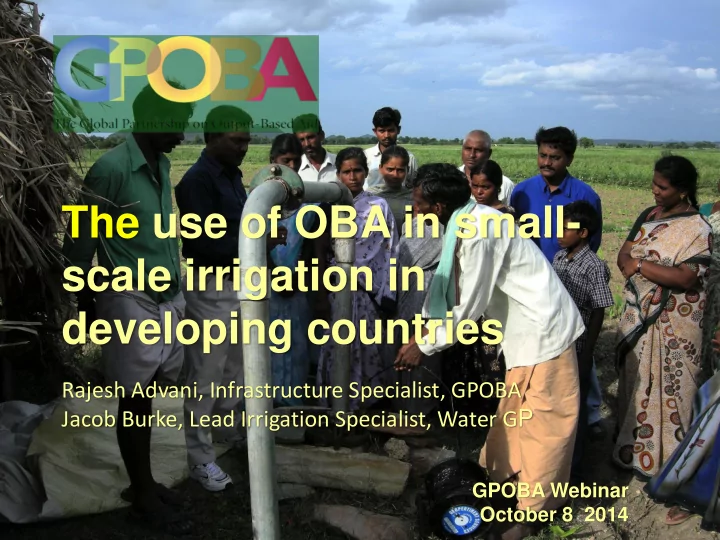
The use of OBA in small- scale irrigation in developing countries - - PowerPoint PPT Presentation
The use of OBA in small- scale irrigation in developing countries Rajesh Advani, Infrastructure Specialist, GPOBA Jacob Burke, Lead Irrigation Specialist, Water G P GPOBA Webinar October 8 2014 Introduction Objectives 1. Evaluate the scope
GPOBA Webinar October 8 2014
Main Report – results of in-country consultations (India, Zambia) Annex A: OBA financial model user guide Annex B: Review of OBA approach and case studies Annex C: Country studies for desk-based review
Government policies generally consistent with OBA principles Concerns: Provider pre-financing; sector bureaucracy; subsidy administration in India
There is scope to apply OBA to boos small holder irrigation - but in conjunction with
technology application and producer price margin in irrigated crops needs to be clear from the outset.
Implementation
Irrigation projects have employed 3rd parties to verify
Concerns: Capacity
to manage an OBA contract.
subsidies and grants
Demand is evident – a step-up approach. Concerns: Potentially difficult to measure delivery of irrigation service
sustainability of the sector
Possible to levy irrigation service charges. Concerns: Typically set too low to cover O&M costs; collection difficulties
approaches
projects
grower models
Indicators Indicative costs/ outputs Indicative OBA grant $10m Funding gap
Impact on farmers’ income Up by approx. $400 per year Key risks Pre-financing ability of NGOs
INTERNATIONAL DEVELOPMENT ENTERPRISES INDIA (IDEI)
Supply-chain partners produce and then market products
Smallholder farmers Cash Payments
Reporting
OBA subsidy
Indicators Indicative costs/ outputs Indicative OBA grant $5m to $10m Funding gap
Impact on farmers’ income Up by approx. $550 per ha per annum Water use efficiency Improve by 45% to 60% Key risks Relies on counterpart funding from state governments.
Farmers
irrigation technology
Water Users’ Association
Private Partners
infrastructure
Electricity Board Water Board Government
with private partner
IVA
Smallholder Farmers NGO i.e. Pradan
Commercial Bank
Reporting Verification Loan (pre-finance)
Implementation Support
OBA subsidy Indicators Indicative costs/ outputs Indicative OBA grant
Funding gap $890 – lower if additional support from government Impact on farmers’ income Increase up to $222 per farmer per year, and $400 after loan repaid Key risks Level of smallholder farmer demand and ability of NGOs to pre-finance.
Indicators Indicative costs/ outputs Indicative OBA grant $5m Funding gap $5,000 - $25,000 Impact on farmers’ income Increase up to $1,350 per hectare per annum Key Risks
to small farmers until market fully develops
KEDE Ltd
(JV – 3 comm. farmers)
Reporting
OBA subsidy
Smallholder Farmers
Sugar Sugar Sugar Factory
Provides Irrigation Services & pre-finance Manage Off-take
Linkage with a viable crop model.
Technology choice and scaling
How to keep it simple for the IVA
Market-based approaches for a range of micro-irrigation technology and rainwater harvesting tanks are potentially good candidates for OBA funds.
the structure of outputs and link to indicators, such as long term improvements in land productivity.
Opportunities for OBA funds to support larger scale interventions would need to be structured carefully
India. Risk: Complexities of working with State governments and limited time-frame of OBA intervention.
Risks: Incentives for larger farmers to continue ongoing provision of irrigation services to smallholder farmers. Funding gap is large.
Deep dive analysis of project opportunities. Further analysis of risk appetite for linking OBA subsidy disbursements to verification that the productivity has improved - particularly where private sector provider has limited control on farmer output. Scope for project funding over 3-5 year timeline, given consultants’ recommendations of longer involvement for GPOBA for larger-scale
Develop concept note for OBA financing for most viable opportunity and where there is strong demand from clients and government, and sector/ country fit for the Bank and donors.