The Value of Geospatial Information in Local Public Service Delivery - - PowerPoint PPT Presentation

the value of geospatial information in local public
SMART_READER_LITE
LIVE PREVIEW

The Value of Geospatial Information in Local Public Service Delivery - - PowerPoint PPT Presentation

The Value of Geospatial Information in Local Public Service Delivery Dr Gesche Schmid, GI Policy Lead, Local Government Association In association with Andrew Coote, Consulting Where Alan Smart, ACIL Tasman New approach to local public service


slide-1
SLIDE 1

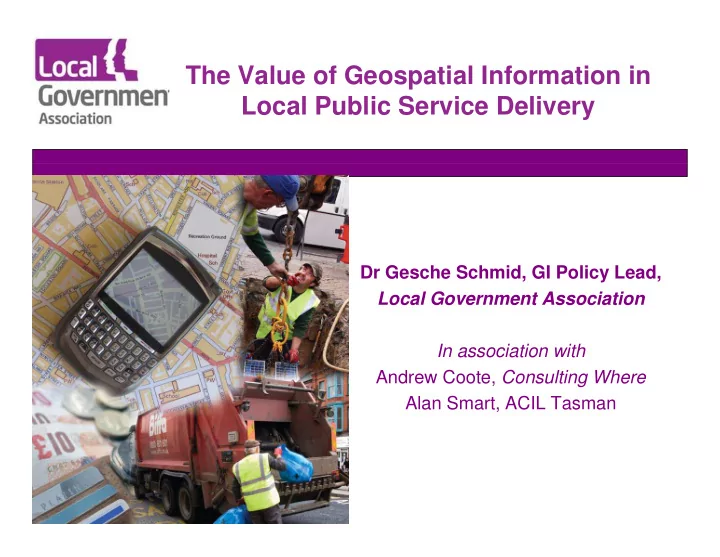
The Value of Geospatial Information in Local Public Service Delivery

Dr Gesche Schmid, GI Policy Lead, Local Government Association In association with Andrew Coote, Consulting Where Alan Smart, ACIL Tasman

slide-2
SLIDE 2

New approach to local public service delivery

  • Spending cuts and operational efficiency: the need to

reduce costs while delivering quality services;

  • Shared Services: working across organisational

boundaries and to operate through partnership (Total Place/Place based budgeting);

  • Localism - manage services locally based on the needs
  • f citizen and business. Shift from central to local control
  • The Big Society: local government as an enabler of a

more self-service approach that facilitates citizens and business to act for themselves;

  • Information economy: move to ‘data transparency’ and

the opening up of data for reuse

slide-3
SLIDE 3

GI needs in local public service delivery

  • Delivering services according to the needs of citizen and

businesses at a local level requires knowledge about place

  • Geospatial information widely used in local government in

England and Wales for

  • evidence-based decision-making
  • designing and managing services and infrastructures
  • achieving and enforcing regulatory compliance
  • describing and monitoring local conditions and change; and
  • understanding and meeting customer needs locally
  • Used in a range of services including
  • planning, housing, economic development, transport,

environmental protection, education, health and social care

slide-4
SLIDE 4

Background and purpose of study

The economic value of GI for underpinning local

services is little understood.

Local Government Group commissioned research

into the value of geospatial services in local public service delivery

To understand where changes to current geospatial

policy and practice can

  • enable better and more effective use of GI in local public

service design and delivery, and

  • support cost savings in a period of public expenditure

constraint.

slide-5
SLIDE 5

Research approach based on Geo-economic modelling

  • Use of Geo-economics: modelling the national

economy’s ability to deliver more with the same resources by using geospatial information.

  • Approach of the study
  • Evidence collation of economic benefits of GI used by local

public service providers

  • Assessment of social benefits alongside costs and savings
  • Estimated “knock on” benefits into other sectors of economy
  • Data assembled and fed into an ACIL Tasman’s computable

general equilibrium (CGE) model to assess the economic value of GI at regional and national level from 2009 to 2015.

  • Measures the productivity increases in “business as usual”

and “ideal policy” scenarios as a result of GI uptake

slide-6
SLIDE 6

Case Study: Daventry saving in waste collection

  • Use of GI to optimise refuse (waste) collection

routes leads to savings:

  • Mileage reduction of 12-13 per cent delivering

savings of £25,000 p.a.

  • Spare capacity to allow for vehicle washing

securing savings of £17,000 p.a.

  • Employee overtime will be virtually eliminated,

saving approximately £28,000 p.a.

  • The planned purchase of a new vehicle has

been rationalised to a smaller new vehicle saving £25,000.

  • Reduction from 18 to 16 collection rounds and to

4 days working week with cashable annual savings of £153,000 per annum

slide-7
SLIDE 7

Case Study: Tendring District e2e planning

  • Implementation of end to end planning systems

(e2e)

  • Making the whole process of planning electronically

enabled

  • Planning application received electronically
  • View applications electronically with the ability to self

service – Public Access

  • Consultation of planning proposals with consultees
  • nline
  • Assessed cost and savings before and after the

project was implemented

  • Savings of £ 49,500 annually mostly as a result of

reduced personal visits to planning offices.

  • Savings to citizens and construction industry

identified resulting from negating travel costs and reduced disputes respectively.

slide-8
SLIDE 8

Case Study: East Sussex online fault reporting

  • Set-up of online fault reporting within

East Sussex partnership with districts and police

  • Use of interactive web mapping to

identify fault location

  • The information is automatically routed to
  • ne of the 8 partnership agencies

responsible for the service

  • The key benefits to the participating local

service providers are:

  • More cost effective contact and feedback

from citizen

  • Reduction in service costs, with 18,800

fault incidents logged over 5 years with an approximate net saving of £60,000

  • Cost of remedial action reduced by more

accurate location

  • Savings on abandoned cars by removing

vehicles before they are vandalised.

slide-9
SLIDE 9

Case Study: Nottingham City Insight

Nottingham City Council, working with the local NHS, police, districts and the county council, created an online geo-enabled Local Information System:

  • providing access to comprehensive, up-to-date information to neighbourhood

level to staff both inside and outside the participating organisations and community groups to quickly find information they require

  • Demonstrable savings from reductions in the time required to research and

analyse evidence for decision making; saves up to £460,000 a year

  • Leads to better quality decisions at a local level;
  • Example: Customer profiling enabling additional benefit to be paid to most

deprived families in Newark and Sherwood district;

slide-10
SLIDE 10

Case Study: Newport City Council

  • ne address system
  • Rationalising addresses held by the Council has benefits

as each service area used to carry a different address for the location where a person lives

  • Local Land and Property Gazetteer (LLPG) now the

master source of address information in many departmental systems

  • Use of the LLPG as the master address system reduces

duplication and joins up services for the citizen

  • Estimated cost savings of £57,000 per annum as the

approximately 2300 address updates and changes are

  • nly carried out once instead of applying it to 17

separate systems

  • Sharing of the National Land and Property Gazetteer

(NLPG) created by local authorities as part of the street naming and numbering function leads to cost savings of £15 to £ 24 million in local authorities over 5 years

slide-11
SLIDE 11

Benefits from case studies

  • Channel shift –use of transactional web mapping systems

reduces the need for face to face contact.

  • Improved transport efficiency – by wide application of route
  • ptimisation and better streetworks management.
  • Better decision making – using geospatially-enabled local

information systems to gather intelligence about a place.

  • Reduced data duplication – using master datasets such as the

NLPG as a shared data source.

  • Empowering frontline workers – by speeding up analysis and

enhancing mobile working.

  • Helping identify social deprivation – through data integration

and analysis.

  • Broader citizen engagement in local decision making and taking

part in democracy at the local level through wider access and use

  • f geospatial information.
slide-12
SLIDE 12

Economic impact of GI: Modelling outcome

  • real output of local government increased by over £230

million in 2009 as a result of the accumulated productivity benefits of using geospatial applications

  • the average annualised cost to benefit ratio of using

geospatial information in local government is around 1:2.5 over 5 years.

  • Gross Domestic Products (GDP) for England and Wales

was over £320 million higher in 2009 using GI

  • projecting forward to 2015, GDP for England and Wales

will be an estimated £560 million higher using GI

  • Better policies and action to deliver the ideal scenario,

could improve GDP by an estimated £600m by 2014-5

  • government revenue from taxation was over £44 million

higher and has the potential to increase to £89 million by 2015

slide-13
SLIDE 13

Other benefits

  • Reduced emissions intensity of the economies of

England and Wales by around 0.013 per cent in 2009 as a result of using GI (ie: reduction in car journeys)

  • better sustainable environmental management

and better planning of infrastructure projects through better, more accessible and interoperable data

  • improved health and wellbeing of citizens

through better targeted local public service delivery

  • small improvements in time available for citizens

for leisure and family activities due to improved access to data about services and routing information

slide-14
SLIDE 14

Conclusions and recommendations

  • The intelligent use of GI could lead to further savings of

£ 140 million within 6 years. (accounts for 2 per cent of the efficiency savings local government needs to make this year and 12 per cent by 2014/15)

  • The use of geospatial information has come a long way

within local government since its early inception. We now have to demonstrate that GI forms part of a wider information intelligence which underpins vital frontline service delivery.

  • Promoting better top management and political

understanding of the case for the better use of GI and

  • ther information
  • Good quality standardised data and its intelligent use

does not happen on its own. It needs skilled staff to make best use of the data.

slide-15
SLIDE 15

Next steps

  • Information services provide a valuable resource to help

deliver services where needed and to reduce cost in service delivery.

  • to maximise the value of GI and to reap the benefits of the

Location Infrastructure

  • Share data services,
  • Open up data and link with location based data,
  • Use data more intelligently
  • Free up restrictive licensing terms for derived data so that they

can be more easily shared and reused.

  • INSPIRE, the UK Location Infrastructure and the Public

Sector Mapping Agreement have the potential to make better use of data and contribute to a further increase in the productivity for the public sector and the wider economy.

slide-16
SLIDE 16

Further information:

Report published on www.lga.gov.uk/GIresearch The publishers/authors can be contacted on:

  • Gesche Schmid, Local Government Association

Email gesche.schmid@lga.gov.uk

  • Andrew Coote, Consulting Where Ltd

Telephone +44 (0)1923 291000 Mobile +44 (0) 7860 884119 Email andrew.coote@consultingwhere.com

  • Alan Smart, ACIL Tasman

Telephone +61 2 6103 8201 Mobile +61 404 822 312 Email a.smart@aciltasman.com.au