The Various Possibility of Telemedicine for Cardiovascular - - PDF document

the various possibility of telemedicine for
SMART_READER_LITE
LIVE PREVIEW

The Various Possibility of Telemedicine for Cardiovascular - - PDF document

The 5th Asia Telemedicine Symposium The Various Possibility of Telemedicine for Cardiovascular Intervention Fumiaki Ikeno, M.D Cardiovascular Medicine, Stanford University, Associate Professor, Osaka University, Japan Advisor of California Office,


slide-1
SLIDE 1

The 5th Asia Telemedicine Symposium

Stanford

The Various Possibility of Telemedicine for Cardiovascular Intervention

Fumiaki Ikeno, M.D

Cardiovascular Medicine, Stanford University, Associate Professor, Osaka University, Japan Advisor of California Office, Kyusyu University, Japan

The 5th Asia Telemedicine Symposium

Stanford

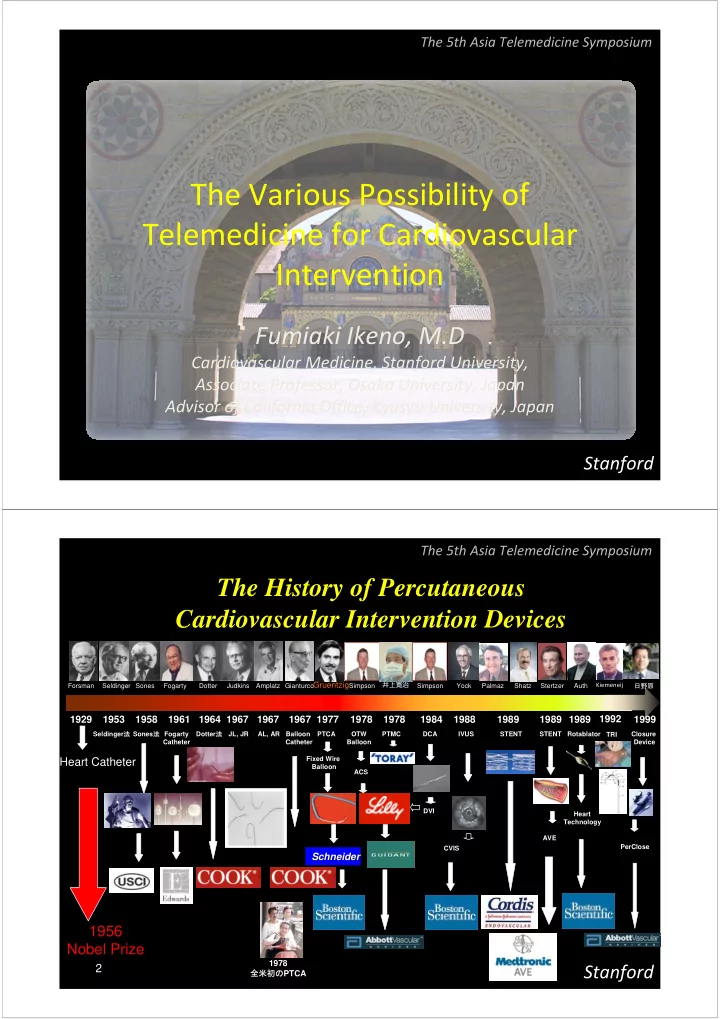
2

Seldinger Forsman Sones Amplatz Judkins Fogarty Dotter

1978 1953

Seldinger法

1929 1958

Sones法

1967 1967

JL, JR AL, AR Fogarty Catheter

1961 1964

Dotter法

Heart Catheter

1956 Nobel Prize

1967

Gianturco Balloon Catheter

1977

Gruentzig

PTCA Fixed Wire Balloon

Schneider Schneider

1978 全米初のPTCA

Simpson

1978

OTW Balloon ACS 井上寛治 井上寛治

1978

PTMC Simpson DCA

1984

DVI

1988

IVUS Yock CVIS

1989

Palmaz Shatz STENT Stertzer AVE

1989

STENT Auth

1989

Rotablator Heart Technology Closure Device

1999

PerClose 日野原

The History of Percutaneous Cardiovascular Intervention Devices

Kiemeneij

1992

TRI

slide-2
SLIDE 2

The 5th Asia Telemedicine Symposium

Stanford

Coronary Artery Angioplasty has started in 1977.

Andreas Roland Grüntzig (1939–1985) The 5th Asia Telemedicine Symposium

Stanford

He started the educational course in order to spread the angioplasty all over the world.

But, at first, nobody believed angioplasty worked!

slide-3
SLIDE 3

The 5th Asia Telemedicine Symposium

Stanford

Since then, Live demonstration is the standard way for the education of angioplasty!

The 5th Asia Telemedicine Symposium

Stanford

Nowadays, the angioplasty is Nowadays, the angioplasty is introduced into any other arteries. introduced into any other arteries.

Peripheral arteries Renal arteries Carotid arteries

slide-4
SLIDE 4

The 5th Asia Telemedicine Symposium

Stanford

7

2001

Drug Eluting Stent

The History of Percutaneous Cardiovascular Intervention Devices

2011

The 5th Asia Telemedicine Symposium

Stanford

Transcatheter Intervention Transcatheter Intervention for Structural Heart Disease for Structural Heart Disease

Mitral Valve LAA Pulmonary Valve Aortic Valve Tricuspid Valve VSD ASD、PFO PDA

slide-5
SLIDE 5

The 5th Asia Telemedicine Symposium

9

Edwards-SAPIEN XT

18 Fr Balloon Expandable Trans Apical Trans Femoral Approach Bovine Tissue, Cobalt Frame The 5th Asia Telemedicine Symposium

10

Edwards-SAPIEN: Trans Femoral

slide-6
SLIDE 6

The 5th Asia Telemedicine Symposium

11

Current Devices for Percutaneous Mitral valve Intervention

Mitra Clip

MONARC™ (Edward LifeSciense) CARILLON™ (Cardiac Dimension, Inc) PTMA™ (Viacor, Inc) AccucinchTM (Guided Delivery Systems) MITRALIGN Inc OuantumCor Inc Cordis Corp EndoValve, Inc

Edge to edge Approach

Coronary Sinus Approach AV grove Cinching Apporach Mitral Valve Replacement

The 5th Asia Telemedicine Symposium

12

Mitra Clip

slide-7
SLIDE 7

The 5th Asia Telemedicine Symposium

13

Mitra Clip

The 5th Asia Telemedicine Symposium

slide-8
SLIDE 8

The 5th Asia Telemedicine Symposium

Stanford

Application of Telemedicine in Cardiovascular Catheter Intervention

  • 1. Education
  • 2. Consultation
  • 3. Conference

The 5th Asia Telemedicine Symposium

Stanford

Toyohashi Heart Center

slide-9
SLIDE 9

The 5th Asia Telemedicine Symposium

Stanford

Telemedicine for Cardiovascular Intervention Live Demonstration of New Devices

The 5th Asia Telemedicine Symposium

Stanford

Telemedicine for Cardiovascular Intervention Specific Issue in Japan

slide-10
SLIDE 10

The 5th Asia Telemedicine Symposium

Stanford From the standpoint of physicians From the standpoint of physicians……… ……….. ..

GDP: No.3 (1968-2009: No2) GDP: No.1

We can use the newest devices the first in the world! We can use the newest devices the first in the world! We can use the new devices after our large pivotal trial in the USA. But these days, it is becoming slower. We can use the new devices after our large pivotal trial in the USA. But these days, it is becoming slower. We are the last country that can use new devices, but at that time, no more new! We are the last country that can use new devices, but at that time, no more new!

But patients are waiting for more effective devices! But patients are waiting for more effective devices! This is universal wish for patients This is universal wish for patients…… …….. ..

SAPIEN XT

US Pivotal Trial

Germany Registry

20

“Device Lag” for TAVI

Under investigation in EU 2002 2004 2006 2008 2010 First in Man First in Man

US PIVOTAL, n=600

E-REVIVE/RECAST

Feasibility, n=36

REVIVE-2

Feasibility, n=90

REVIVAL-2

Feasibility, n=77

Now

SAPIEN Edwards-SAPIEN Medtronic CoreValve Edwards-SAPIEN XT

SAPIEN SAPIEN SAPIEN SAPIEN

治 験

CHIKEN N=60

SAPIEN XT

Feasibility, n=86 N=1300

slide-11
SLIDE 11

EU FIM

21

“Device Lag” for Mitral valve Intervention

Under investigation in EU & Latin America 2003 2005 2007 2009 Now First in Man

US PIVOTAL, n=279

Mitra ClipTM (eValve/ABBOTT)

EVEREST-II

EVEREST-I

Feasibily, n=107

CARILLON™ (Cardiac Dimension, Inc)

N=30

AMADEUS

N=30

TITAN

First in Man

N=36

The 5th Asia Telemedicine Symposium

Stanford

Telemedicine for Cardiovascular Intervention We, Japanese, need to learn the new treatment from outside of Japan!

slide-12
SLIDE 12

The 5th Asia Telemedicine Symposium

Stanford

The same species, but…………..

The 5th Asia Telemedicine Symposium

Stanford

Telemedicine for Cardiovascular Intervention We, Asian, need to discuss the new treatment by ourselves!

slide-13
SLIDE 13

The 5th Asia Telemedicine Symposium

Stanford

Telemedicine for Cardiovascular Intervention Future, but not so far!

Stanford Stanford

Gaming Industry: “Wii” of Medicine

Today’s 30 yo is much better at “hand – eye”

Courtesy from Prof. Peter Fitzgerald

slide-14
SLIDE 14

Valves: The “touch” of a surgeon in the Cath Lab

Courtesy from Prof Peter Fitzgerald

Stanford Stanford

Robotic Catheter System Robotic Catheter System

Catheter Management Catheter Management

MD Teaching MD Teaching & Training & Training Patient Patient Consistency Consistency

Courtesy from Prof. Peter Fitzgerald

slide-15
SLIDE 15

Stanford Stanford

Robotic Catheter System Robotic Catheter System

(training and planning for the procedure) (training and planning for the procedure)

Routine Catheter Movement Routine Catheter Movement Standardization Standardization Complex Catheter Movement Complex Catheter Movement Facilitation Facilitation

Courtesy from Prof. Peter Fitzgerald The 5th Asia Telemedicine Symposium

Stanford

Courtesy from Prof. Peter Fitzgerald

slide-16
SLIDE 16

The 5th Asia Telemedicine Symposium

Stanford

In the cardiovascular fields, we need the brainstorming to conjugate the telemedicine! We believe telemedicine will improve the daily practice of this fields and help the patients!