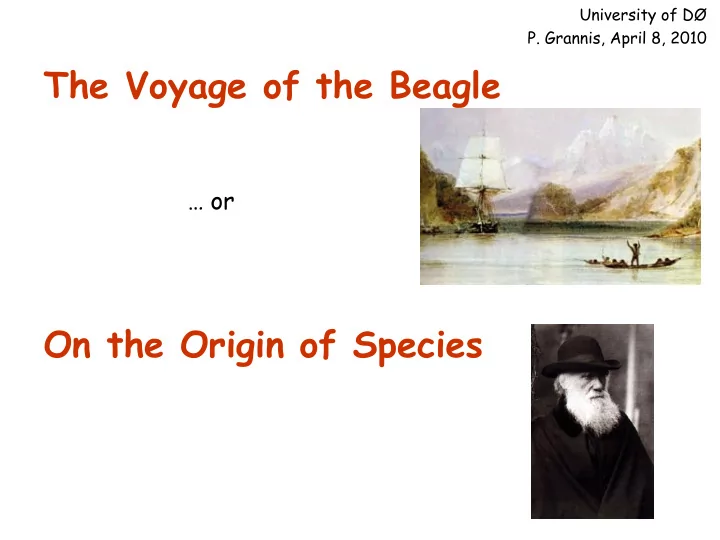
SLIDE 1 The Voyage of the Beagle
… or
On the Origin of Species
University of DØ
- P. Grannis, April 8, 2010
SLIDE 2 The Voyage of the Beagle
… or
On the Origin of Species DØ
From mid-1983 to end 1984, the DØ collaboration was formed and the experiment was shaped. From 1984 onward, many tests, studies, detector fabrication and commissioning were done, leading to Run 1 collisions from 1992 to 1996.
University of DØ
- P. Grannis, April 8, 2010
SLIDE 3 Pre - 1983
In 1981, Director Leon Lederman called for proposals for an experiment in the DØ
- IR. He asked for something ‘small
(<750 m3), simple, and clever’. It must be moveable on and
- ff the beam (fixed target beam extraction occurred in DØ).
Aim for first operation in 1986. Fermilab
contributions to the detector up to $1M! 19 proto-proposals of varying complexity resulted; 12 survived and were finally considered in the June 1983 PAC meeting. The result was disapproval of all proposals – and carte blanche Stage I approval (July 1, 1983) for a new consortium
- riginally consisting of only one person (PG). The charge was
to create a new experiment for high pT physics that was at least no worse than the proposed concepts.
Not very auspicious beginnings …
28
SLIDE 4 Rubbia: 4T SC dipole, hi press tracking, fine grained calorimeter § Pope: 2 Pb glass fwd arrays; MWPC tracking Kennett: track chmbrs, 1.5T solenoid; PWC cal Barish: PWC calorimeter egg around IP Longo: PWCs and Cal in forward regions – 50 m long! § Marx.: LAPDOG; Pb glass, 600 tons Diebold: Borrow large dipole; dE/dx, TOF,
§ Green: Muon scint hodoscopes above ground Rushbrook: Move UA5 streamer chamber Garelick: non magnetic Fe, muon tracker * Giacomelli: Roman pots elastic scattering Frisken: 2000 ton detector for e-p collisions W.Lee; e-p collision detector
Letters of intent
* Price: Lexan stack monopole search Devlin: 4 calorimeter § Ferbel: move ISR R807 axial field spectrometer Thun: drift chambers, PWC and Pb glass calorimeter § Erwin: Forward calorimeters based on E609 fixed target detectors
- S. Smith: Time expansion chamber, 10T SC
solenoid, HCal, muons
* Ultimately approved and ran in
§ Portions of these ultimately became DØ Two became HERA-based
27
SLIDE 5 Pre – 1983 : LAPDOG
Large Angle Particle Detector Or Gammas
LAPDOG focussed
hadron physics with an (EM) calorimeter made from extruded lead glass bars. By 1983, it had merged with a proposal to build a muon spectrometer (in the berm) that morphed into a hadron calorimeter.
- Detector ~ 7m along beam (~1/3 of DØ)
26
The “DØ døg” was born as the logo for LAPDOG, courtesy George Booth, my Stony Brook neighbor.
- Central cal. rotated to accommodate MR.
- Note (ATLAS folks) the air toroids
in the forward direction.
- Note advanced CAD system!
SLIDE 6
1983 : DØ proposal
Starting in summer 1983, a collaboration formed from portions of many of the earlier proposals. It should complement the CDF detector that started ~4 years earlier. The first challenge was to settle on a name – GEM, BELLA, DØGBREATH, … we failed utterly to agree and settled on the lowest common denominator “DØ”, our address in the lattice. The guiding principle was the focus on high pT physics (electrons, muons, jets and MET) without a central magnet. The EM calorimeter was first scintillating glass bars (more light, more rad hard, more expensive than Pb glass). In the ‘September revolution’, this scheme was seen as too complex and cumbersome (and under-performing). DØ switched to liquid argon calorimetry (ensuring delay while learning the LAr business).
25
SLIDE 7
71 collaborators, 12 institutions all in US.
1983 : DØ proposal
By the December PAC meeting a full proposal was presented and given Stage I approval (and a resounding ovation) but few $$.
24
SLIDE 8 71 collaborators, 12 institutions all in US.
1983 : DØ proposal
10 individuals remain from 1983
current DØ masthead. 9 institutions remain among the 67 now participating. By the December PAC meeting a full proposal was presented and given Stage I approval (and a resounding ovation) but few $$.
24
SLIDE 9 Highlights of 1983 proposal
5 toroids (CF/IF/EF); 5 calorimeters (CC/EC/PC) complex! Octagonal shape for toroids, muon chambers.
1983 Design Rept cover
23
SLIDE 10
Highlights of 1983 proposal
Tracking: Inner and outer drift chambers; 4 layer Transition Radiation Detector in both central and forward region for electron ID. Again a polygonal structure. TRD schematic
22
No magnet for tracking volume – enabling compact high quality calorimetry
SLIDE 11
Highlights of 1983 proposal
Calorimetry: Interesting CC pinwheel modules! Single, very heavy, EC module with tapered hole for a plug calorimeter within Θ < 5O
21
SLIDE 12 Highlights of 1983 proposal
Considerable work was done on DAB design; the collision hall size was frozen, so it constrained the detector design. FNAL decreed that there would be no movable door to allow rolling the detector into collision hall. Also decreed that Main Ring accelerator (400 GeV) could not be lifted all the way above our hall, as in CDF. Collision hall Assembly hall Control room Very few offices A Director with an over-developed imagination suggested a turntable with detector & shield wall on it that could be twirled from In to Out positions…
- r a vertical piston elevator to the
surface. We decided that a stackable concrete block wall was simpler!
20
(Pretty much as built, but office bldg later extended.)
SLIDE 13 On to 1984
- Feb. 1984 DOE (Big Brother) charged HEPAP to
advise on the relative priority of SLD and DØ (not enough funds to start both). In a split vote of HEPAP, SLD was favored (desire to beat LEP was the reason). Big Brother however recognized the case for DØ and did allocate some funds for R&D, and scheduled a Temple (a.k.a. Lehman) review for November. This meant that a real design, cost estimate, schedule with milestones, management plan etc. was needed (in the end, the total accounted cost was $75M, not the $1M offered by Lederman). DØ moved administratively to Accel Div (to promote competition between CDF/PPD and DØ/AD) and into quarters in a series of leaky portakamps around the Booster pond . AD knew little about experiments and this adventure was abandoned in several years.
19
SLIDE 14
Some 1984 activities
Test beam run to measure the poorly known hadron punchthrough – Pb block simulating CC. Calorimeter preamp shaping electronics prototypes MC simulations – jet trigger cross sections
18
SLIDE 15
1984 MSU Workshop
17
SLIDE 16 1984 MSU Workshop
Cutts Hedin Protopopescu Yamada Grannis Edmunds Brock Schamberger
For some there has been a noticeable aging process.
17
SLIDE 17 But if you think we looked young, what about the babies now running DØ, as seen in 1984 ?
Dmitri Denisov in USSR boot camp Darien Wood in grad school in Berkeley 16
Dashing
Stefan Soldner-Rembold,
- ld enough to have a beard
SLIDE 18
Now 91 members (added 20) 14 institutions (add Rochester, LBNL, Saclay; drop Arizona)
1984 Design Report
15
SLIDE 19 1984 DR muon
Still had plug calorimeter. Squared up the toroids (re-use Newport News cyclotron steel). Eliminated intermediate toroid. Detector rolls on movable platform. Muon PDT cells, with vernier pads for z-
placement about as built.
14
Ultimately plug cal replaced by plug toroid/muon detector
SLIDE 20
LAr readout structure defined: G10 readout boards with signal pads under resistive coat, signal boards for sending longitudinally ganged signals.
1984 DR calorimeter
Calorimeter module design was similar to as built. Pad segmentation fixed
13
SLIDE 21
1984 DR tracking
Run I tracking layout was as built apart from the forward TRD later dropped for lack of space (and large track density). CDC and FDC cell structures determined.
12
SLIDE 22
1984 DR trigger/DAQ
Level 0 interaction trigger + 2 level trigger and data acquisition design fixed Level 1 trigger (muon & calorimeter) block diagram.
11
Processor-based Level 2 trigger and data acquisition.
SLIDE 23 1984 DOE Review
November 1984 DOE review: Gave baseline approval (equivalent to CD1 in today’s DOE jargon). Added contingency to the cost estimate. Some funding started in FY1985. About 4-5 years behind CDF (CDF recorded first collisions at BØ early in 1985 with an unfinished detector; first physics run in 1987). One collaborating institution said “Run by 1988 or we quit”. First collisions were in April 1992 with this group still with us (and still with us today!)
10
1984 Design Report cover – multiple ‘DØ’s
SLIDE 24 Physics Landscape in 1984
1974: J/Ψ discovery (BNL/SLAC) 1975: SLAC/SPEAR: jets observed 1976: Open charm, tau discoveries (SPEAR) 1977: Upsilon discovery (FNAL) 1982: Open beauty meson discovery (CLEO) 1983: W/Z discoveries (CERN) 1984: High pT jets seen at UA2 UA1: Monojets (jets with large missing ET ) ?? UA1/UA2: anomalous Z→ l+
l-
?? UA1: W → t b top evidence ??
Sidebar: T. Wyatt’s first UA1 assignment was to ‘confirm’ the 40 GeV top quark discovery in the new data sample - which he failed utterly to do (for good reason ! ).
- H. Montgomery to Terry on the occasion of 2007 DØ
evidence for single top: “Well, you killed the last single top signal. I hope you worked hard to try to kill this one!”
There was a sense of excitement and discovery in the air. Scepticism about tantalizing fluctuations was largely suspended. A decade of discovery!
9
SLIDE 25 DØ Physics Program (Run 1)
DØ central goal was to explore high pT phenomena with three major themes: 1. Precision tests in the intermediate vector boson sector 2. High pT studies of QCD through jets and photons 3. Searches beyond the Standard Model
- Top quark, b-physics, Higgs search were not mentioned.
Physics studies assumed a run at L = 1x1030 cm-2 s-1 each year for 5 pb-1 (~1500 Z→ ee, 15,000 W → e). We probably imagined about three years of running. John Peoples: “Tevatron cannot exceed L > 3x1030 ”. In the end, 3.5 years Run I netted 120 pb-1 and peak L = 2x1031. But the 1984 Design Report was remarkably optimistic on trigger/selection efficiencies, and was quite cavalier in documenting expected precisions. One would not get away with this today!
8
SLIDE 26
Program: W/Z physics
1. W and Z masses: Design report outlined W mass methods – the newly-devised transverse mass, and from the W/Z ratio by ignoring one lepton from Z and measuring the transverse mass distribution for each. Estimated MW ~ 400 MeV via transverse mass (achieved 84 MeV in Run 1 !!) sin2W = 0.0025 (syst limited; radiative corrections, energy scale; top quark effects). 2. Z and W width. Z constrains N (at the time, N < 44!) Z ~ 130 MeV → N ~ 0.7. W ~ 200 MeV would constrain low mass top (expect W→tb but little Z→tt ; recall top mass of 30 - 40 GeV was indicated then). 3. Narrow states (Z→X) (UA1/UA2 had seen several unexpected ee & events so there was a prospect for new states.) Use longitudinal EM cal segmentation to distinguish and (2).
7
SLIDE 27
Program: W/Z physics
1. W and Z masses: Design report outlined W mass methods – the newly-devised transverse mass, and from the W/Z ratio by ignoring one lepton from Z and measuring the transverse mass distribution for each. Estimated MW ~ 400 MeV via transverse mass (achieved 43 MeV in 1 fb-1 !!) sin2W = 0.0025 (syst limited; radiative corrections, energy scale; top quark effects). 2. Z and W width. Z constrains N (at the time, N < 44!) Z ~ 130 MeV → N ~ 0.7. W ~ 200 MeV would constrain low mass top (expect W→tb but little Z→tt ; recall top mass of 40 GeV was indicated). 3. Narrow states (Z→X) (UA1/UA2 had seen several unexpected ee & events so there was a prospect for new states.) Use longitudinal EM cal segmention to distinguish and (2).
didn’t exist but used this trick for ID LEP/SLC did Z ; left W for Tevatron/LEP2
7
SLIDE 28
Program: W/Z physics
4. Asymmetry in W production & decay: (only muons without solenoid) 1% measurement in <cos*>; measure pdf’s. 5. Trilinear gauge boson couplings: Expect ~ 20 W(l) establish WW
see effect of the radiation amplitude zero! 6. W/Z production cross sections Small-x parton distribution functions; pT distribution in W+jet production to probe S (Q2) 7. W/Z→ qq Can observe “if QCD jet backgrounds controlled” (!!). Can flavor tag using semileptonic decays. Seek W → tb (150 events for mt = 60 GeV)
6
SLIDE 29 4. Asymmetry in W production & decay: (only muons without solenoid) 1% measurement in <cos*>; measure pdf’s.
Program: W/Z physics
5. Trilinear gauge boson couplings: Expect ~ 20 W(l) establish WW
see effect of the radiation amplitude zero! 6. W/Z production cross sections Small-x parton distribution functions; pT distribution in W+jet production to probe S (Q2) 7. W/Z→ qq Can observe “if QCD jet backgrounds controlled” (!!). Can flavor tag using semileptonic decays. Seek W → tb (150 events for mt = 60 GeV)
CDF with B field better in Run 1 ; DØ caught up in Run 2 Chutzpah! Only now might see Z → bb, W→qq
6
Got the RAZ only in Run 2
SLIDE 30
Program: QCD
1. Jet production; “observe jets up to 500 GeV”; probe high q2 QCD; look for compositeness through deviations. 2. Ratio of 3 to 2 jets: measure S (q2) 3. Ratio qqg/ qq: Measure S /EM Separate single photons from , , through the distribution of first conversion points in CCEM. 4. Diphoton production: complementary parton structure info to Drell Yan dilepton. 5. Quark gluon plasma: Observe by excess / ratio at low ET (~100 MeV !!)
5
SLIDE 31
Program: QCD
1. Jet production; “observe jets up to 500 GeV”; probe high q2 QCD; look for compositeness through deviations. 2. Ratio of 3 to 2 jets: measure S (q2) 3. Ratio qqg/ qq: Measure S /EM Separate single photons from , , through the distribution of first conversion points in CCEM. 4. Diphoton production: complementary parton structure info to Drell Yan dilepton. 5. Quark gluon plasma: Observe by excess / ratio at low ET (~100 MeV !!)
No S in Run 1; theory not
Run 2 did we get s Insufficient energy density
5
SLIDE 32 5. Discover toponium up to 55 GeV (we still expected bound state
Program: New Phenomena
1. Heavy W/Z: sensitivity – Z’ to 230 GeV; W’ to 150 GeV. 2. Heavy leptons: W →L± L
L+ L-. 3. SUSY: pp → ggX (g → qq) should reach m(gluino)~ 100 GeV. Seek C-non-invariant g → g ~~ ~ ~ ~ ~ 4. Heavy quarks beyond top; if inaccessible in W → Qu Qd , seek Q → W q up to mQ = 120 GeV in a six-jet final state. 7. UA1/UA2 anomalies: Monojets; Z l+
l-
; + MET; dijet bumps; anomalous multi-muons … A whole zoo seemed waiting to be explored. 6. Technicolor: Techni-eta to 250 GeV; Leptoquarks to 150 GeV.
4
SLIDE 33 5. Discover toponium up to 55 GeV (we still expected bound state
Program: New Phenomena
1. Heavy W/Z: sensitivity – Z’ to 230 GeV; W’ to 150 GeV. 2. Heavy leptons: W →L± L
L+ L-. 3. SUSY: pp → ggX (g → qq) should reach m(gluino)~ 100 GeV. Seek C-non-invariant g → g ~~ ~ ~ ~ ~ 4. Heavy quarks beyond top; if inaccessible in W → Qu Qd , seek Q → W q up to mQ = 120 GeV in a six-jet final state. 7. UA1/UA2 anomalies: Monojets; Z l+
l-
; + MET; dijet bumps; anomalous multi-muons … A whole zoo seemed waiting to be explored. 6. Technicolor: Techni-eta to 250 GeV; Leptoquarks to 150 GeV.
LEP got there first Did it, but it was top No bound toponium None of it was real
4
SLIDE 34
DØ Physics Program: Comments
The stress on jets, leptons and missing ET paid off. Don’t be too confident in predicting what you will do – Nature has devious ways. The possibility that top was very heavy was not foreseen. We were brainwashed by the successes of SPEAR and UA1 preliminary ‘result’. The dominant role in Z physics that LEP was to play was not well understood (by us). The importance of b-tagging was underestimated. The possibility of important b-physics in a hadron collider was not articulated. No mention made of the Higgs. (lets fix that !) None of the UA1/UA2 zoo turned out to be real. The new physics terrain was more barren than we had hoped in the euphoric 1980’s.
3
SLIDE 35
20-20 Hindsight
What might we have done differently? I don’t regret the initial non-magnetic design – Run I was successful, but the physics subsequently took us to a magnet in Run 2. Choosing LAr gave us heartburn for years, but served us well (and we have even learned to deal with 400 ns bunch crossings in Run 2). More tracking volume would have been good. DØ tracking has always been on the edge. The vertex drift chamber was almost unused (one study of J/ production by Indiana group). But the small radius allowed the superb calorimeter. That damned main ring! Lost 10% of L due to blanking – never did find a clever detector to put in that hole in Run 2. You get to choose one very difficult detector challenge per experiment – biting off more is a recipe for disaster. Bright people and clever ideas can solve lots of problems. We were lucky that the Tevatron luminosity growth only came after DØ came on line.
2
Lessons:
SLIDE 36
The broad outlines of the early DØ design were sound – stress on high pT physics with good lepton/parton recognition served us well. The detector worked well considering the ~100 fold increase in Run 1 accumulated luminosity over the expectations. The Design Rept. physics studies and detector simulations were extremely qualitative and crude by today’s standards. Many of the physics objectives were addressed, and many new topics arose. The Run 2 upgrade we now know and love was actually proposed in 1990 before Run 1 began, with a much more detailed simulation and more careful scrutiny over 5 years!
Final notes
SLIDE 37
Final notes
That beagle did have fleas, and we’ve been scratching hard for 27 years – a pretty good run. Hope for more discoveries to come !
The broad outlines of the early DØ design were sound – stress on high pT physics with good lepton/parton recognition served us well. The detector worked well considering the ~100 fold increase in Run 1 accumulated luminosity over the expectations. The Design Rept. physics studies and detector simulations were extremely qualitative and crude by today’s standards. Many of the physics objectives were addressed, and many new topics arose. The Run 2 upgrade we now know and love was actually proposed in 1990 before Run 1 began, with a much more detailed simulation and more careful scrutiny over 5 years!