The Westpac Group Investor Discussion Pack March 2010 Westpac - - PDF document

the westpac group
SMART_READER_LITE
LIVE PREVIEW

The Westpac Group Investor Discussion Pack March 2010 Westpac - - PDF document

The Westpac Group Investor Discussion Pack March 2010 Westpac Banking Corporation ABN 33 007 457 141 Westpac Banking Corporation at a glance Australias second largest bank, and the worlds 15 th largest bank, ranked by market


slide-1
SLIDE 1

Westpac Banking Corporation ABN 33 007 457 141

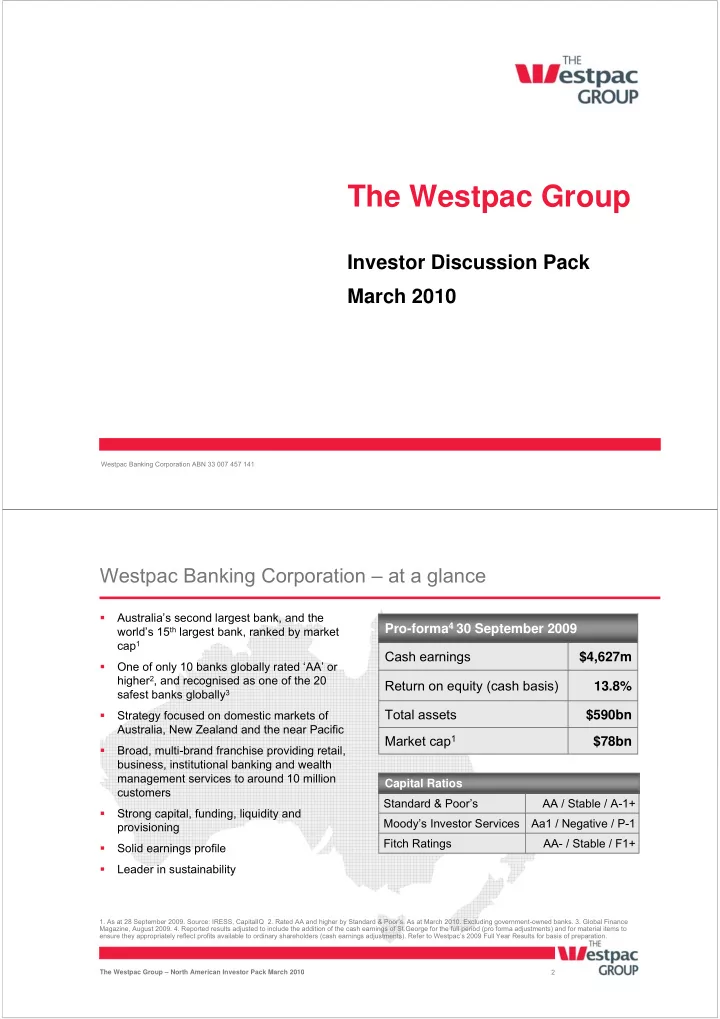
The Westpac Group

Investor Discussion Pack March 2010

2 The Westpac Group – North American Investor Pack March 2010

Westpac Banking Corporation – at a glance

  • Australia’s second largest bank, and the

world’s 15th largest bank, ranked by market cap1

  • One of only 10 banks globally rated ‘AA’ or

higher2, and recognised as one of the 20 safest banks globally3

  • Strategy focused on domestic markets of

Australia, New Zealand and the near Pacific

  • Broad, multi-brand franchise providing retail,

business, institutional banking and wealth management services to around 10 million customers

  • Strong capital, funding, liquidity and

provisioning

  • Solid earnings profile
  • Leader in sustainability
  • 1. As at 28 September 2009. Source: IRESS, CapitalIQ 2. Rated AA and higher by Standard & Poor’s. As at March 2010. Excluding government-owned banks. 3. Global Finance

Magazine, August 2009. 4. Reported results adjusted to include the addition of the cash earnings of St.George for the full period (pro forma adjustments) and for material items to ensure they appropriately reflect profits available to ordinary shareholders (cash earnings adjustments). Refer to Westpac’s 2009 Full Year Results for basis of preparation.

$78bn Market cap1 $590bn Total assets 13.8% Return on equity (cash basis) $4,627m Cash earnings Pro-forma4 30 September 2009

AA / Stable / A-1+ Standard & Poor’s AA- / Stable / F1+ Fitch Ratings Aa1 / Negative / P-1 Moody’s Investor Services Capital Ratios

slide-2
SLIDE 2

3 The Westpac Group – North American Investor Pack March 2010 3 The Westpac Group – North American Investor Pack March 2010

Australia well positioned during global downturn

  • Australia avoided recession and was one of few

countries to expand in 2009. GDP increased by 1.3% (year avg) and by 2.7% (through the year)

  • Unemployment is low by global standards and at

5.3% in January is down from a high of 5.8% in 2009

  • Policy stimulus played a key supportive role:

− Variable mortgage rates fell to a 41 year low. The RBA is in the process of lifting rates towards average levels given positive conditions − Fiscal stimulus has been timely, targeted and effective − 2008/09 stimulus represented 2.3% of GDP (focus on cash payments). Stimulus in 2009/10 also 2.3% of GDP (focus on building schools)

  • Government debt remains low and manageable -

Federal government had no net debt prior to crisis

  • Strong banking system: 4 major banks all AA rated
  • Other positives have been the momentum in mining

infrastructure projects and the boost from Asia Unemployment rate (%)

Sources: Facset, Westpac Economics Sources: Treasury budget papers

GDP growth: international comparison (%)

2 4 6 8 10 12 Jan-90 Jan-94 Jan-98 Jan-02 Jan-06 Jan-10 2 4 6 8 10 12 Eur o Ar e a Aust r a li a US J a pa n

  • 8
  • 6
  • 4
  • 2

2 4 Ireland Japan Germany Euro zone UK * Canada NZ US * Australia * year to Sep 2009

* yr to Dec '09

Strategy and St.George merger

slide-3
SLIDE 3

5 The Westpac Group – North American Investor Pack March 2010

A Transformational year

$41bn Market capitalisation Size Brands 7.8% 70% 44% 14% 13% 14% 13% 7m 1,045

  • 24
  • 13

Sept 08

Tier 1 Ratio Stable funding ratio Expense/income ratio Housing Business Household Deposits Wealth platforms Customers Branches (Aust) NPS1 Westpac RBB NPS1 St.George Customers Balance sheet Productivity Australian Market share Up almost 90% $77bn Positioned to support customers $400m in merger synergies Around 1% of the increase in mortgage and deposit market share has been from organic growth 40% distribution uplift Improving NPS

Movements

8.1% 84% 40% 23% 18% 23% 20% 10m 1,645

  • 15
  • 9

Sept 09

1 Source for Consumer NPS (Net Promoter Score): Roy Morgan Research – NPS of main financial institution Aged 14+. Data at Sep09. 6 The Westpac Group – North American Investor Pack March 2010

Westpac differentiated by its focus and strong franchise

Focus on core markets

Major Australian bank most focussed on Australia and New Zealand Leveraging customer-focussed, multi-brand strategy to grow both customers and products per customer

Strategically well placed

Westpac Bank of the Year 20091; St.George Home Lender of the Year1; RAMS Best Non-Bank Lender of Year1; Institutional Banking in lead position for relationships and products2; BTFG best investment platform3 Strong banking momentum, with consistent growth in market share in mortgages and deposits Growing share in wealth, with business model well suited to emerging industry changes including having transparent fees, open architecture Wrap, and low cost Super for Life product Portfolio of strong, distinctive brands increases strategic options

Transformational St.George merger

Adds multi-brand capability Increased Australian distribution network by 40%; total customers now around 10m Improved efficiency path, seeking a sub 40% expense to income ratio by FY11 Larger revenue base from which to leverage investment

Sustainability leader

Global sustainability leader Employer of choice

  • 1. Money Magazine June 2009. 2. Peter Lee July 2009. 3. BT Wrap ‘smart investor award for best investment platform and best margin loan’ Aug 09.
slide-4
SLIDE 4

7 The Westpac Group – North American Investor Pack March 2010

Good progress on our strategic priorities

  • Grew St.George customer numbers and had no disruption to Westpac RBB momentum
  • St.George momentum has been restored, consistently increasing market share in key

products

  • Expense synergies progressing ahead of plan

Integrate without customer disruption Merger

  • Simplifying processes, eliminating unnecessary requests, improving online tools
  • Effective use of overflow space and capacity between Westpac and St.George

Transform service delivery Operations

  • Built IT management bench strength and completed strategic roadmap incorporating

merger

  • Projects focused on improving the customer experience, including online capabilities

and an improved collections system

  • Improved systems reliability

Strengthen capability & improve flexibility / simplicity Technology

  • Staff engagement up 3 percentage points to 81%, results consistent across brands
  • Successful head office integration

Drive one team approach People 2009 and 1Q10 Progress Objective Strengthen and drive locally empowered business Earn all of our customers’ business

  • Westpac Local being rolled out, largely complete. Continuing roll-out in NZ
  • 13 new branches, 4 new business centres, and 124 new ATMs in 2009
  • St.George regional structure established, leveraging off successful BankSA model

Distribution

  • Products per customer - best of Australian banks1
  • Growing share across key products with Australian mortgages up 17% and total

customer deposits up 17% in 2009

  • Improving cross sell – Insurance, BT Super for Life

Customers

  • 1. Source: Business Intelligence Group based on August 2009 data.

8 The Westpac Group – North American Investor Pack March 2010

Westpac St.George

  • 30%
  • 20%
  • 10%

0% Jan-09 Apr-09 Jul-09 Oct-09 Jan-10

Customers are at the centre of everything we do

1 Dedicated call centre designed to support customers in early stress, including through adjusting loan terms/duration. 2 Net Promoter Score (NPS). Source for NPS: Roy Morgan Research – NPS of main financial institution Aged 14+. Major banks includes WBC, ANZ, CBA, and NAB (simple average).

Australian Consumer NPS2 – 6 month moving average (%)

  • Fully supported customers through the more challenging times:

− Institutional – continued to lend as capital markets closed − Consumer – funding for mortgage borrowers including first home buyers; improved deposits focus − Business – supporting debt reduction/consolidation through education − Extended Westpac Assist1 across small business and introduced St.George Assist − New and fairer exception fee structure

  • Investment focused on further improving customer experience:

− Continued roll-out of Westpac Local business model (largely complete) putting more decision making in the front

  • line. Model being rolled out in NZ

− New regional operating structure in St.George bringing senior management closer to customers − 13 new branches, 4 new business centres, and 124 new ATMs across Westpac and St.George brands in 2009

  • Work in progress:

− Improved call centre management and complaint resolution − Installing St.George sales and service desktop to Westpac − Program of cultural change across the organisation

  • Measuring success of putting customers at the centre is based
  • n ‘NPS’2. NPS measures the propensity of customers to

recommend our brands.

Major banks

slide-5
SLIDE 5

9 The Westpac Group – North American Investor Pack March 2010

Customer choice supported by multi-brand strategy

Lead Institutional bank in Australia/NZ with $75bn

in lending and $51bn in deposits

Leading provider of FX & Debt market products

Australia & New Zealand wide plus major international centres Full suite of institutional & corporate banking products including, FX, Debt Markets & Equities Westpac Institutional Bank

20% share in wealth platforms (includes Wrap) 10% of advice market (second largest network) 7% in life insurance

Australian wide Wealth management, private banking & insurance for

  • consumers. Superannuation for

Corporate and SME BT Financial Group

20% share of mortgages 19% share of household deposits

New Zealand wide Consumer and SME Westpac New Zealand

Largest bank in South Australia with 17% share of

mortgages and 23% share of household deposits South Australia & Northern Territory Consumer and SME BankSA

8% share of mortgages 9% share of household deposits

Australian wide but skewed to New South Wales & East Coast Consumer, SME and some corporate lending St.George

Non-bank lender of the year 70 outlets, small market share given no back book

Australia wide with focus on capital cities Specialist mortgage provider RAMS

16% share of mortgages 15% share of household deposits

Australia wide Consumer & SME banking Westpac Retail & Business Banking

Position/Share1,2,3 Geography Segment Business/Brand Following the St.George merger, Westpac has implemented a multi-brand strategy. Maintaining unique and distinct brands, enables the Group to support more customers and respect their choices

  • 1. Reserve Bank of Australia share of financial system (Dec 09). 2. For BankSA APRA share of banking system (Dec 09). 3. For Westpac New Zealand RBNZ Dec09

10 The Westpac Group – North American Investor Pack March 2010 115 175 70 70 100 100 120 143 255 400 7 (20) (150) (160)

  • 200

200 400 600 800 FY09 - Model FY09 Actual FY10 - Model FY11 - Target

Revenue benefits Funding benefits Expense synergies Revenue attrition

Merger benefits well ahead of plan

  • In FY09 merger benefits were $200m ahead of initial merger model:
  • Customer growth removes $150m drag per annum from the

customer attrition assumed in the original business case

  • Expense synergies 19% ahead of plan at $143m
  • Funding benefits fully achieved
  • Revenue benefits $7m versus plan of $20m cost:

−Commenced selling of BT insurance products into St.George, early trends positive −Launched BT Super for Life to St.George customers in early 2010

  • Utilised $392 of $700m integration spend

Year 1 merger benefits versus merger model ($m) 143 44 99 FY09 121 40 81 2H09 Annual run rate Benefits 19% ahead of plan; 59% of planned expense synergies already achieved Sourcing savings from a review of external contracts Rationalised head office costs Early technology and operations synergies 1,275 reduction in roles Comment 22 4 18 1H09 182 Personnel 234 Total 52 Non-personnel Expense synergies ($m)

1. Revenue benefit in FY09 model was a cost of $20m. Achieved $7m in benefits in FY09.

1

Model net $20m Actual net $220m

slide-6
SLIDE 6

11 The Westpac Group – North American Investor Pack March 2010

Technology – focus on improving customer experience

  • In 2009, the focus for Technology has been on

improving the customer experience

  • This has included improving system reliability,

developing the technology strategy and architecture for the merged Group and implementing the merger with St.George

  • Priority has now moved from strategy

development to implementation, with a detailed 5 year plan now in place

  • Major merger milestones completed:

– Reciprocal ATM usage – Group-wide IT connectivity, including for secure email

  • 2009 investment has significantly improved

systems reliability: – Disruptive incidents down over 75% over the year – Time to restore incidents improved by

  • ver 50%

– 76% decline in PC help desk calls

Completed in 2009:

12,700 new PCs installed across branches, contact centres and corporate sites. Supported by 12,200 new teller keyboards and pin-pads Upgraded bandwidth across network doubling capacity and reducing response times New Westpac website now up and running Systems investment to launch BT wealth/ insurance products into St.George General Ledger/Human Resource system integration complete

Under development:

Group wide sales and service desktop (teller and contact centre system) utilising scalable St.George platform Implement new online system for internet banking

Technology investment focused on improving the customer experience

12 The Westpac Group – North American Investor Pack March 2010

A leader in the global banking sector Measurement

  • Enhanced focus on material issues and

performance

  • Revised 2010 and 2013 objectives for

focus areas, part of a five year plan

  • Priorities integrated into business strategy,

project investment, product development and individual performance scorecards

  • Division plans roll up into Group objectives

coordinated via Sustainability Council Enhanced Accountability Strategy

  • Reduce direct and indirect emissions
  • Transition to low carbon economy
  • Sustainability led products and services
  • Leading human capital management
  • Responsible banking and investment
  • Engage on local issues and concerns
  • Leading risk management / governance

Objective: to be a global leader in sustainability – and clearly recognised as such by customers, investors, employees and communities

Top-rated (10.0) in 19 consecutive assessments Included in the Global Carbon Leadership Index (CLI) for sixth consecutive year

2010 objectives across key focus areas

Environment Tread lightly: footprint Transitioning to low carbon/water future Going mainstream: products & services Solid foundations: governance and risk management People and places

Reduce scope one and two emissions by 12.5%; paper consumption by 7%; water consumption by 6% (all on 2008 levels) Increased accountability for scope three emissions Develop framework for ESG1 analysis across all divisions Implement sustainable supply chain management across all countries and brands Enhanced governance and further implementation of UNPRI2 Provide carbon hedging and risk management products in Australia and New Zealand Embed carbon into credit and

  • ther risk processes

Continue to engage with customers on impacts Finance the growth of renewable energy generation Embed sustainability criteria into product design and decisions Launch energy efficiency loans Launch innovative savings product Employee engagement 81% Roll-out branch-based management, recruitment, community engagement Roll-out $1m cash and in-kind financial counselling support Report customer feedback on Assist (for customers with financial problems)

Embedded environment, social and governance management driving leading performance outcomes

1 ESG is Environmental, Social and Governance. 2 UNPRI is United Nations Principles for Responsible Investment.

slide-7
SLIDE 7

13 The Westpac Group – North American Investor Pack March 2010

A large regulatory and reform agenda…

  • Supportive of an expected loss

approach although current proposal is overly complex

  • Current high level of provisioning

sees Westpac well placed

  • Concerned that current proposal

would introduce unnecessary complexity to provisioning calculations and reporting

  • 2014 implementation provides

significant transition period

  • Moving to an expected cash flow

provisioning model from an incurred loss provisioning methodology

Credit Provisioning

  • Stricter liquidity requirements
  • Narrow definition of what qualifies

as liquidity

  • Considering a net stable funding

ratio

  • More conservative assessment of

capital under the Basel accord: – Revised capital deductions – Tougher treatment of hybrids – Greater focus on fundamental capital and Tier 1 capital – Considering leverage ratio

Proposals

  • Westpac has already significantly

changed its funding mix boosting its stable funding ratio

  • Holding $74bn in liquid assets

compared to pre GFC of $17bn

  • Current proposals would lead to a

significant increase in liquid assets and a change in the liquidity mix towards government securities and away from other bank paper

Funding & Liquidity

  • Westpac remains strongly

capitalised: – Tier 1 capital well above target range – Fundamental capital ratio comparable with domestic peers and at upper end of UK and Canadian peers (most relevant comparators)

  • Proportion of Hybrid equity in Tier

1 relatively small at 18%

  • In Australia impact is expected to

be less given: – APRA capital deductions are already conservative relative other jurisdictions – Hybrids are already a small proportion of capital (<25%)

  • Leverage ratio expected to be a

supplementary ratio only. Still need to differentiate for different asset risk

Capital The Westpac Group position/response Possible outcomes/ implications

Westpac is actively engaged with regulators to support sensible and practical regulatory change

14 The Westpac Group – North American Investor Pack March 2010

A large regulatory and reform agenda… cont.

  • Minimal changes required to

existing remuneration practices to

  • btain full compliance with

Standards, which will be achieved by 1 April 2010

  • APRA changes are principles

based so a level of flexibility remains whilst ensuring appropriate risk adjustment and management

  • APRA and other national

regulators introduced new provisions to ensure remuneration is appropriately risk adjusted

Remuneration

  • BT Financial Group has little

exposure to high fee legacy products and majority of platform fees are not ‘all in’

  • Super for Life fees already under

1%, has life stage funds as a default and no hidden commissions.

  • Supporting the unbundling of

advice fees, making financial advice tax deductible, delivering efficiencies and streamlining portability

  • Industry fees likely to gradually fall

closer to 1% from closer to 2%

  • Further move to a fee for service

rather than a commission based advice model

  • Introduction of a simple, low cost,

no commission default fund for those not actively managing their superannuation

  • Various industry reviews seeking

to simplify the industry and reduce costs to the consumer (including Cooper review)

Wealth Management

  • Supportive of change to

encourage more national savings

  • Working cooperatively with

authorities on disclosure and mindful of impact on various counterparties

  • Possible changes in tax incentives

for saving

  • Comprehensive review of

Australian tax system (Henry tax review)

  • Increased tax disclosure

Tax

Proposals The Westpac Group position/response Possible outcomes/ implications

slide-8
SLIDE 8

Financial Performance

16 The Westpac Group – North American Investor Pack March 2010

Sound performance in challenging conditions in 2009

Large 13.8% Return on equity (cash earnings)

  • 8%

$4,627m Cash earnings (pro forma)3 4% 7% Large 320bps 13%

  • 11%

% movement $3,446m Net profit after tax (reported) $329bn Total deposits $463bn Total loans 10.8% Return on equity (reported) 40.2% Cost to income ratio (cash earnings) $16,755m Revenue (cash earnings) Key financial data for full year to 30 September 2009 Cash earnings3 FY08 – FY09 ($m) 4,627 5,047 70 (300) 1,897 (2,087) 2,500 4,500 6,500 8,500 2008 Revenue Expenses Impairment Charges 2009

Tax, Minority Int. & Pref Divs

IAP1 CAP2

1 Individually assessed provisions. 2 Collectively assessed provisions. 3 Reported results adjusted to include the addition of the cash earnings of St.George for the full period (pro forma adjustments) and for material items to ensure they appropriately reflect profits normally available to ordinary shareholders (cash earnings adjustments). See disclaimer for details of preparation

slide-9
SLIDE 9

17 The Westpac Group – North American Investor Pack March 2010

A diversified portfolio

2,332 2,295 2,605 282 (36) (142) 63 45 (103) (72) (64) 21 (22) (65) (275) 14 81 2H08 WBC RBB St.George* WIB* BTFG* NZ PB GBU* 1H09 WBC RBB St.George* WIB* BTFG* NZ PB GBU* 2H09

* Pro forma basis.

Business unit contributions to cash earnings movement half on half ($m)

(8)% 66% 10% (50)% (8)% (58)% (5)% 9% Cash earnings growth over prior year (%) 10,015 980 168 735 729 2,044 2,085 3,274 Core earnings 11% 526 (339) (115) (24) 1,004 GBU* 4% 194 (75) (466) (604) 1,339 NZ 11% 493 (221) (15) (856) 1,585 BTFG* 8% 361 (155) (1,528) (1,028) 3,072 WIB* 23% 1,043 (448) (594) (1,200) 3,285 St.George* 2% 102 (43) (23) (85) 253 PB 100% 4,627 (2,096) (3,292) (6,740) 16,755 Group 41% 1,908 (815) (551) (2,943) 6,217 WBC RBB Operating income Contribution to cash earnings (%) Pro forma cash earnings Tax and minority interests Impairment charges Expenses 2009 cash earnings ($m)

18 The Westpac Group – North American Investor Pack March 2010

Supporting customers through the more challenging period

Australian mortgage customers supported via the assist program (customers in early stress3) (No.)

0.4 0.7 1.0 1.3 1.6 2H08 1H09 2H09 1Q10 Mortgages Deposits

St.George growth versus banking system1 (times)

  • 1. APRA Monthly Banking Statistics, December 2009. 2. The Relationship Strength Index is a single measure combining a range of service quality factors, including Relationship

Manager capability, visibility, knowledge of client’s business and industry, and understanding and advice. The number is a statistical combination of evaluations. Peter Lee (July/August 2009). Peer group includes ANZ, CBA and NAB 3. Customers contacting the Assist program for assistance in managing their mortgage repayments

0.4 0.8 1.2 1.6 2.0 2.4 2H08 1H09 2H09 1Q10 Mortgages Deposits

Westpac RBB growth versus banking system1 (times) Westpac Institutional Bank – Relationship Strength2

55 65 75 85 95 2007 2008 2009 WBC Nearest Peer

400 800 1,200

Mar-07 Jun-07 Sep-07 Dec-07 Mar-08 Jun-08 Sep-08 Dec-08 Mar-09 Jun-09 Sep-09

slide-10
SLIDE 10

19 The Westpac Group – North American Investor Pack March 2010

Small rise in customer margins

1 Pro forma basis.

  • Customer (consumer & business) margins

− FY09 up 7 basis points − 1Q10 down 5 basis points on 2H09

  • Treasury and Mix effects making up the

rest of margin growth, with Treasury margin contribution likely to retrace in 2010

  • 1Q10 reported margins flat on 2H09

2.32% 9bps 14bps 2.09% (9bps) 16bps 2.02%

2008 Asset spread/ mix Liability spread/ mix Treasury WIB & Other 2009

Net interest margin movement1 2008 – 2009 (%)

7bps 23bps

1.5 1.9 2.3 2.7 3.1 3.5 1998 2000 2002 2004 2006 2008

Group net interest margin (%)

2.39% 4bps 11bps 2.24% (2bps) 2bps 2.24%

1H09 Asset spread/ mix Liability spread/ mix Treasury WIB & Other 2H09

Net interest margin movement1 1H09 – 2H09 (%)

Flat 15bps

Includes St.George

20 The Westpac Group – North American Investor Pack March 2010

Excellent Markets and Treasury performance

  • Markets revenue in 2009 assisted by

− Strong customer flows − Higher market spreads reverting in 2H09 from return of competition − Well positioned for market movements

  • Very strong 2009 Treasury result

− 1H09 driven by Bills/Libor spreads and global interest rate movements − 2H09 from positioning of liquidity portfolio for narrowing credit spreads

  • VaR modestly higher in 2009
  • Unlikely to maintain Treasury and

Markets revenue at elevated levels in 2010

1. Pro forma basis. 2. VaR at 99% confidence level, 1 day hold period.

7.1 350 170 180

1H08

9.5 314 124 190

2H08

9.3 713 376 337

1H09 2H09

224 Customer activity 10.6 Average VaR2 367 Total 143 Trading Markets revenue1 ($m) 9.9 89 (1) 90

1H08

22.9 217 57 160

2H08

41.4 389 14 375

1H09 2H09

578 Net interest income 36.0 Average VaR2 581 Total 3 Non-interest income Treasury revenue1 ($m)

slide-11
SLIDE 11

21 The Westpac Group – North American Investor Pack March 2010

Expenses – maintaining investment

36 38 40 42 44 46 48 50 52 54

1H03 2H03 1H04 2H04 1H05 2H05 1H06 2H06 1H07 2H07 1H08 2H08 1H09 2H09

Expense to income ratio (%)

  • 1Q09 expense growth lower than FY09,

with a reduction in operating expense growth partly offset by increased strategic investment

  • FY09 expense growth of 5%, with

investment funded by productivity initiatives

  • Continued investment

− More employees in the front line − Additional branches and ATMs − Brand investment in St.George − Enhancing reliability of IT

  • Productivity benefits

− Merger benefits − Processing efficiencies in BT, and Product and Operations

AGAAP A-IFRS Pro forma incl St.George

FY09 40.2%

22 The Westpac Group – North American Investor Pack March 2010

Composition of quarterly impairment charges

1Q10 impairment charge around half that of recent quarters due to a reduction in new stressed assets, particularly in institutional

1Q10

Development property in Australia, mostly WA and SE Qld Small business stress continuing Development property in Australia and New Zealand Early signs of small business stress Economy impacting commercial sector Margin lending (in Institutional) Higher economic

  • verlay

Dominated by companies directly impacted by GFC

4Q09 3Q09 2Q09 1Q09

Impairment charges by quarter ($m)

200 400 600 800 1,000 Q109 Q209 Q309 Q409 1Q10 (for total Group) Other (incl. Eco Overlay) New Zealand Aust Consumer Aust Business Institutional

1. Australian business includes business customers in St.George, Westpac RBB, and Premium Business Group (PBG) within the Institutional Bank. 2. Includes Westpac Institutional Bank customers and Margin Lending excluding PBG (which are mostly commercial customers with exposures between $10m to $100m).

1 2

1% 7% (6%) (>50%)

slide-12
SLIDE 12

23 The Westpac Group – North American Investor Pack March 2010

1Q10 Cash earnings around $1.6bn

1Q10 impairment charge of around $0.4bn with decline over prior quarters mainly from the Institutional Bank No change to economic overlays Impairment charges Continued improvement in Wealth, with market recovery and improving sales Fee income impacted by exception fee reductions Markets income remained strong in 1Q10 although below 1Q09 levels Non-interest income Lending up 1.7% from September 2009, with virtually all growth in mortgages. Other personal and business flat, while corporate lower Customer deposits up 1.4%, particularly in term deposits Volumes Customer margins down 5bps, reported margins little changed from 2H09 given mix effects Margins Growth over prior corresponding quarter lower than FY09, with a reduction in

  • perating expense growth partly offset by increased strategic investment

Expenses

24 The Westpac Group – North American Investor Pack March 2010

2010 considerations – post strong 1Q10 start

  • We believe that we are well placed for changed environment with capital, funding and liquidity standards expected

to evolve over the year

  • Engaged in regulatory reform process – some way to go

Balance Sheet

  • Proceeding ahead of plan, no change to $700m integration costs or estimated cost savings
  • Single ADI completed on 1 March 2010 and Basel II advanced accreditation on target for middle of 2010

St.George Merger

  • Impairment charges expected to ease in 2010, however 1Q10 impairment charge of around $0.4bn was below

expectations, and some variability in quarterly impairment charges expected throughout the year

  • Commercial property portfolio being worked through with outlook improving. Valuations stabilised, investor

sentiment improving and development presales continue to clear

  • Consumer performing well although delinquencies expected to rise

Impairment charges

  • Merger synergies more prominent 2010, starting run rate $234m
  • Increased productivity focus gaining traction
  • Further rise in IT expenditure as the IT strategy is implemented

Expenses

  • Good balance sheet momentum and wealth recovering
  • Treasury and Markets income for FY10 unlikely to replicate FY09 levels
  • System credit growth remaining low; expect Westpac to grow above system
  • Higher funding costs, including deposits;
  • Reduction in exception fees to impact revenue by approximately $300m

Revenue

slide-13
SLIDE 13

25 The Westpac Group – North American Investor Pack March 2010

Factors influencing the return on equity

  • Westpac’s return on equity was lower over the year at 13.8%

(down from 22.3%). Key factors impacting the decline included: – St.George merger, including goodwill and associated equity (480bps) – The impact of lower cash earnings – Additional equity raised to strengthen the balance sheet, particularly in the first half of the year

  • The further fall in the return on equity in 2H09 principally reflects

the full period impact from capital issued through 1H09 (in December 2008 and February 2009)

  • Return on equity is expected to trend higher over the coming years

given: – Westpac’s fundamental capital ratio is already high by international standards, limiting the need for additional equity – No further equity dilution in train as no additional fundamental equity raised since February 2009 (apart from normal DRP and employee share issues) – Amortisation of intangibles following the merger with St.George will add around 10bps per annum to cash ROE

  • ver the next 5 years (no impact on cash return on tangible
  • rdinary equity)

– Wealth earnings are expected to be a larger contributor to returns as markets improve and cross-sell increases – Improved returns in some businesses, including institutional, from margin expansion and less fee discounting – Impairment charges likely to trend lower – This will be partially offset by likelihood of lower returns from Treasury and Markets in 2010 – both of which are high return businesses

  • Measures the return on equity deployed in the

business

  • More accurately measures businesses returns over

time, not distorted by movements in intangible items

  • A more relevant benchmark across companies
  • Provides a better link to dividend payment capacity

Return on tangible ordinary equity an important measure of returns

23.9 21.2 14.8 Average tangible ordinary equity $bn 34.8 32.2 17.2 Average ordinary equity $bn 19.6 21.7 25.6 Cash return on tangible

  • rdinary equity

14.3 1H09 21.9 2H08 Cash return on ordinary equity Returns on equity % 13.4 2H09

Capital, funding and liquidity

slide-14
SLIDE 14

27 The Westpac Group – North American Investor Pack March 2010

6.6

1.8 1.7 1.5 1.5

6.0 7.0 6.7 2H08 1H09 2H09 1Q10

Fundamental capital Hybrids

Strong balance sheet

Strong Tier 1 ratio at 8.5% − Healthy organic capital growth − Comfortably above target range High provision coverage − Economic overlay remains over $500m Funding profile improved − Customer deposits up 17% in FY09 and 1.4% in 1Q10 − Higher proportion of term wholesale funding, with a longer duration

Tier 1 Ratio (%)

105 125 142 143 2H08 1H09 2H09 1Q10 87 84 81 70 2H08 1H09 2H09 1Q10

Collectively assessed provisions/credit risk weighted assets (bps) Stable funding ratio1 (%)

1. Stable funding ratio includes, customer deposits plus term funding with a residual maturity greater than one year and securitisation. Ratio for 1H08 and 2H08 are on a Westpac standalone basis (not including the merger with St.George)

8.5 8.1 8.4 7.8

28 The Westpac Group – North American Investor Pack March 2010

Strong capital position

Westpac capital ratios under international standards1 (%)

11.1 8.5 7.0 14.0 10.9 9.2 14.7 11.5 9.9

Fundamental Tier 1 Tier 1 Total Regulatory Capital APRA FSA OSFI No No Yes Net dividends deducted 10% 10% 20% Downturn LGD floor for mortgages No No Yes Deduction for investments in insurance and/or funds management subsidiaries No No Yes IRRBB RWA included No No FSA (UK) No Yes APRA Yes No OSFI (Canada) Summary of major differences in capital measurement Only deduct intangibles excluding goodwill in excess of 5% DTA & certain capitalised expenses deducted

Fundamental capital ratios 2, 3, 4 (%)

7.1 7.0 8.3 6.8 Fundamental (APRA) WBC Peer 1 Peer 2 Peer 3 9 9.2 11.0 10 Fundamental (FSA) WBC UK Peer 1 UK Peer 2 UK Peer 3 9.9 9.4 9 8.2 7.5 7.2 Fundamental (OSFI) WBC CAD Peer 1 CAD Peer 2 CAD Peer 3 CAD Peer 4 CAD Peer 5 1 Financial Services Authority (FSA) and Office of the Superintendent of Financial Institutions (OSFI) calculations are estimates based on Westpac’s application of publicly available

  • standards. 2 Peer 1 as at 31 January 2010. Canadian Peer data as at October 2009 to January 2010. 3 UK Peers include Barclays, HSBC, and RBS. 4 CAD Peers include Bank of

Montreal, CIBC, RBC, Scotia Bank and TD.

289 6.6 10.8 10.7 8.1 FY09 10.9 Tier 1 ratio (FSA basis) (%) 7.0 Fundamental capital ratio (%) 292 Risk weighted assets ($bn) 1Q10 Key capital ratios 11.1 Total capital ratio (%) 8.5 Tier 1 ratio (%)

slide-15
SLIDE 15

29 The Westpac Group – North American Investor Pack March 2010

Strengthened funding profile & liquidity position

Funding composition by residual maturity1 (%)

1 Represents % of total net funding. Less than 12 months includes liquid assets excess over minimum. Netted equally against onshore and offshore. 2 Westpac standalone. 3 All assets are repo eligible with a central banks. 2008 comparatives have not been restated on a pro forma basis.

62 52 4 7 12 12 2 3 8 13 8 17 2008 2009

Wholesale Offshore <1Yr Wholesale Onshore <1Yr Securitisation Wholesale Offshore >1Yr Wholesale Onshore >1Yr Customer deposits

Stable funding ratio

2

74 62 45

20 30 40 50 60 70 80 2H08 1H09 2H09

Westpac liquid assets3 ($bn)

Funding:

  • Stable funding ratio improved to 84% at FY09 and 87% at

1Q10: − Targeting above 75%

  • Strong growth in customer deposits with the proportion

increasing to 62% of the Group’s funding, up from 52%

  • Increased proportion of wholesale term funding to 19%, up

from 16%

  • Reduced proportion of short term wholesale funding to 16%,

down from 30%

  • Raised $45bn of term funding over 2009 with weighted average

maturity of 4.2 years

  • Raised $21bn of term funding in 1Q10 with a weighted average

maturity of 4.8 years Liquidity:

  • Liquidity position strengthened in 2009:

− Treasury held liquid assets of $74bn3 at FY09 − Covers offshore maturities for more than 12 months

  • Additional liquidity of $2.6bn is also available, including trading

assets held in WIB Financial Markets

  • Formal review of liquidity framework underway with preliminary

APRA paper released

30 The Westpac Group – North American Investor Pack March 2010

Wholesale Funding costs continuing to rise

Average cost of term wholesale funding

(bps) (%)

Estimate

  • Proactive in funding markets:

− Supporting continued lending growth − Reverse enquiry from diverse investor base − Further lengthened funding profile with average tenor of new term issuance in 1Q10 of 4.8 years

  • Funding markets remain open but

cautious due to recent global events (e.g. Dubai World; Greece)

Range of estimated future average term w’sale funding costs (RHS) 20 40 60 80 100 Sep-05 Mar-06 Sep-06 Mar-07 Sep-07 Mar-08 Sep-08 Mar-09 Sep-09 Mar-10 Sep-10 Mar-11 Sep-11 20 40 60 80 100 120 140 160 180 200 Term funding as a % of w'sale funding Modelled marginal cost

  • f Aust term w'sale

funding (RHS) Marginal cost of Aust term w'sale funding (RHS) Average cost of term w'sale funding (RHS)

Range of potential future average wholesale funding costs. Actual outcome depends on loan growth, deposit growth and the cost of new funding. Average costs will be higher and may even be higher than the marginal cost given elevated offshore funding costs.

slide-16
SLIDE 16

31 The Westpac Group – North American Investor Pack March 2010

Retail funding costs higher over the year and rising

(3) (43) (33) 2007 2008 2009 67 (32) (43) 2007 2008 2009

  • Customers received much higher relative interest rates on retail

deposits over the last 12 months (relative to market rates)

  • Higher relative interest rates paid to customers impact

Westpac’s funding costs. The higher costs are principally due to increased competition with: − Term deposits rates relative to market (BBSY) up 99bps

  • ver the year

− Online interest rates relative to market (cash rate) up over 40bps over the year

  • A change in the mix of deposits, with more term deposits and

more online accounts has further increased funding costs

  • These trends will see retail funding costs continue to rise in the

year ahead

Australian customer deposits % of total

0% 20% 40% 60% 80% 100% Sep-08 Mar-09 Sep-09 At call Term Non-interest bearing

Australian term deposit interest rates

  • ver BBSY (bps)

Australian online account interest rates over

  • fficial cash rate (bps)

Term deposit rates are currently around 67bps higher than comparable market rates (BBSY) Rates for high interest online accounts are very competitive and close to the cash rate

Risk management

slide-17
SLIDE 17

33 The Westpac Group – North American Investor Pack March 2010

Stressed exposures stabilising in 1Q10

0.0% 0.5% 1.0% 1.5% 2.0% 2.5% 3.0% 2001 2002 2003 2004 2005 2006 2007 2008 1Q09 1Q09 1H09 3Q09 4Q09 1Q10 Watchlist & substandard 90 days past due w ell secured Impaired Includes St.George

Stressed exposures as a % of total committed exposures (TCE)

  • Primarily focused on working through existing

stressed facilities rather than uncovering new sources of stress

  • New stressed assets smaller, fewer and spread

across industries and geographies. Minimal write-offs in the quarter

  • Watchlist/substandard lower from debt

repayments/recapitalisations, particularly in Institutional Bank

  • Commercial property being worked through with
  • utlook improving:

− Valuations stabilised, investor sentiment improving − Development presales continue to clear − Level of stressed assets likely to remain high for some time − Commercial property lending <10% of gross loans (down from 13% a year ago)

  • Consumer performing well although

delinquencies expected to rise

34 The Westpac Group – North American Investor Pack March 2010

Impairment provisions to impaired assets (%)

41 27 32 38

10 20 30 40 50

WBC Peer 1 Peer 2 Peer 3

Source: Westpac, Company data as at December 2009. Peer 1 as at 31 January 2010.

40.7% 39.3% 48.4% Impairment provisions to impaired assets 188bps 182bps 152bps Collective provision to performing non-housing loans 169bps 164bps 160bps Total provisions to total RWA 143bps 142bps 125bps Collective provision to credit RWA 104bps 1Q10 99bps 1H09 101bps 2H09 Total provisions to gross loans Key coverage ratios

1.43 1.32 1.15 1.34

0.4 0.6 0.8 1.0 1.2 1.4 1.6

WBC Peer 1 Peer 2 Peer 3

Collective provisions to credit RWA (%)

Source: Westpac, Company data as at December 2009. Peer 1 as at 31 January 2010.

Increased provisioning levels, leading peers

slide-18
SLIDE 18

35 The Westpac Group – North American Investor Pack March 2010 * Other consumer includes credit cards, margin lending and personal loans. 1 Exposure by booking office.

Other, 1% Australia, 89% NZ/Pacific, 10%

Total exposure by region (%) as at 30 Sep 2009 On balance sheet lending (%) as at 30 Sep 2009

9 64,076

  • 82

4 4,528 59,462 BB- to B+ Exposure by risk grade1 as at 30 September 2009 ($m) % of Total <1% <1% <1% 10% 89% Exposure by region (%) 6 48 3 9 9 6 10 663,167 1,407 4,077 3,793 64,360 589,530 Total committed exposure 40,650

  • 3,729

36,921 Unsecured consumer 315,344

  • 30,931

284,413 Secured consumer 18,674 34 49 287 3,051 15,253 <B+ 60,226 91 452 589 7,153 51,941 BB+ to BB 56,488 440 1,345 1,141 7,281 46,281 BBB+ to BBB- 42,329 358 1,704 1,073 2,943 36,251 A+ to A- 65,380 484 445 699 4,744 59,008 AAA to AA- Group Asia Europe Americas NZ / Pacific Australia Risk grade

Low risk balance sheet composition

Mortgages, 61%

Other consumer*, 5%

Corporate, 11% Business, 23%

36 The Westpac Group – North American Investor Pack March 2010

Australian mortgage portfolio risk profile remains sound

Australian mortgage1 portfolio2 ($bn)

1 Represents all brands (Westpac, RAMS and St.George) as indicated. 2 Figures represent average balances over the half. 3 Includes Westpac and St.George excl. RAMS. 4 Average LVR of new loans is for the 12 months to 30 September 2009. 5 Includes Westpac and St.George excl. RAMS. 67 73 74 108 124 56 59 61 84 97 14 13 13 36 36 50 100 150 200 250 300 1H08 2H08 1H09 1H09 2H09 Portfolio loan/line of credit Investment Ow ner occupied

Proportion of portfolio

14% 48% 38%

Rebased to include St.George

71% 49% 68% Total3 1H09 70% 46% 67% Total3 WBC 2H09 70% 44% 67% 2H08 Average LVR of new loans4 Australian mortgage portfolio Average LVR of portfolio at

  • rigination

Average LVR based on current outstanding balances and value at origination

10 20 30 40 50 60 70 80 0-60% 60-70% 70-80% 80-90% 90-95% 95-97% 97- 100% LVR at origination LVR current outstanding balance &

  • riginal valuation

Australian mortgage5 portfolio LVR distribution (%)

Loan-to-Value Ratio (LVR) band % of portfolio

Australian mortgage1 delinquencies (%) 0.0 0.5 1.0 1.5 Mar-05 Sep-05 Mar-06 Sep-06 Mar-07 Sep-07 Mar-08 Sep-08 Mar-09 Sep-09

slide-19
SLIDE 19

37 The Westpac Group – North American Investor Pack March 2010

Commercial property - most stress in development and NZ

1 Geographic segments are shown by booking office location. 2 Stressed exposures include watchlist, substandard, 90 days past due well secured and impaired assets. 3 Includes exposures relating to both investment and development activities. 4 Total includes $148m of Pacific Banking exposures.

  • Developers’ cash flows have been impacted by weaker sales
  • Stress most evident for regions that were subject to higher growth

(WA and south-east Qld)

  • Valuation adjustments more severe for development sites

25.6% 13% 7,785 Development

  • Diverse portfolio, with market turnover and development activity

more resilient than for larger assets

  • Significant increase in stressed exposures, particularly from

downgrades in Qld and WA 10.3% 42% 25,724 Australia <$10m Investment Diversified property groups and property trusts3

  • Less than 10% of gross lending December 2009 (down from 13%

December 2008) 12.5% 100% 60,566 Total4 7% 17% 21% % Total 3,959 10,525 12,425 TCE ($m)

  • Stress is moderate for low-LVR, diversified exposures (multiple

properties), and customers that have raised equity

  • Most increase has been in watchlist & substandard categories,

where lower property valuations have not been offset by equity raisings or asset sales 9.1% Australia >$10m

  • Increase in stress mainly driven by valuation adjustments

increasing LVRs, rather than debt servicing issues 8.6% 22.9% % Stressed2

  • Weaker activity and a more depressed property market has led to

increased stress, particularly for development properties

  • Market liquidity remains depressed

New Zealand Comments Segment1 Exposures Sept 09

38 The Westpac Group – North American Investor Pack March 2010

First home buyers (FHB) an important market segment

  • FHB is an important market segment that the

Group has continued to support through this cycle

  • FHB represents 19% flows and 8% stock
  • Solid growth in this sector due to:

− RAMS whose activity targets FHB − Other lenders less active in this segment

  • FHB traditionally perform better than overall

portfolio through this cycle. Given: − Early in career and benefit from income growth − Loan often supported with two incomes in its early stages − Average borrower aged 32 and not just entering workforce

  • FHB tightened credit standards again in April 09:

− Increase servicing hurdles − More restrictive LVR − Additional genuine saving requirement − 170bps buffer to interest rates applied to assessing repayment serviceability

90+ days delinquencies: FHB v non-FHB mortgages (%) Characteristics of FHB v WBC Aust mortgage (average)

70 297 80 59 44 99 294 67 23 32 Age (year) Income ('000) Mortgage ('000) LVR (%) Insured (%) FHB WBC 0.0 0.1 0.2 0.3 0.4 0.5 Mar- 05 Sep- 05 Mar- 06 Sep- 06 Mar- 07 Sep- 07 Mar- 08 Sep- 08 Mar- 09 Sep- 09 FHB WBC

slide-20
SLIDE 20

39 The Westpac Group – North American Investor Pack March 2010

Lenders Mortgage Insurance – managing risk transfer

Lenders Mortgage Insurance structure Westpac Aust. Consumer residential mortgages not covered by LMI Westpac Aust. Consumer mortgages covered by WLMI & SGIA 30% of Westpac risk, and 60% of RAMS risk, is protected by quota share reinsurance

Retained risk is protected by a stop loss reinsurance programme

Stop loss reinsurance Genworth Aust. quota share Reinsurance

WLMI

Provides cover for residential mortgages originated under the Westpac and RAMS brands

SGIA

Provides cover for residential mortgages

  • riginated under the

St.George brand

1 SGIA is rated AA-/Aa3, Stable outlook. 2 The MCR is an insurers Minimum Capital Requirement. The MCR is determined having regard to a range of risk factors that may threaten the ability of the insurer to meet policyholder obligations.

75% 25%

Finalising stop loss reinsurance negotiations for SGIA

Reinsurance Stop loss reinsurance Genworth Aust. quota share 30% of St George risk is protected by quota share reinsurance

  • The Group has aligned risk acceptance processes and

reinsurance programmes of our two captive mortgage insurers, Westpac Lenders Mortgage Insurance (WLMI) and St.George Insurance Australia (SGIA)1: − SGIA has recently implemented a quota share reinsurance agreement with Genworth for 30% of St.George risk − SGIA is close to finalising negotiations with new stop loss reinsurer

  • Underwriting standards have been tightened – maximum LVR
  • n new business risks lowered to 90% as the Group now

sources mortgage insurance on residential mortgages with 90%+ LVR written since June 2009 directly from Genworth

  • Conservatively positioned – focus on risk management and

underwriting profit

  • All investments are in cash
  • Reinsurance arrangements transfer risk away from the bank and

provide cover during periods of extremely high claims

  • Both WLMI and SGIA are strongly capitalised (separate from

bank capital) and subject to APRA regulation: − WLMI capitalised at 1.30 MCR2 and SGIA at 1.54 MCR2 at September 2009

  • Scenarios confirm sufficient capital to fund claims arising from

events with return periods of up to 1 in 250 years: − In a 1 in 250 years loss scenario, estimated losses for WLMI $256m and SGIA $314m (net of re-insurance recoveries)

40 The Westpac Group – North American Investor Pack March 2010

Australian mortgage market – significantly different from the US

Australian mortgage market:

  • Majority of housing loans are variable rate – approx. 80% of Westpac portfolio
  • Low loan-to-value ratios – Westpac average LVR at origination 67%
  • For mortgage-insured loans, mortgage insurance covers the entire loan
  • Interest payments on primary residence are not tax deductible – generally leads to mortgages being paid off quicker
  • Banks in Australia have recourse to the borrower’s mortgaged property and other assets
  • Serviceability assessed on current income + interest rate buffer not assessed on “honeymoon rates”
  • House prices have begun to improve

RBA estimates sub-prime lending approx. 1% of the Australian market – no NINJA loans or other high risk products Housing market fundamentals are sound – price depreciation not as severe as US market Non-conforming and sub-prime loans small proportion

  • f the market

Australian mortgage market undersupplied prior to crisis RBA estimates sub-prime lending approx. 15% of the US market Decline in house prices has coincided with riskier lending (e.g. no equity home loans, stated income loans to wage earners) Adjustable rate mortgages have exposed borrowers to rising interest rates US mortgage market oversupplied prior to crisis

Australia United States

slide-21
SLIDE 21

41 The Westpac Group – North American Investor Pack March 2010

Prior investments in risk management systems have positioned portfolio well

  • Investment in collections capabilities in prior years

has seen early cycle delinquencies trend down over a long period of time. Over year to Sep 09: − Credit Cards 1-29 day delinquencies down 50bps − Personal loan 1-29 day delinquencies down 74bps, despite tougher economic conditions

  • Limits the number of customers entering late cycle

delinquencies and enhances recovery rates

  • Attributable to:

− Improved income for consumers as a result of interest rate reductions and government stimulus − Introduction of advanced risk segmentation in

  • riginating accounts and within collections

strategies − Further improvements in matching resource levels to appropriate customer risk profiles

  • Expect consumer delinquencies to rise in 2010 due to

lagged effect from rising unemployment Australian credit cards 1-29 day delinquencies (%) Australian personal loans 1-29 day delinquencies (%) 3.5 4.0 4.5 5.0 5.5 6.0 Mar-04 Sep-04 Mar-05 Sep-05 Mar-06 Sep-06 Mar-07 Sep-07 Mar-08 Sep-08 Mar-09 Sep-09 5.0 5.5 6.0 6.5 7.0 Mar-04 Sep-04 Mar-05 Sep-05 Mar-06 Sep-06 Mar-07 Sep-07 Mar-08 Sep-08 Mar-09 Sep-09

42 The Westpac Group – North American Investor Pack March 2010

New Zealand business portfolio experiencing higher stress with prolonged economic downturn

  • New Zealand economy in recession for five quarters, from Q208 and ending in Q209
  • New Zealand business stressed exposures up 855bps to 16.24%:
  • Most stress being felt in the property sectors with early signs of stress in the agribusiness sector
  • Watchlist and Substandard business exposures up 731bps to 14.38%:
  • Watchlist focus covers all sectors given length of recession in NZ
  • Impaired business exposures up 93bps to 1.44%, mainly in property
  • Top 10 stressed exposures increased by 90bps to 4% of business TCE

4 8 12 16 2005 2006 2007 2008 2009

Watchlist and Substandard 90 days past due well secured Impaired

% Stressed exposures as a % of New Zealand Business TCE1

1 TCE is total committed exposure. 2 Other includes accommodation, cafes and restaurants, transport, finance and insurance.

14% 28% 10% 3% 35% 3% Agriculture, Forestry and Fishing Manufacturing Wholesale trade Retail trade Property Other 2

slide-22
SLIDE 22

Economics

44 The Westpac Group – North American Investor Pack March 2010 44 The Westpac Group – North American Investor Pack March 2010

Australian and New Zealand economic outlook

Key economic indicators as at February 2010 Calendar year 2008 2009 2010f World GDP 3.0

  • 1.0

3.8 Australia1 GDP3 2.4 1.3 3.3 Private consumption3 2.7 2.2 3.6 Business investment2,3 12.5

  • 1.0

4.5 Unemployment – end period 4.6 5.5 5.2 CPI headline – year end 3.7 2.1 2.6 Interest rates – cash rate 4.25 3.75 4.50 Credit growth, Total – year end 6.8 1.5 5.0 Credit growth, Housing – year end 7.8 8.2 9.0 Credit growth, Business – year end 8.0

  • 7.1
  • 1.0

New Zealand GDP

  • 1.4

3.7 4.3 Unemployment – end period 4.7 7.3 6.5 Consumer prices 3.4 2.0 2.7 Interest rates – official cash rate 5.0 2.5 4.0 Credit growth – Total3 10.5 4.4 3.1 Credit growth– Housing3 8.5 3.1 3.7 Credit growth– Business (incl. agriculture)3 14.1 6.8 2.3

1 GDP and component forecasts were updated following the release of quarterly national accounts. 2 Business investment adjusted to exclude the effect of private sector purchases of public assets. 3 Annual average percentage change basis. Source: Westpac Economics.

slide-23
SLIDE 23

45 The Westpac Group – North American Investor Pack March 2010 45 The Westpac Group – North American Investor Pack March 2010

Australia – upbeat prospects for 2010

  • The Australian economy, after gaining momentum
  • ver the second half of 2009, is set to return to trend

growth in 2010 – if not better

  • GDP growth is forecast to be around 3.3% yr avg in

2010, and to be 3.5% (with upside risks) through the year

  • In response to policy stimulus, two building booms

(housing and schools) will be key growth engines

  • Dwelling approvals jumped 48% in the year to

January, given very favourable fundamentals: − 41 year low in interest rates; government incentives for First Home Buyers, brisk population growth and pent-up demand

  • Federal Government is spending about $7bn on

public housing and $15bn on schools over two years

  • Firms are hiring again (employment surged 1.8% over

the 5 months of January) and are revising up investment plans (capacity utilisation levels have rebounded to be a little above historic average)

  • Consumers, buoyed by greater job security and rising

wealth, are upbeat and spending more freely – even with the end of the governments cash handouts Housing building boom 2010 & beyond

  • 10

40 90 140 190 240 Jul-91 Jul-95 Jul-99 Jul-03 Jul-07

  • 10

40 90 140 190 240 Housing stock deficiency (est.) Dwelling approvals (annualised) +53%yr

Sources: ABS, Westpac Economics Sources: ABS, Westpac Economics

School building: burst of activity

2 4 6 8 10 12 14 16 2 4 6 8 10 12 14 16 private * public * education $bn, 6mth $bn, 6mth Non-residential building approvals * ex education Half years: Dec '03 to Dec '09

46 The Westpac Group – North American Investor Pack March 2010 46 The Westpac Group – North American Investor Pack March 2010

Credit growth expected to improve

Source: RBA, RBNZ, Westpac Economics

Credit growth (%)

  • 10
  • 5

5 10 15 20 25 30

Sep-99 Sep-00 Sep-01 Sep-02 Sep-03 Sep-04 Sep-05 Sep-06 Sep-07 Sep-08 Sep-09 Sep-10 Sep-11

  • Aust. housing
  • Aust. business

Total credit (Aust) Total credit avg (Aust) Total housing avg (Aust) Total credit (NZ) Forecasts to Sep ‘11

slide-24
SLIDE 24

47 The Westpac Group – North American Investor Pack March 2010 47 The Westpac Group – North American Investor Pack March 2010

Australia – positive medium-term growth prospects

  • Australia is unique among advanced countries
  • Like other advanced economies, the services sectors

dominate and are continuing to grow in importance − Communications was the fastest growing sector

  • ver last 20 years. Education and tourism are

major exports, with a focus on the Asian region

  • The difference is that Australia is a major commodity

producer and resources are the dominant export

  • The growing emergence of commodity hungry China

has driven a sharp lift in Australia’s terms of trade – thereby boosting national income: − A rebound to historic highs is expected, with coal & iron ore prices to rise in 2010 by 20%–to– 40%

  • Mining investment has responded, doubling over the

last four years to be 4.25% of GDP in 2008/09

  • Population growth has accelerated to 2.1% p.a., as

job opportunities increase

  • The outlook is very positive – particularly for energy:

− Investment in the LNG sector could rise from 0.5% of GDP to 2.5% within 5 years. Notable is the commencement of the $50bn Gorgon project

Sources: ABS, Westpac

40 60 80 100 120 Mar-70 Mar-80 Mar-90 Mar-00 Mar-10 40 60 80 100 120 Terms of trade index index Forecasts to end 2011

Terms of trade up, as commodity prices rise

Sources: ABS, Westpac Economics

1 2 3 4 5 6 1959 1969 1979 1989 1999 2009 2019 1 2 3 4 5 6 % of GDP % of GDP

Mining investment: upward trend to resume

48 The Westpac Group – North American Investor Pack March 2010

Disclaimer

The material contained in this presentation is intended to be general background information on Westpac Banking Corporation (“Westpac”) and its activities. It does not constitute a prospectus, offering memorandum or offer of securities. It should not be reproduced, distributed or transmitted to any person without the consent of Westpac and it is not intended for distribution in any jurisdiction in which such distribution would be contrary to local law or reputation. The information is supplied in summary form and is therefore not necessarily complete. Also, it is not intended that it be relied upon as advice to investors or potential investors, who should consider seeking independent professional advice depending upon their specific investment objectives, financial situation or particular needs. The material contained in this presentation may include information derived from publicly available sources that have not been independently verified. No representation or warranty is made as to the accuracy, completeness or reliability of the information. All amounts are in Australian dollars unless otherwise indicated. Presentation of financial information Unless otherwise noted, financial information in this presentation is presented on a cash earnings basis. Refer to Westpac’s Full Year 2009 Results (incorporating the requirements

  • f Appendix 4E) for the financial year ended 30 September 2009 available at www.westpac.com.au (“Profit Announcement”) for details of the basis of preparation of cash earnings.

The material contained in this presentation includes pro forma financial information. This pro forma financial information is prepared on the assumption that Westpac’s merger with St.George Bank Limited (“St.George”) was completed on 1 October 2007 with the exception of the impact of the allocation of purchase consideration, associated fair value adjustments and accounting policy alignments, which are only incorporated from the actual date of the merger, 17 November 2008. The pro forma financial information is

  • unaudited. It is provided for illustrative information purposes to facilitate comparisons of the latest period with prior periods and is not meant to be indicative of the results of
  • perations that would have been achieved had the merger actually taken place at the date indicated.

The pro forma financial information should be read in conjunction with the reported financial information in the Profit Announcement. Refer to the Profit Announcement for a description of the basis of preparation of pro forma financial information for the year ended 30 September 2009 and prior comparative periods. Future operating results may differ materially from the unaudited pro forma financial information presented in this presentation due to various factors including those described below in the section “Disclosure regarding forward-looking statements”. Disclosure regarding forward-looking statements This presentation contains statements that constitute “forward-looking statements” within the meaning of Section 21E of the US Securities Exchange Act of 1934. The forward- looking statements include statements regarding our intent, belief or current expectations with respect to our business and operations, market conditions, results of operations and financial condition, including, without limitation, future loan loss provisions, financial support to certain borrowers, indicative drivers, forecasted economic indicators and performance metric outcomes. We use words such as ‘will’, ‘may’, ‘expect’, 'indicative', ‘intend’, ‘seek’, ‘would’, ‘should’, ‘could’, ‘continue’, ‘plan’, ‘probability’, ‘risk’, ‘forecast’, ‘likely’, ‘estimate’, ‘anticipate’, ‘believe’, or similar words to identify forward-looking statements. These statements reflect our current views with respect to future events and are subject to change, certain risks, uncertainties and assumptions which are, in many instances, beyond our control and have been made based upon management’s expectations and beliefs concerning future developments and their potential effect upon us. Should one or more of the risks or uncertainties materialise, or should underlying assumptions prove incorrect, actual results may vary materially from the expectations described in this presentation. Factors that may impact on the forward-looking statements made include those described in the section entitled 'Risk and risk management' in Westpac’s 2009 Annual Report on Form 20-F filed with the U.S. Securities and Exchange Commission on 13 November 2009. When relying on forward-looking statements to make decisions with respect to us, investors and others should carefully consider such factors and other uncertainties and events. We are under no

  • bligation, and do not intend, to update any forward-looking statements contained in this presentation.