The What and the How A goal of AI is to learn how to build software - - PowerPoint PPT Presentation

the what and the how
SMART_READER_LITE
LIVE PREVIEW

The What and the How A goal of AI is to learn how to build software - - PowerPoint PPT Presentation

The What and the How A goal of AI is to learn how to build software components of intelligent agents capable of reasoning and acting in a changing environment. To exhibit intelligent behavior, an agent should have a mathematical model of


slide-1
SLIDE 1

The What and the How

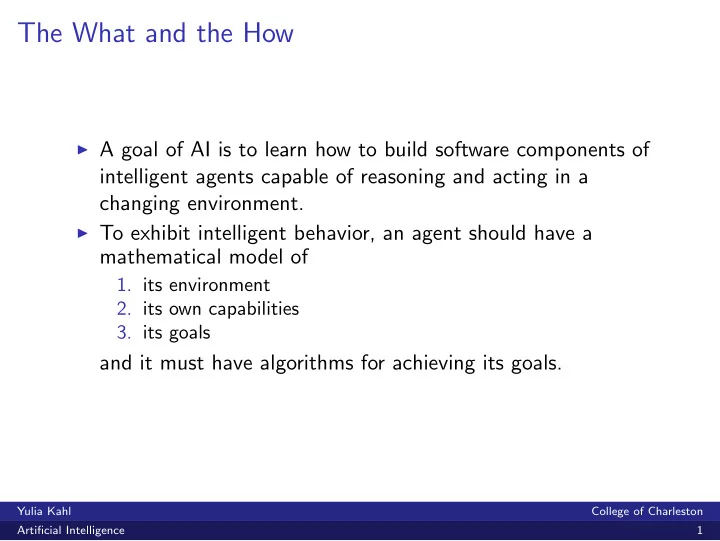
◮ A goal of AI is to learn how to build software components of

intelligent agents capable of reasoning and acting in a changing environment.

◮ To exhibit intelligent behavior, an agent should have a

mathematical model of

  • 1. its environment
  • 2. its own capabilities
  • 3. its goals

and it must have algorithms for achieving its goals.

Yulia Kahl College of Charleston Artificial Intelligence 1

slide-2
SLIDE 2

The Why

  • 1. AI can give us insights into the nature of thought. For the

first time in history, researchers are applying a new tool — the computer — to study and test their ideas by designing intelligent agents!

  • 2. AI can help us with software engineering.
  • 3. AI can give us things of practical value such as decision

support systems, intelligent search engines, and robots.

  • 4. AI can serve as a connection between disciplines, both within

computer science and between CS and science, logic, philosophy, and linguistics.

Yulia Kahl College of Charleston Artificial Intelligence 2

slide-3
SLIDE 3

What Is an Agent?

◮ agent — an entity that observes and acts on its environment

and directs its activity toward achieving goals; i.e., almost any program.

◮ intelligent agent — performs complex reasoning tasks that

lead to nontrivial behavior

◮ adaptive agent — adapts to changes in its environment ◮ autonomous agent — independent of human control

Yulia Kahl College of Charleston Artificial Intelligence 3

slide-4
SLIDE 4

What Is a Mathematical Model of an Agent?

◮ a language(s) for representing the agent’s knowledge ◮ reasoning algorithms for things like

◮ learning ◮ planning ◮ diagnostics

Often based on sophisticated search.

◮ agent architecture — structure combining different submodels

  • f an agent into one coherent whole

Yulia Kahl College of Charleston Artificial Intelligence 4

slide-5
SLIDE 5

What Does an Agent Do?

We’ll look at a simple agent architecture:

  • 1. observe the world:

◮ make sure that what you sense makes sense ◮ update what you know based on what you sense

  • 2. select a goal
  • 3. search for a plan to achieve the goal
  • 4. carry out the beginning part of the plan, update your view of

the world based on what you did, return to step 1.

Yulia Kahl College of Charleston Artificial Intelligence 5

slide-6
SLIDE 6

AI Has Become a Vast Field

AI as a field has grown very large so it is impossible to cover all subfields in one class with any depth. All are rich fields pursued by a lot of scientists from different angles. It is exciting!

◮ natural language processing ◮ computer vision ◮ planning ◮ diagnostics ◮ learning ◮ * This is not an exhaustive list.

Yulia Kahl College of Charleston Artificial Intelligence 6

slide-7
SLIDE 7

Various Approaches

We will cover neural nets, genetic algorithms, hidden Markov models for NLP, and then jump into ASP to learn about defaults, hierarchies, planning, diagnostics, and the subtleties of Bayesian

  • reasoning. This will cover

◮ biological ◮ evolutionary ◮ statistical ◮ and logical approaches to AI.

All have lead to significant discoveries.

Yulia Kahl College of Charleston Artificial Intelligence 7