The z=0.89 molecular absorber toward PKS1830-211: molecules as - - PowerPoint PPT Presentation
The z=0.89 molecular absorber toward PKS1830-211: molecules as cosmological probes Sbastien Muller Onsala Space Observatory, Sweden Cosmology for All Lund, 2013 Feb. 4 Interests of molecular absorption studies at z>0 - Chemical
- Chemical inventory and gas properties in distant galaxies
- No distance dilution
- Spatial resolution (continuum illumination ~ few mas)
Interests of molecular absorption studies at z>0 As cosmological probes
- CMB temperature as a function of redshift
- Test of variations of fundamental constants (α, μ=mp/me)
- H0
- Chemical enrichment of the Universe (isotopic ratios)
Source z(abs) Background continuum flux (Jy @3mm) N(H2) (cm-2) Molecules detected Cen A 0.002 6 2 x 10²⁰
CO, OH, NH3, CN, HCO+, HCN, N2H+, CS, H2CO, C3H2
3C293 0.045 2 x 10¹⁹
CO, HCO+, HCN
4C31.04 0.060 1 x 10¹⁹
CO, HCO+, HCN
PKS 1413+135 0.247 0.5 5 x 10²⁰
CO, CN, HCO+, HCN, HNC
B 1504+377 0.673 0.4 5 x 10²⁰
CO, HCO+, HCN, HNC
B 0218+357 0.685 0.5 lensed 4 x 10²¹
CO, NH3, H20, HCO+, HCN, HNC, CS, H2S, H2CO
PKS 0132-097 0.765 0.4
OH (only)
PKS 1830-211 0.886 2-3 lensed 2 x 10²² > 40 ! species (not incl. isotopic variants)
Extragalactic radio-mm molecular absorbers
e.g. see review by Combes 2008
PKS1830-211 is the most notable radio molecular absorber at z>0
Of the only 5 distant radio molecular absorbers known to date (0.24 < z < 0.89) PKS1830-211 has:
- highest redshift: z=0.89
- brightest mm continuum
- largest amount of absorbing material
- gravitational lens
- molecular absorption toward the SW and NE
images of the quasar
- time variations (continuum & molecular profile)
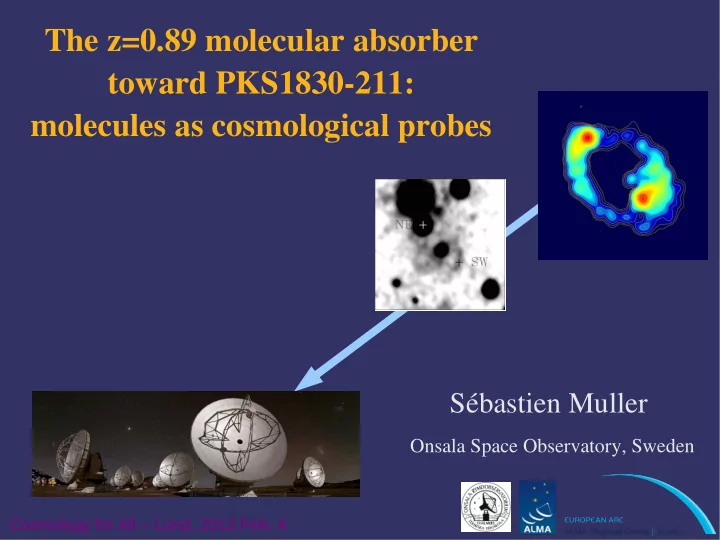
PKS1830-211
Foreground z=0.19 galaxy Lensed images
- f the quasar
z=0.89 absorber HST, Courbin et al
Unbiased ATCA-7mm spectral survey
- Frequency coverage 30 - 50 GHz with ATCA
- 28 species + 8 isotopic variants detected toward the SW LOS
- Molecular abundances similar to that of Galactic diffuse/translucent clouds
Universality of chemistry !
- Excitation mostly coupled with the CMB photons
- Additional velocity components at -300, -225, and +170 km/s (unknown origin)
Muller et al 2011
ALMA Early Science (Cycle 0) data
APEX - Menten et al 2008
The ground-state transition of ortho-water:
- > Deepest absorption of all observed lines
- > Heavy saturation toward SW LOS
- > Multiple velocity components toward both LOS
- > Absorption spanning a large velocity range
Muller et al in prep
H2O
ALMA: Main absorption along the SW LOS
Saturated Optically thick Optically thin
ALMA: Absorption along the NE LOS
- Multiple velocity
components
- Large velocity span
- Similarity of H2O and
HCO+ profiles
- Optically thin lines
ATCA Muller et al 2011
1 atom 2 atoms 3 atoms 4 atoms 5 atoms 6 atoms 7 atoms H CH NH2 NH3 CH2NH CH3OH CH3NH2 C OH H2O H2CO c-C3H2 CH3CN CH3CCH CO C2H l-C3H l-C3H2 NH2CHO CH3CHO CS HCN HNCO H2CCN SiO HNC HOCO+ H2CCO NS N2H+ H2CS C4H SO HCO+ HC3N SO+ HCO HOC+ H2S H2Cl+ HCS+ C2S
Chemical inventory toward the SW LOS
42 species + 14 isotopic variants
See Muller et al 2011, 2013 + in prep
@ z=0.89 !
ATCA 7 mm + 3 mm RADEX + Monte Carlo Markov Chains Best fit to the data:
TCMB = 5.08 ± 0.10 K (68%)
Tkin ~ 80 K n(H2) ~ 1000 - 2000 cm-3 Muller et al 2013
Multi-transition excitation analysis
TCMB = 5.08 ± 0.10 K
- > Consistent with adiabatic expansion of the Universe:
TCMB(z) = T0 x (1+z) … = 5.14 K @z=0.89
The TCMB – redshift law
See Noterdaeme et al 2011
Probing the cosmological variations of fundamental constants of Physics with molecules
- Astronomical constraints toward high-z quasars cover longer time (and space) span
than laboratory measurements
- A variation of e.g. or µ=mp/me would introduce a shift in transition frequency
Hence a velocity offset between two lines i,j with different freq dependence in a, µ ∆Vij / c = (Kµ
i – Kµ j ) ∆µ/µ + (Kα i – Kα j ) ∆α/α
Sensitivity coefficients
- H2: |∆Kµ| ~ 0.01
- Inversion lines of NH3 wrt a rotational line: |∆Kµ| = 3.5
Flambaum & Kozlov 2007
- Various lines of CH3OH have different sensitivity: Kµ = -40 to +50 Jansen et al 2011
- CI wrt a rotational line |∆Kµ| = 1, |∆Kα| = 2
- CH @532,536 GHz wrt a rotational line: |∆Kµ| = 0.8, |∆Kα| = 1.6
de Nijs et al 2012
- OH conjugate lines have sensitivity to G=gp(µα2)1.85
e.g. Kanekar et al 2010
e.g. Constraints on ∆µ/µ using molecules
Method Target
∆µ/µ
Ref. inv.NH3 vs (HCO+, HCN) B0218+357 z=0.68 < 1.8 x 10⁻⁶
Murphy et al 2008
inv.NH3 vs HC3N PKS1830-211 z=0.89 < 1.4 x 10⁻⁶
Henkel et al 2009
inv.NH3 vs (CS, H2CO) B0218+357 z=0.68 < 3.6 x 10⁻⁷
Kanekar 2011
inv.NH3 vs (average of 22 species) PKS1830-211 z=0.89 < 2.2 x 10⁻⁶
Muller et al 2011
CH3OH vs (average of 22 species) PKS1830-211 z=0.89 < 1.4 x 10⁻⁶
Muller et al 2011
CH3OH PKS1830-211 z=0.89 < 6.3 x 10⁻⁷
Ellingsen et al 2012
CH3OH PKS1830-211 z=0.89 < 3.0 x 10⁻⁷
Bagdonaite et al 2013
Issues:
- Chemical segregation
- > Observe self-reference (e.g. CH3OH)
- > Statistical constraint wrt multi references
- Excitation/opacity effects
- Time variability of the continuum
- > Simultaneous observation of reference
- Change of the continuum morphology with frequency
Time delay and H0
- Altern. using molecules
Wiklind & Combes (1999)
SEST monitoring HCO+ J=2-1 line Time delay: 24 (-4 +5) days + Lens model (Nair et al 1993) H0 = 69 (-11 +12) km s-1 Mpc-1 (q0=0.5)
Total continuum flux NE + SW images Depth of HCO+ 2-1 line (= flux of SW image)
Time delay + lens model => geometrical measurement of H0 Need to 1) Resolve the NE-SW images, separated by 1'' 2) Disentangle the core-jet emission of the quasar ATCA 8.6 GHz Time delay = 26 (-5+4) days
(Lovell et al 1998)
Isotopic ratios
Ratio @z=0.89 Note Earth
D/H < 7e-4
Upper limit Cosmic
2.5e-5
12C/13C
30 - ?
Difficult to measure due to opacity / fractionation effects
89
14N/15N
100 - 200
~< (Uncertainty from 12C/13C)
272
16O/18O
~100
< (Uncertainty from 12C/13C)
499
18O/17O
13 ± 3
>
5.5
28Si/29Si
7 ± 0.5
(preliminary)
<
22
29Si/30Si
1.9 ± 0.3
(preliminary)
~
1.5
32S/34S
10.5 ± 0.5
<
22.5
35Cl/37Cl
~3
~
3.1
- PKS1830-211 is a unique target for molecular absorption studies
- > Basic gas properties and interstellar chemistry
in the disk of a z=0.89 galaxy
- Molecules as cosmological probes:
- > Evolution of the CMB temperature with z
- > Variations of fundamental constants
- > H0
- > Isotopic ratios and nucleosynthesis constraints
- Unfortunately, only a handful of known z>0 mm-radio absorbers