THEORETICAL STUDY OF NONLINEAR PHOTOLUMINESCENCE FROM PEROVSKITE - - PowerPoint PPT Presentation

theoretical study of nonlinear photoluminescence from
SMART_READER_LITE
LIVE PREVIEW

THEORETICAL STUDY OF NONLINEAR PHOTOLUMINESCENCE FROM PEROVSKITE - - PowerPoint PPT Presentation

THEORETICAL STUDY OF NONLINEAR PHOTOLUMINESCENCE FROM PEROVSKITE QUANTUM DOTS ENHANCED BY RESONANT SILICON NANOPARTICLES Lab symbolics D. Khmelevskaia 1 , P. Tonkaev 1 , D. Markina 1 , A. Pushkarev 1 , A. Rogach 2 , S. Makarov 1 1 or author


slide-1
SLIDE 1
  • D. Khmelevskaia1, P. Tonkaev1, D. Markina1, A. Pushkarev1, A. Rogach2, S. Makarov1

1

THEORETICAL STUDY OF NONLINEAR PHOTOLUMINESCENCE FROM PEROVSKITE QUANTUM DOTS ENHANCED BY RESONANT SILICON NANOPARTICLES Lab symbolics

  • r author photo

1ITMO University, 49 Kronverkskiy pr., St. Petersburg, Russia, 197101 2Department of Materials Science and Engineering, and Centre for Functional Photonics (CFP), City

University of Hong Kong, Kowloon, Hong Kong SAR, P. R. China

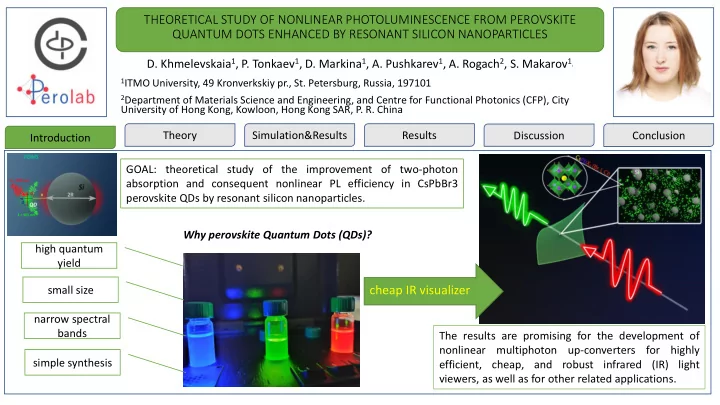
Introduction Theory Simulation&Results Results Discussion Conclusion Why perovskite Quantum Dots (QDs)?

cheap IR visualizer

GOAL: theoretical study of the improvement of two-photon absorption and consequent nonlinear PL efficiency in CsPbBr3 perovskite QDs by resonant silicon nanoparticles. The results are promising for the development of nonlinear multiphoton up-converters for highly efficient, cheap, and robust infrared (IR) light viewers, as well as for other related applications. high quantum yield small size narrow spectral bands simple synthesis

slide-2
SLIDE 2

Introduction Theory

The emission intensity at multifold frequency is significantly inferior to the incident IR radiation intensity due to the nonlinear nature of the process. It is important to maximize QDs emission quantum efficiency via increasing of Purcell factor near resonant Si NP in combination with near-field enhancement at IR pump wavelength. Theoretical model for nonlinear PL enhanced in CsPbBr3 QDs

(1) (2) 2 (3) 3

... P E E E       = + + +

Purcell Factor: R P

F   =

3 2

3 4

P c

F Q V     =    

  • D. Khmelevskaia1, P. Tonkaev1, D. Markina1, A. Pushkarev1, A. Rogach2, S. Makarov1

1

THEORETICAL STUDY OF NONLINEAR PHOTOLUMINESCENCE FROM PEROVSKITE QUANTUM DOTS ENHANCED BY RESONANT SILICON NANOPARTICLES Mie Resonances in Silicon nanoparticles with radius 80 nm

According to the Mie theory, strong optical resonances can be generated in small dielectric NPs [1]. Placing an excited quantum emitter near Si NP leads to interaction between them and, as a result, to the multifold enhancement of QD radiation intensity due to the Purcell effect, which can be roughly estimated using the Purcell factor. To match the maxima of the high Q-factor quadrupole mode with perovskite QDs excitonic transition, we carry out analytical calculations of Mie coefficients revealing spectral positions of main resonances in Si NP [2]. The emission intensity at multifold frequency is significantly inferior to the incident IR radiation intensity due to the nonlinear nature of the process. It is important to maximize QDs emission quantum efficiency via increasing of Purcell factor near resonant Si NP in combination with near-field enhancement at IR pump wavelength.

Protesescu, L.. et al. (2015). Nano letters, 15(6), 3692-3696. [1] Bohren, C. F., & Huffman, D. R. (2008). John Wiley & Sons. [2] Ladutenko, K. et. al. (2017). Comput. Phys. Commun., 214, 225-230.

Discussion Conclusion Simulation&Results

γR - radiative decay rate γ - total decay rate Two-photon absorption is a nonlinear process: Vc - cavity volume Q - quality factor

slide-3
SLIDE 3

Introduction Theory Simulation&Results Discussion Conclusion

The average numerically estimated Purcell factor

  • D. Khmelevskaia1, P. Tonkaev1, D. Markina1, A. Pushkarev1, A. Rogach2, S. Makarov1

1

THEORETICAL STUDY OF NONLINEAR PHOTOLUMINESCENCE FROM PEROVSKITE QUANTUM DOTS ENHANCED BY RESONANT SILICON NANOPARTICLES

1 |Ez|/|E0| dipole

Spectral dependence of the Purcell factor for longitudinal oriented dipole for various distances ❑ The Purcell factor at the QDs emission frequency decreases with the distance of the dipole from the resonance NP. ❑ The large Purcell factor at small distances is provided by effectively excited quadrupole magnetic mode in the Si NP by longitudinal oriented dipole. ❑ The average numerically estimated Purcell factor for 10 nm perovskite QD in PDMS medium is calculated to be around 2. The Numerical model was designed for spherical Si NP in polydimethylsiloxane (PDMS) surrounding medium with a dipole source [2] on the NP surface to achieve

  • ptimal spectral coupling in

the studied objects. To take into account all dipole moments induced in the Si NP by the QD, we consider the averaging as 2/3 dipoles oriented longitudinally and 1/3

  • rientated orthogonally with respect

to the nanoparticle surface [3]. The Purcell Factor at the QD excitonic transition wavelength

[2] Greffet, J. J. et. al. (2010). Phys. Rev. Lett., 105(11), 117701. [3] Zyuzin, M. V. et. al. (2018). Sci. Rep., 8(1), 1-7.

slide-4
SLIDE 4

Introduction Theory Simulation&Results Discussion Conclusion

Total QDs multiphoton PL intensity enhancement

To estimate a possible nonlinear PL enhancement in CsPbBr3 QDs placed in closer proximity to Si NP, we consider a distance between the dipole center and NP boundary equal to 10 nm, which is comparable with the QD size. A total perovskite QDs multiphoton PL intensity enhancement near Si NP is:

Near-field enhancement at IR pump wavelength in Si NP

To obtain a total nonlinear PL intensity enhancement in perovskite QDs, the model of the Si NP near-field amplification by the external IR radiation is considered. Both polarizations of the external electric field (along z and y axis) are taken into account.

1.5 E E 

4

10

PL R PL

E I I E      =     

  • D. Khmelevskaia1, P. Tonkaev1, D. Markina1, A. Pushkarev1, A. Rogach2, S. Makarov1

1

THEORETICAL STUDY OF NONLINEAR PHOTOLUMINESCENCE FROM PEROVSKITE QUANTUM DOTS ENHANCED BY RESONANT SILICON NANOPARTICLES

The averaged contribution of such near-field enhancement in Si NP to the total QDs PL intensity magnification.

Numerically calculated near-field distribution by a plane wave at 1050 nm excitation with polarization indicated by the corresponding black arrow.

where 𝐽𝑄𝑀

0 and 𝐹0 are QDs PL intensity and electric field amplitude without

Si NP, respectively. According to the previous works, CsPbBr3 QDs PLQY can be taken as 50% at room temperature, and here we use η0 equal to 0.5

slide-5
SLIDE 5

Lab symbolics

  • r author photo

Introduction Theory Discussion Conclusion

  • 1. Perovskite QDs PL intensity can be dramatically improved by Mie resonances in silicon nanoparticles.
  • 2. The average numerically estimated Purcell factor for 10 nm perovskite QD in PDMS medium is calculated

to be around 2, thus the perovskite QDs quantum yield is increased from 0.5 to 1 via Purcell Effect.

  • 3. Applying both numerical and analytical approaches, we have shown the total PL intensity enhancement for

the nonlinear radiated CsPbBr3 grows up to 10.

  • 4. This model is also suitable for QDs in a close proximity to the particle, and can be further developed to

describe real samples with a random distribution of QDs around the resonant nanoparticles.

  • 5. Future research will be devoted to the experimental study of the predicted effects, which can be exploited

in modern IR-convertors and for bioimaging. dariya.hmelevskaya@metalab.ifmo.ru

  • D. Khmelevskaia1, P. Tonkaev1, D. Markina1, A. Pushkarev1, A. Rogach2, S. Makarov1

1

THEORETICAL STUDY OF NONLINEAR PHOTOLUMINESCENCE FROM PEROVSKITE QUANTUM DOTS ENHANCED BY RESONANT SILICON NANOPARTICLES

1ITMO University, 49 Kronverkskiy pr., St. Petersburg, Russia, 197101 2Department of Materials Science and Engineering, and Centre for Functional Photonics (CFP), City

University of Hong Kong, Kowloon, Hong Kong SAR, P. R. China

Simulation&Results