Theory of Computation Course note based on Computability, Complexity, - - PowerPoint PPT Presentation

theory of computation
SMART_READER_LITE
LIVE PREVIEW

Theory of Computation Course note based on Computability, Complexity, - - PowerPoint PPT Presentation

Preliminaries (1) Primitive Recursion Functions (3) Theory of Computation Course note based on Computability, Complexity, and Languages: Fundamentals of Theoretical Computer Science , 2nd edition, authored by Martin Davis, Ron Sigal, and Elaine


slide-1
SLIDE 1

Preliminaries (1) Primitive Recursion Functions (3)

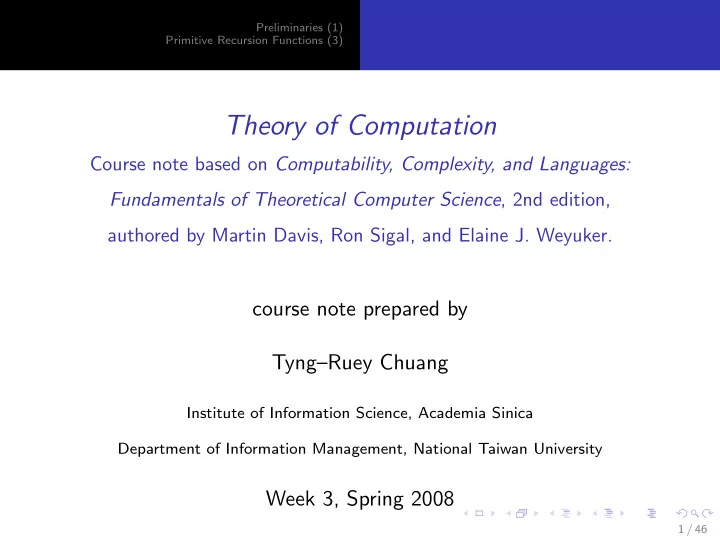
Theory of Computation

Course note based on Computability, Complexity, and Languages: Fundamentals of Theoretical Computer Science, 2nd edition, authored by Martin Davis, Ron Sigal, and Elaine J. Weyuker.

course note prepared by Tyng–Ruey Chuang

Institute of Information Science, Academia Sinica Department of Information Management, National Taiwan University

Week 3, Spring 2008

1 / 46

slide-2
SLIDE 2

Preliminaries (1) Primitive Recursion Functions (3)

About This Course Note

◮ It is prepared for the course Theory of Computation taught at

the National Taiwan University in Spring 2008.

◮ It follows very closely the book Computability, Complexity,

and Languages: Fundamentals of Theoretical Computer Science, 2nd edition, by Martin Davis, Ron Sigal, and Elaine

  • J. Weyuker. Morgan Kaufmann Publishers. ISBN:

0-12-206382-1.

◮ It is available from Tyng-Ruey Chuang’s web site:

http://www.iis.sinica.edu.tw/~trc/ and released under a Creative Commons “Attribution-ShareAlike 2.5 Taiwan” license: http://creativecommons.org/licenses/by-sa/2.5/tw/

2 / 46

slide-3
SLIDE 3

Preliminaries (1) Primitive Recursion Functions (3) Predicates (1.4) Quantifiers (1.5) Proof by Contradiction (1.6) Mathematical Induction (1.7)

Predicate

A predicate, or a Boolean-valued function, on a set S is a total function P on S such that for each a ∈ S, either P(a) = TRUE

  • r

P(a) = FALSE We also identify the truth value TRUE with number 1 and the truth value FALSE with number 0.

3 / 46

slide-4
SLIDE 4

Preliminaries (1) Primitive Recursion Functions (3) Predicates (1.4) Quantifiers (1.5) Proof by Contradiction (1.6) Mathematical Induction (1.7)

Logic Connectives

The three logic connectives, or propositional connectives, ∼, ∨, & are defined by the two tables below. p ∼ p 1 1 p q p & q p ∨ q 1 1 1 1 1 1 1 1

4 / 46

slide-5
SLIDE 5

Preliminaries (1) Primitive Recursion Functions (3) Predicates (1.4) Quantifiers (1.5) Proof by Contradiction (1.6) Mathematical Induction (1.7)

Characteristic Function

Given a predicate P on a set S, there is a corresponding subset R

  • f S consisting of all elements a ∈ S for which P(a) = 1. We write

R = {a ∈ S | P(a)}.

5 / 46

slide-6
SLIDE 6

Preliminaries (1) Primitive Recursion Functions (3) Predicates (1.4) Quantifiers (1.5) Proof by Contradiction (1.6) Mathematical Induction (1.7)

Characteristic Function

Given a predicate P on a set S, there is a corresponding subset R

  • f S consisting of all elements a ∈ S for which P(a) = 1. We write

R = {a ∈ S | P(a)}. Conversely, given a subset R of a given set S, the expression x ∈ R defines a predicate P on S: P(x) = 1 if x ∈ R if x ∈ R. The predicate P is called the characteristic function of the set R.

5 / 46

slide-7
SLIDE 7

Preliminaries (1) Primitive Recursion Functions (3) Predicates (1.4) Quantifiers (1.5) Proof by Contradiction (1.6) Mathematical Induction (1.7)

Characteristic Function

Given a predicate P on a set S, there is a corresponding subset R

  • f S consisting of all elements a ∈ S for which P(a) = 1. We write

R = {a ∈ S | P(a)}. Conversely, given a subset R of a given set S, the expression x ∈ R defines a predicate P on S: P(x) = 1 if x ∈ R if x ∈ R. The predicate P is called the characteristic function of the set R. Note the easy translations between the two notations: {x ∈ S | P(x) & Q(x)} = {x ∈ S | P(x)} ∩ {x ∈ S | Q(x)}, {x ∈ S | P(x) ∨ Q(x)} = {x ∈ S | P(x)} ∪ {x ∈ S | Q(x)}, {x ∈ S | ∼ P(x)} = S − {x ∈ S | P(x)}.

5 / 46

slide-8
SLIDE 8

Preliminaries (1) Primitive Recursion Functions (3) Predicates (1.4) Quantifiers (1.5) Proof by Contradiction (1.6) Mathematical Induction (1.7)

Bounded Existential Quantifier

Let P(t, x1, . . . , xn) be a (n + 1)-ary predicate. Let predicate Q(y, x1, . . . , xn) be defined by Q(y, x1, . . . , xn) = P(0, x1, . . . , xn) ∨ P(1, x1, . . . , xn) ∨ . . . ∨ P(y, x1, . . . , xn)

6 / 46

slide-9
SLIDE 9

Preliminaries (1) Primitive Recursion Functions (3) Predicates (1.4) Quantifiers (1.5) Proof by Contradiction (1.6) Mathematical Induction (1.7)

Bounded Existential Quantifier

Let P(t, x1, . . . , xn) be a (n + 1)-ary predicate. Let predicate Q(y, x1, . . . , xn) be defined by Q(y, x1, . . . , xn) = P(0, x1, . . . , xn) ∨ P(1, x1, . . . , xn) ∨ . . . ∨ P(y, x1, . . . , xn) That is, Q(y, x1, . . . , xn) is true if there is a value t ≤ y such that P(t, x1, . . . , xn) is true. We write this predicate Q as (∃t)≤yP(t, x1, . . . , xn) “(∃t)≤y” is called a bounded existential quantifier.

6 / 46

slide-10
SLIDE 10

Preliminaries (1) Primitive Recursion Functions (3) Predicates (1.4) Quantifiers (1.5) Proof by Contradiction (1.6) Mathematical Induction (1.7)

Bounded Universal Quantifier

Let P(t, x1, . . . , xn) be a (n + 1)-ary predicate. Let predicate Q(y, x1, . . . , xn) be defined by Q(y, x1, . . . , xn) = P(0, x1, . . . , xn) & P(1, x1, . . . , xn) & . . . & P(y, x1, . . . , xn)

7 / 46

slide-11
SLIDE 11

Preliminaries (1) Primitive Recursion Functions (3) Predicates (1.4) Quantifiers (1.5) Proof by Contradiction (1.6) Mathematical Induction (1.7)

Bounded Universal Quantifier

Let P(t, x1, . . . , xn) be a (n + 1)-ary predicate. Let predicate Q(y, x1, . . . , xn) be defined by Q(y, x1, . . . , xn) = P(0, x1, . . . , xn) & P(1, x1, . . . , xn) & . . . & P(y, x1, . . . , xn) That is, Q(y, x1, . . . , xn) is true if for all value t ≤ y such that P(t, x1, . . . , xn) is true. We write this predicate Q as (∀t)≤yP(t, x1, . . . , xn) “(∀t)≤y” is called a bounded universal quantifier.

7 / 46

slide-12
SLIDE 12

Preliminaries (1) Primitive Recursion Functions (3) Predicates (1.4) Quantifiers (1.5) Proof by Contradiction (1.6) Mathematical Induction (1.7)

Proof by Contradiction

In a proof by contradiction, we begin by assuming the assertion we wish to prove is false. We then derive a contradiction based on this (faulty) assumption along with (faultless) logical reasoning. We then conclude that the original assertion must be true.

8 / 46

slide-13
SLIDE 13

Preliminaries (1) Primitive Recursion Functions (3) Predicates (1.4) Quantifiers (1.5) Proof by Contradiction (1.6) Mathematical Induction (1.7)

Proof by Contradiction: Example

Prove that the equation 2 = (m/n)2 has no solution m, n ∈ N.

9 / 46

slide-14
SLIDE 14

Preliminaries (1) Primitive Recursion Functions (3) Predicates (1.4) Quantifiers (1.5) Proof by Contradiction (1.6) Mathematical Induction (1.7)

Proof by Contradiction: Example

Prove that the equation 2 = (m/n)2 has no solution m, n ∈ N.

  • Proof. Assume 2 = (m/n)2 has a solution m, n ∈ N. Then it must

also have a solution where not both m and n are even. This is so because we can repeatedly “cancel” 2 from m and n until at least

  • ne of them becomes odd, and still have the two “reduced”

numbers as a solution.

9 / 46

slide-15
SLIDE 15

Preliminaries (1) Primitive Recursion Functions (3) Predicates (1.4) Quantifiers (1.5) Proof by Contradiction (1.6) Mathematical Induction (1.7)

Proof by Contradiction: Example

Prove that the equation 2 = (m/n)2 has no solution m, n ∈ N.

  • Proof. Assume 2 = (m/n)2 has a solution m, n ∈ N. Then it must

also have a solution where not both m and n are even. This is so because we can repeatedly “cancel” 2 from m and n until at least

  • ne of them becomes odd, and still have the two “reduced”

numbers as a solution. However, the equation 2 = (m/n)2 can be rewritten as m2 = 2n2 which shows that m must be even. Let m = 2k, then m2 = (2k)2 = 4k2. But this implies n2 = 2k2. Thus n is even. Now both m and n are even, which is a contradiction.

9 / 46

slide-16
SLIDE 16

Preliminaries (1) Primitive Recursion Functions (3) Predicates (1.4) Quantifiers (1.5) Proof by Contradiction (1.6) Mathematical Induction (1.7)

Proof by Contradiction: Example

Prove that the equation 2 = (m/n)2 has no solution m, n ∈ N.

  • Proof. Assume 2 = (m/n)2 has a solution m, n ∈ N. Then it must

also have a solution where not both m and n are even. This is so because we can repeatedly “cancel” 2 from m and n until at least

  • ne of them becomes odd, and still have the two “reduced”

numbers as a solution. However, the equation 2 = (m/n)2 can be rewritten as m2 = 2n2 which shows that m must be even. Let m = 2k, then m2 = (2k)2 = 4k2. But this implies n2 = 2k2. Thus n is even. Now both m and n are even, which is a contradiction. We conclude that 2 = (m/n)2 has no solution m, n ∈ N.

  • 9 / 46
slide-17
SLIDE 17

Preliminaries (1) Primitive Recursion Functions (3) Predicates (1.4) Quantifiers (1.5) Proof by Contradiction (1.6) Mathematical Induction (1.7)

Mathematical Induction

Given a predicate P(x), and the assertion “P(n) is true for all n ∈ N”, we can use mathematical induction to try to establish this

  • assertion. One proceeds by proving a pair of auxiliary statements

about P(x), namely, P(0) and For all n ∈ N, P(n) implies P(n + 1)

10 / 46

slide-18
SLIDE 18

Preliminaries (1) Primitive Recursion Functions (3) Predicates (1.4) Quantifiers (1.5) Proof by Contradiction (1.6) Mathematical Induction (1.7)

Mathematical Induction

Given a predicate P(x), and the assertion “P(n) is true for all n ∈ N”, we can use mathematical induction to try to establish this

  • assertion. One proceeds by proving a pair of auxiliary statements

about P(x), namely, P(0) and For all n ∈ N, P(n) implies P(n + 1) In the second statement above, P(n) is called an induction

  • hypothesis. If both statements above are proved to be true, one

then concludes that For all n ∈ N, P(n)

10 / 46

slide-19
SLIDE 19

Preliminaries (1) Primitive Recursion Functions (3) Predicates (1.4) Quantifiers (1.5) Proof by Contradiction (1.6) Mathematical Induction (1.7)

Mathematical Induction: Example

Prove that for all n ∈ N, n

i=0(2i + 1) = (n + 1)2.

11 / 46

slide-20
SLIDE 20

Preliminaries (1) Primitive Recursion Functions (3) Predicates (1.4) Quantifiers (1.5) Proof by Contradiction (1.6) Mathematical Induction (1.7)

Mathematical Induction: Example

Prove that for all n ∈ N, n

i=0(2i + 1) = (n + 1)2.

  • Proof. For n = 0, then 0

i=0(2i + 1) = 1 = (0 + 1)2, which is true.

11 / 46

slide-21
SLIDE 21

Preliminaries (1) Primitive Recursion Functions (3) Predicates (1.4) Quantifiers (1.5) Proof by Contradiction (1.6) Mathematical Induction (1.7)

Mathematical Induction: Example

Prove that for all n ∈ N, n

i=0(2i + 1) = (n + 1)2.

  • Proof. For n = 0, then 0

i=0(2i + 1) = 1 = (0 + 1)2, which is true.

It remains to show that for all n ∈ N, if n

i=0(2i + 1) = (n + 1)2 is

true, then n+1

i=0 (2i + 1) = (n + 2)2 is also true.

11 / 46

slide-22
SLIDE 22

Preliminaries (1) Primitive Recursion Functions (3) Predicates (1.4) Quantifiers (1.5) Proof by Contradiction (1.6) Mathematical Induction (1.7)

Mathematical Induction: Example

Prove that for all n ∈ N, n

i=0(2i + 1) = (n + 1)2.

  • Proof. For n = 0, then 0

i=0(2i + 1) = 1 = (0 + 1)2, which is true.

It remains to show that for all n ∈ N, if n

i=0(2i + 1) = (n + 1)2 is

true, then n+1

i=0 (2i + 1) = (n + 2)2 is also true.

We expand n+1

i=0 (2i + 1) by its definition, n+1

  • i=0

(2i + 1) =

n

  • i=0

(2i + 1) + 2(n + 1) + 1 = (n + 1)2 + 2(n + 1) + 1 (by induction hypothesis) = (n + 2)2.

11 / 46

slide-23
SLIDE 23

Preliminaries (1) Primitive Recursion Functions (3) Predicates (1.4) Quantifiers (1.5) Proof by Contradiction (1.6) Mathematical Induction (1.7)

Mathematical Induction: Example

Prove that for all n ∈ N, n

i=0(2i + 1) = (n + 1)2.

  • Proof. For n = 0, then 0

i=0(2i + 1) = 1 = (0 + 1)2, which is true.

It remains to show that for all n ∈ N, if n

i=0(2i + 1) = (n + 1)2 is

true, then n+1

i=0 (2i + 1) = (n + 2)2 is also true.

We expand n+1

i=0 (2i + 1) by its definition, n+1

  • i=0

(2i + 1) =

n

  • i=0

(2i + 1) + 2(n + 1) + 1 = (n + 1)2 + 2(n + 1) + 1 (by induction hypothesis) = (n + 2)2. We conclude that for all n ∈ N, n

i=0(2i + 1) = (n + 1)2.

  • 11 / 46
slide-24
SLIDE 24

Preliminaries (1) Primitive Recursion Functions (3) PRC Classes (3.3) Some Primitive Recursive Functions (3.4) Primitive Recursive Predicates (3.5) Iterated Operations and Bounded Quantifiers (3.6) Minimalization (3.7)

Initial Functions

The following functions are called initial functions: s(x) = x + 1, n(x) = 0, un

i (x1, . . . , xn)

= xi, 1 ≤ i ≤ n. Note: Function un

i is called the projection function. For example,

u4

3(x1, x2, x3, x4) = x3.

12 / 46

slide-25
SLIDE 25

Preliminaries (1) Primitive Recursion Functions (3) PRC Classes (3.3) Some Primitive Recursive Functions (3.4) Primitive Recursive Predicates (3.5) Iterated Operations and Bounded Quantifiers (3.6) Minimalization (3.7)

Primitive Recursively Closed (PRC)

A class of total functions C is called a PRC class if

◮ the initial functions belong to C , ◮ a function obtained from functions belonging to C by either

composition or recursion also belongs to C .

13 / 46

slide-26
SLIDE 26

Preliminaries (1) Primitive Recursion Functions (3) PRC Classes (3.3) Some Primitive Recursive Functions (3.4) Primitive Recursive Predicates (3.5) Iterated Operations and Bounded Quantifiers (3.6) Minimalization (3.7)

Computable Functions are Primitive Recursively Closed

Theorem 3.1. The class of computable functions is a PRC class.

  • Proof. We have shown computable functions are closed under

composition and recursion (Theorem 1.1 & 2.2). We need only verify the initial functions are computable. They are computed by the following programs. s(x) = x + 1 Y ← X + 1; n(x) the empty program; un

i (x1, . . . , xn)

Y ← Xi.

  • 14 / 46
slide-27
SLIDE 27

Preliminaries (1) Primitive Recursion Functions (3) PRC Classes (3.3) Some Primitive Recursive Functions (3.4) Primitive Recursive Predicates (3.5) Iterated Operations and Bounded Quantifiers (3.6) Minimalization (3.7)

Primitive Recursive Functions

A function is called primitive recursive if it can be obtained from the initial functions by a finite number of applications of composition and recursion.

15 / 46

slide-28
SLIDE 28

Preliminaries (1) Primitive Recursion Functions (3) PRC Classes (3.3) Some Primitive Recursive Functions (3.4) Primitive Recursive Predicates (3.5) Iterated Operations and Bounded Quantifiers (3.6) Minimalization (3.7)

Primitive Recursive Functions

A function is called primitive recursive if it can be obtained from the initial functions by a finite number of applications of composition and recursion. Note that, by the above definition and the definition of Primitive Recursively Closed (PRC), it follows that: Corollary 3.2. The class of primitive recursive function is a PRC class.

15 / 46

slide-29
SLIDE 29

Preliminaries (1) Primitive Recursion Functions (3) PRC Classes (3.3) Some Primitive Recursive Functions (3.4) Primitive Recursive Predicates (3.5) Iterated Operations and Bounded Quantifiers (3.6) Minimalization (3.7)

Primitive Recursive Functions & PRC Classes

Theorem 3.3. A function is primitive recursive if and only if it belongs to every PRC class.

  • Proof. (⇐) If a function belongs to every PRC class, then by

Corollary 3.2, it belongs to the class of primitive recursive functions. (⇒) If f is primitive recursive, then there is a list of functions f1, f2, . . . , fn such that fn = f and for each fi, 1 ≤ i < n, either

◮ fi is an initial function, or ◮ fi can be obtained from the preceding functions in the list by

composition or recursion. However, the initial functions belong to any PRC class C . Furthermore, all functions obtained from functions in C by composition or recursion also belong to C . It follows that each function f1, f2, . . . , fn = f in the above list is in C .

  • 16 / 46
slide-30
SLIDE 30

Preliminaries (1) Primitive Recursion Functions (3) PRC Classes (3.3) Some Primitive Recursive Functions (3.4) Primitive Recursive Predicates (3.5) Iterated Operations and Bounded Quantifiers (3.6) Minimalization (3.7)

Primitive Recursive Functions Are Computable

Corollary 3.4. Every primitive recursive function is computable.

  • Proof. By Theorem 3.4, every primitive recursive function belongs

to the PRC class of computable functions so is computable.

  • 17 / 46
slide-31
SLIDE 31

Preliminaries (1) Primitive Recursion Functions (3) PRC Classes (3.3) Some Primitive Recursive Functions (3.4) Primitive Recursive Predicates (3.5) Iterated Operations and Bounded Quantifiers (3.6) Minimalization (3.7)

Primitive Recursive Functions Are Computable

Corollary 3.4. Every primitive recursive function is computable.

  • Proof. By Theorem 3.4, every primitive recursive function belongs

to the PRC class of computable functions so is computable.

  • Note that,

◮ If a function f is shown to be primitive recursive, by the above

Corollary, f can be expressed as a program in language S .

◮ Not only we know there is program in S for f , by Theorem

3.1 (1.1 & 2.2), we also know how to write this program.

◮ Furthermore, the program so written will always terminate.

17 / 46

slide-32
SLIDE 32

Preliminaries (1) Primitive Recursion Functions (3) PRC Classes (3.3) Some Primitive Recursive Functions (3.4) Primitive Recursive Predicates (3.5) Iterated Operations and Bounded Quantifiers (3.6) Minimalization (3.7)

Primitive Recursive Functions Are Computable

Corollary 3.4. Every primitive recursive function is computable.

  • Proof. By Theorem 3.4, every primitive recursive function belongs

to the PRC class of computable functions so is computable.

  • Note that,

◮ If a function f is shown to be primitive recursive, by the above

Corollary, f can be expressed as a program in language S .

◮ Not only we know there is program in S for f , by Theorem

3.1 (1.1 & 2.2), we also know how to write this program.

◮ Furthermore, the program so written will always terminate.

However, if a function f is computable (that is, it is total and expressible in S ), it is not necessarily that f is primitive recursive. (A counter example will be shown later in this course.)

17 / 46

slide-33
SLIDE 33

Preliminaries (1) Primitive Recursion Functions (3) PRC Classes (3.3) Some Primitive Recursive Functions (3.4) Primitive Recursive Predicates (3.5) Iterated Operations and Bounded Quantifiers (3.6) Minimalization (3.7)

Function f (x, y) = x + y Is Primitive Recursive

Function f can be defined by the recursion equations: f (x, 0) = x, f (x, y + 1) = f (x, y) + 1. The above can be rewritten as f (x, 0) = u1

1(x),

f (x, y + 1) = g(y, f (x, y), x), where g(x1, x2, x3) = s(u3

2(x1, x2, x3)).

18 / 46

slide-34
SLIDE 34

Preliminaries (1) Primitive Recursion Functions (3) PRC Classes (3.3) Some Primitive Recursive Functions (3.4) Primitive Recursive Predicates (3.5) Iterated Operations and Bounded Quantifiers (3.6) Minimalization (3.7)

Function h(x, y) = x · y Is Primitive Recursive

Function h can be defined by the recursion equations: h(x, 0) = 0, h(x, y + 1) = h(x, y) + x. The above can be rewritten as h(x, 0) = n(x), h(x, y + 1) = g(y, h(x, y), x), where g(x1, x2, x3) = f (u3

2(x1, x2, x3), u3 3(x1, x2, x3)),

f (x, y) = x + y.

19 / 46

slide-35
SLIDE 35

Preliminaries (1) Primitive Recursion Functions (3) PRC Classes (3.3) Some Primitive Recursive Functions (3.4) Primitive Recursive Predicates (3.5) Iterated Operations and Bounded Quantifiers (3.6) Minimalization (3.7)

Function h(x) = x! Is Primitive Recursive

Function h(x) can be defined by h(0) = 1, h(t + 1) = g(t, h(t)), where g(x1, x2) = s(x1) · x2. Note that g is primitive recursive because g(x1, x2) = s(u2

1(x1, x2)) · u2 2(x1, x2).

20 / 46

slide-36
SLIDE 36

Preliminaries (1) Primitive Recursion Functions (3) PRC Classes (3.3) Some Primitive Recursive Functions (3.4) Primitive Recursive Predicates (3.5) Iterated Operations and Bounded Quantifiers (3.6) Minimalization (3.7)

Function power(x, y) = xy Is Primitive Recursive

Function power can be defined by power(x, 0) = 1, power(x, y + 1) = power(x, y) · x. Note that these equations assign the value 1 to the “indeterminate” 00. The above definition can be further rewritten into . . . .

21 / 46

slide-37
SLIDE 37

Preliminaries (1) Primitive Recursion Functions (3) PRC Classes (3.3) Some Primitive Recursive Functions (3.4) Primitive Recursive Predicates (3.5) Iterated Operations and Bounded Quantifiers (3.6) Minimalization (3.7)

The Predecessor Function Is Primitive Recursive

The predecessor function pred(x) is defined as follows: pred(x) = x − 1 if x = 0 if x = 0. Note that function pred corresponds to the instruction X ← X − 1 in programming language S . The above definition can be further rewritten into . . . .

22 / 46

slide-38
SLIDE 38

Preliminaries (1) Primitive Recursion Functions (3) PRC Classes (3.3) Some Primitive Recursive Functions (3.4) Primitive Recursive Predicates (3.5) Iterated Operations and Bounded Quantifiers (3.6) Minimalization (3.7)

Function x ˙ −y Is Primitive Recursive

Function x ˙ −y is defined as follows: x ˙ −y = x − y if x ≥ y if x < y. Note that function x ˙ −y is different from function x − y, which is undefined if x < y. In particular, x ˙ −y is total while x − y is not.

23 / 46

slide-39
SLIDE 39

Preliminaries (1) Primitive Recursion Functions (3) PRC Classes (3.3) Some Primitive Recursive Functions (3.4) Primitive Recursive Predicates (3.5) Iterated Operations and Bounded Quantifiers (3.6) Minimalization (3.7)

Function x ˙ −y Is Primitive Recursive

Function x ˙ −y is defined as follows: x ˙ −y = x − y if x ≥ y if x < y. Note that function x ˙ −y is different from function x − y, which is undefined if x < y. In particular, x ˙ −y is total while x − y is not. Function x ˙ −y is primitive recursive because x ˙ −0 = x, x ˙ −(t + 1) = pred(x ˙ −t). The above definition can be further rewritten into . . . .

23 / 46

slide-40
SLIDE 40

Preliminaries (1) Primitive Recursion Functions (3) PRC Classes (3.3) Some Primitive Recursive Functions (3.4) Primitive Recursive Predicates (3.5) Iterated Operations and Bounded Quantifiers (3.6) Minimalization (3.7)

Function |x − y| Is Primitive Recursive

Function |x − y| can be defined as follows: |x − y| = (x ˙ −y) + (y ˙ −x)

24 / 46

slide-41
SLIDE 41

Preliminaries (1) Primitive Recursion Functions (3) PRC Classes (3.3) Some Primitive Recursive Functions (3.4) Primitive Recursive Predicates (3.5) Iterated Operations and Bounded Quantifiers (3.6) Minimalization (3.7)

Function |x − y| Is Primitive Recursive

Function |x − y| can be defined as follows: |x − y| = (x ˙ −y) + (y ˙ −x) It is primitive recursive because the above definition can be further rewritten into . . . .

24 / 46

slide-42
SLIDE 42

Preliminaries (1) Primitive Recursion Functions (3) PRC Classes (3.3) Some Primitive Recursive Functions (3.4) Primitive Recursive Predicates (3.5) Iterated Operations and Bounded Quantifiers (3.6) Minimalization (3.7)

Is Function α(x) below Primitive Recursive?

Function α(x) is defined as: α(x) = 1 if x = 0 if x = 0.

25 / 46

slide-43
SLIDE 43

Preliminaries (1) Primitive Recursion Functions (3) PRC Classes (3.3) Some Primitive Recursive Functions (3.4) Primitive Recursive Predicates (3.5) Iterated Operations and Bounded Quantifiers (3.6) Minimalization (3.7)

Is Function α(x) below Primitive Recursive?

Function α(x) is defined as: α(x) = 1 if x = 0 if x = 0. It is primitive recursive because . . . .

25 / 46

slide-44
SLIDE 44

Preliminaries (1) Primitive Recursion Functions (3) PRC Classes (3.3) Some Primitive Recursive Functions (3.4) Primitive Recursive Predicates (3.5) Iterated Operations and Bounded Quantifiers (3.6) Minimalization (3.7)

x = y Is Primitive Recursive

Is the function d(x, y) below primitive recursive? d(x, y) = 1 if x = y if x = y

26 / 46

slide-45
SLIDE 45

Preliminaries (1) Primitive Recursion Functions (3) PRC Classes (3.3) Some Primitive Recursive Functions (3.4) Primitive Recursive Predicates (3.5) Iterated Operations and Bounded Quantifiers (3.6) Minimalization (3.7)

x = y Is Primitive Recursive

Is the function d(x, y) below primitive recursive? d(x, y) = 1 if x = y if x = y It is because d(x, y) = α(|x − y|).

26 / 46

slide-46
SLIDE 46

Preliminaries (1) Primitive Recursion Functions (3) PRC Classes (3.3) Some Primitive Recursive Functions (3.4) Primitive Recursive Predicates (3.5) Iterated Operations and Bounded Quantifiers (3.6) Minimalization (3.7)

Is x ≤ y Primitive Recursive?

27 / 46

slide-47
SLIDE 47

Preliminaries (1) Primitive Recursion Functions (3) PRC Classes (3.3) Some Primitive Recursive Functions (3.4) Primitive Recursive Predicates (3.5) Iterated Operations and Bounded Quantifiers (3.6) Minimalization (3.7)

Is x ≤ y Primitive Recursive?

It is primitive recursive because x ≤ y = α(x ˙ −y).

27 / 46

slide-48
SLIDE 48

Preliminaries (1) Primitive Recursion Functions (3) PRC Classes (3.3) Some Primitive Recursive Functions (3.4) Primitive Recursive Predicates (3.5) Iterated Operations and Bounded Quantifiers (3.6) Minimalization (3.7)

Logic Connectives Are Primitive Recursively Closed

Theorem 5.1. Let C be a PRC class. If P, Q are predicates that belong to C , then so are ∼ P, P ∨ Q, and P&Q.

28 / 46

slide-49
SLIDE 49

Preliminaries (1) Primitive Recursion Functions (3) PRC Classes (3.3) Some Primitive Recursive Functions (3.4) Primitive Recursive Predicates (3.5) Iterated Operations and Bounded Quantifiers (3.6) Minimalization (3.7)

Logic Connectives Are Primitive Recursively Closed

Theorem 5.1. Let C be a PRC class. If P, Q are predicates that belong to C , then so are ∼ P, P ∨ Q, and P&Q.

  • Proof. We define ∼ P, P ∨ Q, and P&Q as follows:

∼ P = α(P) P & Q = P · Q P ∨ Q = ∼ (∼ P & ∼ Q)

28 / 46

slide-50
SLIDE 50

Preliminaries (1) Primitive Recursion Functions (3) PRC Classes (3.3) Some Primitive Recursive Functions (3.4) Primitive Recursive Predicates (3.5) Iterated Operations and Bounded Quantifiers (3.6) Minimalization (3.7)

Logic Connectives Are Primitive Recursively Closed

Theorem 5.1. Let C be a PRC class. If P, Q are predicates that belong to C , then so are ∼ P, P ∨ Q, and P&Q.

  • Proof. We define ∼ P, P ∨ Q, and P&Q as follows:

∼ P = α(P) P & Q = P · Q P ∨ Q = ∼ (∼ P & ∼ Q) We conclude that ∼ P, P ∨ Q, and P&Q all belong to C .

  • 28 / 46
slide-51
SLIDE 51

Preliminaries (1) Primitive Recursion Functions (3) PRC Classes (3.3) Some Primitive Recursive Functions (3.4) Primitive Recursive Predicates (3.5) Iterated Operations and Bounded Quantifiers (3.6) Minimalization (3.7)

Logic Connectives Are Primitive Recursive and Computable

Corollary 5.2. If P, Q are primitive recursive predicates, then so are ∼ P, P ∨ Q, and P&Q.

29 / 46

slide-52
SLIDE 52

Preliminaries (1) Primitive Recursion Functions (3) PRC Classes (3.3) Some Primitive Recursive Functions (3.4) Primitive Recursive Predicates (3.5) Iterated Operations and Bounded Quantifiers (3.6) Minimalization (3.7)

Logic Connectives Are Primitive Recursive and Computable

Corollary 5.2. If P, Q are primitive recursive predicates, then so are ∼ P, P ∨ Q, and P&Q. Corollary 5.3. If P, Q are computable predicates, then so are ∼ P, P ∨ Q, and P&Q.

29 / 46

slide-53
SLIDE 53

Preliminaries (1) Primitive Recursion Functions (3) PRC Classes (3.3) Some Primitive Recursive Functions (3.4) Primitive Recursive Predicates (3.5) Iterated Operations and Bounded Quantifiers (3.6) Minimalization (3.7)

Is x < y Primitive Recursive?

30 / 46

slide-54
SLIDE 54

Preliminaries (1) Primitive Recursion Functions (3) PRC Classes (3.3) Some Primitive Recursive Functions (3.4) Primitive Recursive Predicates (3.5) Iterated Operations and Bounded Quantifiers (3.6) Minimalization (3.7)

Is x < y Primitive Recursive?

It is primitive recursive because x < y ⇔ ∼ (y ≤ x).

30 / 46

slide-55
SLIDE 55

Preliminaries (1) Primitive Recursion Functions (3) PRC Classes (3.3) Some Primitive Recursive Functions (3.4) Primitive Recursive Predicates (3.5) Iterated Operations and Bounded Quantifiers (3.6) Minimalization (3.7)

Definition by Cases

Theorem 5.4. Let C be a PRC class. Let functions g, h and predicate P belong to C . Let function f (x1, . . . , xn) = g(x1, . . . , xn) if P(x1, . . . , xn) h(x1, . . . , xn)

  • therwise.

Then f belongs to C .

31 / 46

slide-56
SLIDE 56

Preliminaries (1) Primitive Recursion Functions (3) PRC Classes (3.3) Some Primitive Recursive Functions (3.4) Primitive Recursive Predicates (3.5) Iterated Operations and Bounded Quantifiers (3.6) Minimalization (3.7)

Definition by Cases

Theorem 5.4. Let C be a PRC class. Let functions g, h and predicate P belong to C . Let function f (x1, . . . , xn) = g(x1, . . . , xn) if P(x1, . . . , xn) h(x1, . . . , xn)

  • therwise.

Then f belongs to C .

  • Proof. Function f belongs to C because

f (x1, . . . , xn) = g(x1, . . . , xn) · P(x1, . . . , xn) + h(x1, . . . , xn) · α(P(x1, . . . , xn)).

  • 31 / 46
slide-57
SLIDE 57

Preliminaries (1) Primitive Recursion Functions (3) PRC Classes (3.3) Some Primitive Recursive Functions (3.4) Primitive Recursive Predicates (3.5) Iterated Operations and Bounded Quantifiers (3.6) Minimalization (3.7)

Definition by Cases, More

Corollary 5.5. Let C be a PRC class. Let n-ary functions g1, . . . , gm, h and predicates P1, . . . , Pm belong to C , and let Pi(x1, . . . , xn) & Pj(x1, . . . , xn) = 0 for all 1 ≤ i ≤ j ≤ m and all x1, . . . , xn. If f (x1, . . . , xn) =          g1(x1, . . . , xn) if P1(x1, . . . , xn) . . . . . . gm(x1, . . . , xn) if Pm(x1, . . . , xn) h(x1, . . . , xn)

  • therwise.

then f also belongs to C .

32 / 46

slide-58
SLIDE 58

Preliminaries (1) Primitive Recursion Functions (3) PRC Classes (3.3) Some Primitive Recursive Functions (3.4) Primitive Recursive Predicates (3.5) Iterated Operations and Bounded Quantifiers (3.6) Minimalization (3.7)

Definition by Cases, More

Corollary 5.5. Let C be a PRC class. Let n-ary functions g1, . . . , gm, h and predicates P1, . . . , Pm belong to C , and let Pi(x1, . . . , xn) & Pj(x1, . . . , xn) = 0 for all 1 ≤ i ≤ j ≤ m and all x1, . . . , xn. If f (x1, . . . , xn) =          g1(x1, . . . , xn) if P1(x1, . . . , xn) . . . . . . gm(x1, . . . , xn) if Pm(x1, . . . , xn) h(x1, . . . , xn)

  • therwise.

then f also belongs to C .

  • Proof. Proved by a mathematical induction on m.
  • 32 / 46
slide-59
SLIDE 59

Preliminaries (1) Primitive Recursion Functions (3) PRC Classes (3.3) Some Primitive Recursive Functions (3.4) Primitive Recursive Predicates (3.5) Iterated Operations and Bounded Quantifiers (3.6) Minimalization (3.7)

Iterated Operations

Theorem 6.1. Let C be a PRC class. If function f (t, x1, . . . , xn) belongs to C , then so do the functions g and h g(y, x1, . . . , xn) =

y

  • t=0

f (t, x1, . . . , xn) h(y, x1, . . . , xn) =

y

  • t=0

f (t, x1, . . . , xn)

33 / 46

slide-60
SLIDE 60

Preliminaries (1) Primitive Recursion Functions (3) PRC Classes (3.3) Some Primitive Recursive Functions (3.4) Primitive Recursive Predicates (3.5) Iterated Operations and Bounded Quantifiers (3.6) Minimalization (3.7)

Iterated Operations

Theorem 6.1. Let C be a PRC class. If function f (t, x1, . . . , xn) belongs to C , then so do the functions g and h g(y, x1, . . . , xn) =

y

  • t=0

f (t, x1, . . . , xn) h(y, x1, . . . , xn) =

y

  • t=0

f (t, x1, . . . , xn)

  • Proof. Functions g and h each can be recursively defined as

g(0, x1, . . . , xn) = f (0, x1, . . . , xn), g(t + 1, x1, . . . , xn) = g(t, x1, . . . , xn) + f (t + 1, x1, . . . , xn), h(0, x1, . . . , xn) = f (0, x1, . . . , xn), h(t + 1, x1, . . . , xn) = h(t, x1, . . . , xn) · f (t + 1, x1, . . . , xn). 33 / 46

slide-61
SLIDE 61

Preliminaries (1) Primitive Recursion Functions (3) PRC Classes (3.3) Some Primitive Recursive Functions (3.4) Primitive Recursive Predicates (3.5) Iterated Operations and Bounded Quantifiers (3.6) Minimalization (3.7)

Iterated Operations, More

Corollary 6.2. Let C be a PRC class. If function f (t, x1, . . . , xn) belongs to C , then so do the functions g(y, x1, . . . , xn) =

y

  • t=1

f (t, x1, . . . , xn) and h(y, x1, . . . , xn) =

y

  • t=1

f (t, x1, . . . , xn). In the above, we assume that g(0, x1, . . . , xn) = 0, h(0, x1, . . . , xn) = 1.

34 / 46

slide-62
SLIDE 62

Preliminaries (1) Primitive Recursion Functions (3) PRC Classes (3.3) Some Primitive Recursive Functions (3.4) Primitive Recursive Predicates (3.5) Iterated Operations and Bounded Quantifiers (3.6) Minimalization (3.7)

Bounded Quantifiers

Theorem 6.3. If predicate P(t, x1, . . . , xn) belongs to some PRC class C , then so do the predicates (∀t)≤yP(t, x1, . . . , xn) and (∃t)≤yP(t, x1, . . . , xn)

35 / 46

slide-63
SLIDE 63

Preliminaries (1) Primitive Recursion Functions (3) PRC Classes (3.3) Some Primitive Recursive Functions (3.4) Primitive Recursive Predicates (3.5) Iterated Operations and Bounded Quantifiers (3.6) Minimalization (3.7)

Bounded Quantifiers

Theorem 6.3. If predicate P(t, x1, . . . , xn) belongs to some PRC class C , then so do the predicates (∀t)≤yP(t, x1, . . . , xn) and (∃t)≤yP(t, x1, . . . , xn)

  • Proof. We need only observe that

(∀t)≤yP(t, x1, . . . , xn) ⇔

y

  • t=0

P(t, x1, . . . , xn) = 1 and (∃t)≤yP(t, x1, . . . , xn) ⇔

y

  • t=0

P(t, x1, . . . , xn) = 0

  • 35 / 46
slide-64
SLIDE 64

Preliminaries (1) Primitive Recursion Functions (3) PRC Classes (3.3) Some Primitive Recursive Functions (3.4) Primitive Recursive Predicates (3.5) Iterated Operations and Bounded Quantifiers (3.6) Minimalization (3.7)

Bounded Quantifiers, More

Note that (∀t)<yP(t, x1, . . . , xn) ⇔ (∀t)≤y[t = y ∨ P(t, x1, . . . , xn)], and (∃t)<yP(t, x1, . . . , xn) ⇔ (∃t)≤y[t = y & P(t, x1, . . . , xn)].

36 / 46

slide-65
SLIDE 65

Preliminaries (1) Primitive Recursion Functions (3) PRC Classes (3.3) Some Primitive Recursive Functions (3.4) Primitive Recursive Predicates (3.5) Iterated Operations and Bounded Quantifiers (3.6) Minimalization (3.7)

Bounded Quantifiers, More

Note that (∀t)<yP(t, x1, . . . , xn) ⇔ (∀t)≤y[t = y ∨ P(t, x1, . . . , xn)], and (∃t)<yP(t, x1, . . . , xn) ⇔ (∃t)≤y[t = y & P(t, x1, . . . , xn)]. Therefore, both the quantifiers (∀t)<y and (∃t)<y are primitive recursively closed.

36 / 46

slide-66
SLIDE 66

Preliminaries (1) Primitive Recursion Functions (3) PRC Classes (3.3) Some Primitive Recursive Functions (3.4) Primitive Recursive Predicates (3.5) Iterated Operations and Bounded Quantifiers (3.6) Minimalization (3.7)

y|x Is Primitive Recursive

The “y is a divisor of x” predicate y|x is primitive recursive because

37 / 46

slide-67
SLIDE 67

Preliminaries (1) Primitive Recursion Functions (3) PRC Classes (3.3) Some Primitive Recursive Functions (3.4) Primitive Recursive Predicates (3.5) Iterated Operations and Bounded Quantifiers (3.6) Minimalization (3.7)

y|x Is Primitive Recursive

The “y is a divisor of x” predicate y|x is primitive recursive because y|x ⇔ (∃t)≤x(y · t = x).

37 / 46

slide-68
SLIDE 68

Preliminaries (1) Primitive Recursion Functions (3) PRC Classes (3.3) Some Primitive Recursive Functions (3.4) Primitive Recursive Predicates (3.5) Iterated Operations and Bounded Quantifiers (3.6) Minimalization (3.7)

Prime(x) Is Primitive Recursive

The “x is a prime” predicate Prime(x) is primitive recursive because

38 / 46

slide-69
SLIDE 69

Preliminaries (1) Primitive Recursion Functions (3) PRC Classes (3.3) Some Primitive Recursive Functions (3.4) Primitive Recursive Predicates (3.5) Iterated Operations and Bounded Quantifiers (3.6) Minimalization (3.7)

Prime(x) Is Primitive Recursive

The “x is a prime” predicate Prime(x) is primitive recursive because Prime(x) ⇔ x > 1 & (∀t)≤x[t = 1 ∨ t = x ∨ ∼ (t|x)].

38 / 46

slide-70
SLIDE 70

Preliminaries (1) Primitive Recursion Functions (3) PRC Classes (3.3) Some Primitive Recursive Functions (3.4) Primitive Recursive Predicates (3.5) Iterated Operations and Bounded Quantifiers (3.6) Minimalization (3.7)

Bounded Minimalization

What does the following function g do? g(y, x1, . . . , xn) =

y

  • u=0

u

  • t=0

α(P(t, x1, . . . , xn))

39 / 46

slide-71
SLIDE 71

Preliminaries (1) Primitive Recursion Functions (3) PRC Classes (3.3) Some Primitive Recursive Functions (3.4) Primitive Recursive Predicates (3.5) Iterated Operations and Bounded Quantifiers (3.6) Minimalization (3.7)

Bounded Minimalization

What does the following function g do? g(y, x1, . . . , xn) =

y

  • u=0

u

  • t=0

α(P(t, x1, . . . , xn)) It computes the least value t ≤ y for which P(t, x1, . . . , xn) is true!

39 / 46

slide-72
SLIDE 72

Preliminaries (1) Primitive Recursion Functions (3) PRC Classes (3.3) Some Primitive Recursive Functions (3.4) Primitive Recursive Predicates (3.5) Iterated Operations and Bounded Quantifiers (3.6) Minimalization (3.7)

Bounded Minimalization

What does the following function g do? g(y, x1, . . . , xn) =

y

  • u=0

u

  • t=0

α(P(t, x1, . . . , xn)) It computes the least value t ≤ y for which P(t, x1, . . . , xn) is true! To see why, let t0 ≤ y such that P(t, x1, . . . , xn) = 0 for all t < t0, but P(t0, x1, . . . , xn) = 1

39 / 46

slide-73
SLIDE 73

Preliminaries (1) Primitive Recursion Functions (3) PRC Classes (3.3) Some Primitive Recursive Functions (3.4) Primitive Recursive Predicates (3.5) Iterated Operations and Bounded Quantifiers (3.6) Minimalization (3.7)

Bounded Minimalization

What does the following function g do? g(y, x1, . . . , xn) =

y

  • u=0

u

  • t=0

α(P(t, x1, . . . , xn)) It computes the least value t ≤ y for which P(t, x1, . . . , xn) is true! To see why, let t0 ≤ y such that P(t, x1, . . . , xn) = 0 for all t < t0, but P(t0, x1, . . . , xn) = 1 Then

u

  • t=0

α(P(t, x1, . . . , xn) = 1 if u < t0, if u ≥ t0.

39 / 46

slide-74
SLIDE 74

Preliminaries (1) Primitive Recursion Functions (3) PRC Classes (3.3) Some Primitive Recursive Functions (3.4) Primitive Recursive Predicates (3.5) Iterated Operations and Bounded Quantifiers (3.6) Minimalization (3.7)

Bounded Minimalization

What does the following function g do? g(y, x1, . . . , xn) =

y

  • u=0

u

  • t=0

α(P(t, x1, . . . , xn)) It computes the least value t ≤ y for which P(t, x1, . . . , xn) is true! To see why, let t0 ≤ y such that P(t, x1, . . . , xn) = 0 for all t < t0, but P(t0, x1, . . . , xn) = 1 Then

u

  • t=0

α(P(t, x1, . . . , xn) = 1 if u < t0, if u ≥ t0. Hence g(y, x1, . . . , xn) =

u<t0 1 = t0.

39 / 46

slide-75
SLIDE 75

Preliminaries (1) Primitive Recursion Functions (3) PRC Classes (3.3) Some Primitive Recursive Functions (3.4) Primitive Recursive Predicates (3.5) Iterated Operations and Bounded Quantifiers (3.6) Minimalization (3.7)

Bounded Minimalization, Continued

Define min

t≤y P(t, x1, . . . , xn) =

g(y, x1, . . . , xn) if (∃t)≤yP(t, x1, . . . , xn),

  • therwise.

40 / 46

slide-76
SLIDE 76

Preliminaries (1) Primitive Recursion Functions (3) PRC Classes (3.3) Some Primitive Recursive Functions (3.4) Primitive Recursive Predicates (3.5) Iterated Operations and Bounded Quantifiers (3.6) Minimalization (3.7)

Bounded Minimalization, Continued

Define min

t≤y P(t, x1, . . . , xn) =

g(y, x1, . . . , xn) if (∃t)≤yP(t, x1, . . . , xn),

  • therwise.

Thus, mint≤y P(t, x1, . . . , xn), is the least value t ≤ y for which P(t, x1, . . . , xn) is true, if such exists; otherwise it assumes the (default) value 0.

40 / 46

slide-77
SLIDE 77

Preliminaries (1) Primitive Recursion Functions (3) PRC Classes (3.3) Some Primitive Recursive Functions (3.4) Primitive Recursive Predicates (3.5) Iterated Operations and Bounded Quantifiers (3.6) Minimalization (3.7)

Bounded Minimalization, Continued

Define min

t≤y P(t, x1, . . . , xn) =

g(y, x1, . . . , xn) if (∃t)≤yP(t, x1, . . . , xn),

  • therwise.

Thus, mint≤y P(t, x1, . . . , xn), is the least value t ≤ y for which P(t, x1, . . . , xn) is true, if such exists; otherwise it assumes the (default) value 0. Theorem 7.1. mint≤y P(t, x1, . . . , xn) is in PRC class C if P(t, x1, . . . , xn) is in C .

  • Proof. By Theorems 5.4 and 6.3.
  • 40 / 46
slide-78
SLIDE 78

Preliminaries (1) Primitive Recursion Functions (3) PRC Classes (3.3) Some Primitive Recursive Functions (3.4) Primitive Recursive Predicates (3.5) Iterated Operations and Bounded Quantifiers (3.6) Minimalization (3.7)

⌊x/y⌋ Is Primitive Recursive

⌊x/y⌋ is the “integer part” of the quotient x/y.

41 / 46

slide-79
SLIDE 79

Preliminaries (1) Primitive Recursion Functions (3) PRC Classes (3.3) Some Primitive Recursive Functions (3.4) Primitive Recursive Predicates (3.5) Iterated Operations and Bounded Quantifiers (3.6) Minimalization (3.7)

⌊x/y⌋ Is Primitive Recursive

⌊x/y⌋ is the “integer part” of the quotient x/y. The equation ⌊x/y⌋ = min

t≤x [(t + 1) · y > x]

shows that ⌊x/y⌋ is primitive recursive. Note that according to this definition, ⌊x/0⌋ = 0.

41 / 46

slide-80
SLIDE 80

Preliminaries (1) Primitive Recursion Functions (3) PRC Classes (3.3) Some Primitive Recursive Functions (3.4) Primitive Recursive Predicates (3.5) Iterated Operations and Bounded Quantifiers (3.6) Minimalization (3.7)

R(x, y), The Remainder Function, Is Primitive Recursive

R(x, y) is the remainder when x is divided by y. As we can write R(x, y) = x ˙ −(y · ⌊x/y⌋), so that R(x, y) is primitive recursive. Note that R(x, 0) = x.

42 / 46

slide-81
SLIDE 81

Preliminaries (1) Primitive Recursion Functions (3) PRC Classes (3.3) Some Primitive Recursive Functions (3.4) Primitive Recursive Predicates (3.5) Iterated Operations and Bounded Quantifiers (3.6) Minimalization (3.7)

pn, The nth Prime Number, Is Primitive Recursive

Note that p0 = 0, p1 = 2, p2 = 3, p3 = 5, etc.

43 / 46

slide-82
SLIDE 82

Preliminaries (1) Primitive Recursion Functions (3) PRC Classes (3.3) Some Primitive Recursive Functions (3.4) Primitive Recursive Predicates (3.5) Iterated Operations and Bounded Quantifiers (3.6) Minimalization (3.7)

pn, The nth Prime Number, Is Primitive Recursive

Note that p0 = 0, p1 = 2, p2 = 3, p3 = 5, etc. pn is defined by the following recursive equations p0 = 0, pn+1 = min

t≤pn!+1[Prime(t) & t > pn]

so it is primitive recursive. Note that pn! + 1 is not divisible by any of the primes p1, p2, . . . , pn. So, either pn! + 1 is itself a prime or it is divisible by a prime greater than pn. In either case, there is a prime q such that pn < q ≤ pn! + 1.

43 / 46

slide-83
SLIDE 83

Preliminaries (1) Primitive Recursion Functions (3) PRC Classes (3.3) Some Primitive Recursive Functions (3.4) Primitive Recursive Predicates (3.5) Iterated Operations and Bounded Quantifiers (3.6) Minimalization (3.7)

pn Is Primitive Recursive, Continued

To be precise, we shall first define a primitive recursive function h(y, z) = min

t≤z [Prime(t) & t > y].

Then we define another primitive function k(x) = h(x, x! + 1) Finally, pn is defined as p0 = 0, pn+1 = k(pn), and it is concluded that pn is primitive recursive.

44 / 46

slide-84
SLIDE 84

Preliminaries (1) Primitive Recursion Functions (3) PRC Classes (3.3) Some Primitive Recursive Functions (3.4) Primitive Recursive Predicates (3.5) Iterated Operations and Bounded Quantifiers (3.6) Minimalization (3.7)

Minimalization, With No Bound

We write min

y

P(x1, . . . , xn, y) for the least value of y for which the predicate P is true if there is

  • ne. If there is no value of y for which P(x1, . . . , xn, y) is true,

then miny P(x1, . . . , xn, y) is undefined.

45 / 46

slide-85
SLIDE 85

Preliminaries (1) Primitive Recursion Functions (3) PRC Classes (3.3) Some Primitive Recursive Functions (3.4) Primitive Recursive Predicates (3.5) Iterated Operations and Bounded Quantifiers (3.6) Minimalization (3.7)

Minimalization, With No Bound

We write min

y

P(x1, . . . , xn, y) for the least value of y for which the predicate P is true if there is

  • ne. If there is no value of y for which P(x1, . . . , xn, y) is true,

then miny P(x1, . . . , xn, y) is undefined. Note that unbounded minimalization of a predicate can easily produce function which is not total. For example, x − y = min

z

[y + z = x] is undefined for x < y.

45 / 46

slide-86
SLIDE 86

Preliminaries (1) Primitive Recursion Functions (3) PRC Classes (3.3) Some Primitive Recursive Functions (3.4) Primitive Recursive Predicates (3.5) Iterated Operations and Bounded Quantifiers (3.6) Minimalization (3.7)

Unbounded Minimalization is Partially Computable

Theorem 7.2. If P(x1, . . . , xn, y) is a computable predicate and if g(x1, . . . , xn) = min

y

P(x1, . . . , xn, y) then g is a partially computable function.

46 / 46

slide-87
SLIDE 87

Preliminaries (1) Primitive Recursion Functions (3) PRC Classes (3.3) Some Primitive Recursive Functions (3.4) Primitive Recursive Predicates (3.5) Iterated Operations and Bounded Quantifiers (3.6) Minimalization (3.7)

Unbounded Minimalization is Partially Computable

Theorem 7.2. If P(x1, . . . , xn, y) is a computable predicate and if g(x1, . . . , xn) = min

y

P(x1, . . . , xn, y) then g is a partially computable function.

  • Proof. The following program computes g:

[A] IF P(X1, . . . , Xn, Y ) GOTO E Y ← Y + 1 GOTO A

  • 46 / 46