thermochemistry ques ons

Thermochemistry Ques.ons Can you measure thermal energy - PowerPoint PPT Presentation

Thermochemistry Ques.ons Can you measure thermal energy directly? Why or why not? What CAN we measure changes in? How does that allow us to figure


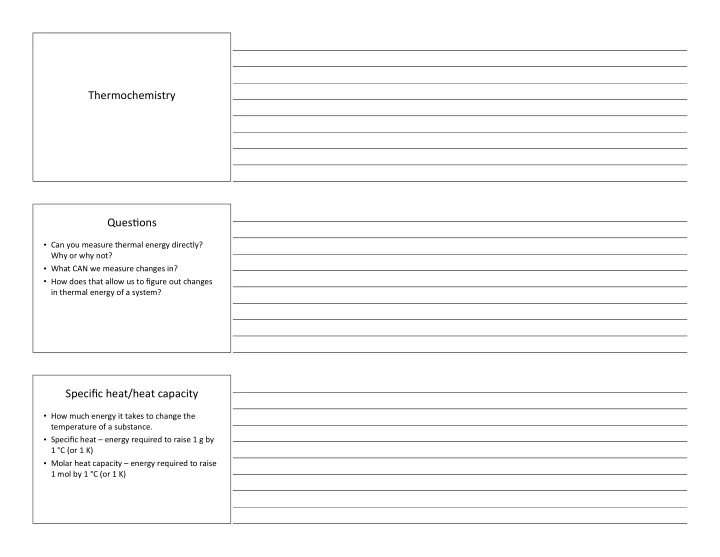
  1. Thermochemistry Ques.ons • Can ¡you ¡measure ¡thermal ¡energy ¡directly? ¡ Why ¡or ¡why ¡not? ¡ • What ¡CAN ¡we ¡measure ¡changes ¡in? • How ¡does ¡that ¡allow ¡us ¡to ¡figure ¡out ¡changes ¡ in ¡thermal ¡energy ¡of ¡a ¡system? Specific ¡heat/heat ¡capacity • How ¡much ¡energy ¡it ¡takes ¡to ¡change ¡the ¡ temperature ¡of ¡a ¡substance. • Specific ¡heat ¡– ¡energy ¡required ¡to ¡raise ¡1 ¡g ¡by ¡ 1 ¡°C ¡(or ¡1 ¡K) • Molar ¡heat ¡capacity ¡– ¡energy ¡required ¡to ¡raise ¡ 1 ¡mol ¡by ¡1 ¡°C ¡(or ¡1 ¡K) ¡

  2. Name Formula Molar ¡mass Molar ¡heat ¡ Specific ¡heat ¡ (g/mol) capacity ¡(J/ ¡mol ¡ (J/g ¡°C) water H 2 O 18 75.4 4.18 methanol CH 3 OH 32 81 2.53 ethanol CH 3 CH 2 OH 48 112 2.44 propanol CH 3 CH 2 CH 2 OH 60 144 2.39 The ¡molar ¡heat ¡capacity ¡increases ¡with ¡molecular ¡weight. ¡Why? – ¡more ¡ways ¡to ¡use ¡energy ¡as ¡the ¡number ¡of ¡atoms ¡and ¡bonds ¡increases ¡(in ¡ vibra.ons ¡and ¡rota.ons). Why ¡is ¡the ¡sp ¡heat ¡of ¡water ¡so ¡high? Lots ¡of ¡molecules ¡per ¡gram ¡(low ¡molecular ¡weight ¡of ¡H2O) Lots ¡of ¡intermolecular ¡aYrac.ons ¡ Add ¡same ¡amount ¡of ¡heat ¡to ¡10g ¡of ¡each ¡-­‑ ¡ which ¡will ¡reach ¡the ¡highest ¡temp? Substance Specific ¡Heat ¡(J/g ¡ °C) A. H2O(s) Aluminum 0.90 B. H2O(l) C. Aluminum Copper 0.39 D. Silver Ice ¡H 2 O(s) 2.05 E. One ¡of ¡the ¡other ¡materials ¡in ¡the ¡table Iron 0.45 Silver 0.24 Steam ¡H 2 O(g) 2.01 Water ¡H 2 O ¡(l) 4.19 Which ¡will ¡end ¡up ¡at ¡the ¡lowest ¡temp? Why ¡does ¡water ¡in ¡its ¡difference ¡phases ¡ That ¡is: ¡why ¡does ¡it ¡take ¡different ¡amounts ¡of ¡thermal ¡ energy ¡to ¡raise ¡the ¡temperature ¡of ¡a ¡fixed ¡amount ¡of ¡solid, ¡ liquid ¡or ¡gaseous ¡water? Why ¡does ¡it ¡take ¡so ¡much ¡energy ¡to ¡ raise ¡the ¡temperature ¡of ¡liquid ¡water?

  3. Water ¡and ¡its ¡anomalous ¡proper.es • High ¡specific ¡heat • High ¡mel.ng/boiling ¡point • Low ¡density ¡of ¡ice • Low ¡vapor ¡pressure ¡(the ¡pressure ¡exerted ¡by ¡a ¡ gas ¡above ¡the ¡liquid ¡at ¡a ¡given ¡temperature) Liquid ¡water Solid ¡water

  4. All ¡these ¡proper.es ¡are ¡caused ¡by ¡the ¡ unique ¡structure ¡of ¡water ¡– ¡with ¡leads ¡ to ¡very ¡high ¡intermolecular ¡interac.ons ¡ (which ¡require ¡a ¡lot ¡of ¡energy ¡to ¡ overcome) ¡ Ques.on • What ¡would ¡be ¡the ¡consequences ¡(to ¡life, ¡the ¡ universe ¡and ¡everything) ¡if ¡water ¡were ¡a ¡linear ¡ molecule? Phase ¡Changes • What ¡happens ¡when ¡we ¡remove ¡thermal ¡ energy ¡from ¡a ¡gas? • How ¡do ¡we ¡remove ¡thermal ¡energy ¡from ¡a ¡ gas? • What ¡has ¡to ¡happen ¡for ¡molecules ¡to ¡s.ck ¡ together? • hYp://phet.colorado.edu/simula.ons/ sims.php?sim=States_of_MaYer

  5. Phase ¡Changes ¡and ¡Temperature • Moving ¡from ¡solid ¡ à ¡liquid ¡ à ¡gas ¡or ¡ ¡ ¡ ¡ ¡ ¡ ¡ ¡ ¡ ¡ ¡ ¡Gas ¡ à ¡liquid ¡ à ¡solid • What ¡happens ¡to ¡the ¡temperature ¡at ¡a ¡phase ¡ change? • What ¡is ¡the ¡energy ¡being ¡used ¡for? Phase ¡changes ¡and ¡temperature ¡ 2 . ¡What ¡happens ¡on ¡the ¡molecular ¡level ¡when ¡thermal ¡energy ¡(heat) ¡is ¡added ¡ to ¡boiling ¡water? A ¡ It ¡increases ¡the ¡speed ¡at ¡which ¡molecules ¡collide. ¡The ¡bonds ¡within ¡the ¡ molecules ¡break ¡and ¡cause ¡a ¡release ¡of ¡hydrogen ¡and ¡oxygen ¡gases ¡into ¡the ¡air. B. The ¡water ¡molecules ¡will ¡move ¡faster ¡and ¡the ¡aYrac.ons ¡between ¡them ¡will ¡ be ¡overcome. ¡The ¡temperature ¡of ¡water ¡will ¡not ¡change. ¡ C. It ¡makes ¡the ¡water ¡molecules ¡move ¡faster ¡and ¡bump ¡into ¡each ¡other; ¡ consequently ¡the ¡water ¡temperature ¡will ¡increase ¡in ¡the ¡process. D. It ¡increases ¡the ¡movement ¡of ¡water ¡molecules ¡and ¡overcomes ¡the ¡ aYrac.ons ¡between ¡them. ¡Energy ¡will ¡be ¡released ¡into ¡the ¡environment ¡and ¡ new ¡bonds ¡will ¡form ¡to ¡make ¡water ¡vapor.

  6. Ques.ons • Draw ¡a ¡graph ¡of ¡the ¡change ¡in ¡temperature ¡when ¡equal ¡ amounts ¡of ¡thermal ¡energy ¡are ¡added ¡at ¡the ¡same ¡rate ¡to ¡ equal ¡masses ¡of ¡water, ¡ethanol ¡and ¡propanol. ¡ • Does ¡each ¡sample ¡reach ¡the ¡same ¡temperature? ¡Why ¡or ¡why ¡ not? • Plot ¡the ¡temperature ¡change ¡vs ¡.me ¡as ¡a ¡sample ¡of ¡water ¡ vapor ¡moves ¡from ¡a ¡temperature ¡of ¡110ºC ¡to ¡90 ¡ºC • Draw ¡a ¡molecular ¡level ¡picture ¡of ¡what ¡the ¡sample ¡looks ¡like ¡ at ¡110ºC ¡and ¡90ºC • Explain ¡what ¡is ¡happening ¡at ¡each ¡different ¡part ¡of ¡your ¡ graph.

Recommend


More recommend


Explore More Topics

Stay informed with curated content and fresh updates.