Thermodynamic manifolds and stability of black holes in various - - PowerPoint PPT Presentation

thermodynamic manifolds and stability of black holes in
SMART_READER_LITE
LIVE PREVIEW

Thermodynamic manifolds and stability of black holes in various - - PowerPoint PPT Presentation

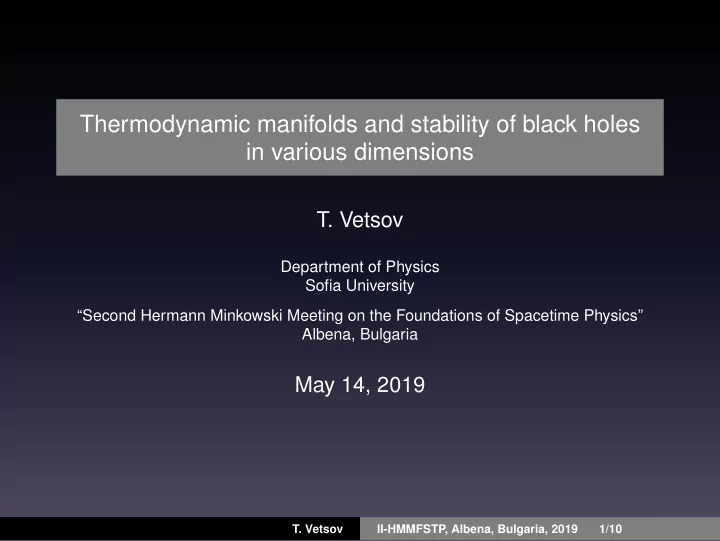
Thermodynamic manifolds and stability of black holes in various dimensions T. Vetsov Department of Physics Sofia University Second Hermann Minkowski Meeting on the Foundations of Spacetime Physics Albena, Bulgaria May 14, 2019 T.


slide-1
SLIDE 1

Thermodynamic manifolds and stability of black holes in various dimensions

  • T. Vetsov

Department of Physics Sofia University “Second Hermann Minkowski Meeting on the Foundations of Spacetime Physics” Albena, Bulgaria

May 14, 2019

  • T. Vetsov

II-HMMFSTP, Albena, Bulgaria, 2019 1/10

slide-2
SLIDE 2

Black hole thermodynamics

Black holes have entropy (Bekenstein-Hawking ’70s): S = kB A 4L2

p

+ corrections (1) The first law of thermodynamics: dM = TdS + ΩdJ + ΦdQ + · · · = TdS + ΦidQi = IadEa (2) Black holes thermal stability (Davies ’80): C = T ∂S ∂T        > 0, stable, < 0, radiating (unstable), = 0, phase transitions, → ∞, phase transitions (3)

  • T. Vetsov

II-HMMFSTP, Albena, Bulgaria, 2019 2/10

slide-3
SLIDE 3

Geometric approaches to the equilibrium space of black holes

The space of extensive parameters E = {Ξ, Ea} is called an equilibrium manifold if supplied with a proper metric structure.

  • Hessian information metrics, “Geometric thermodynamics”

(F . Weinhold 1975, G. Ruppeiner 1979)

  • Legendre invariant metrics, “Geometrothermodynamics”

(H. Quevedo 2006)

  • Method of conjugate potentials, “New geometric

thermodynamics” (B. Mirza, A. Mansoori 2014 & 2019)

  • T. Vetsov

II-HMMFSTP, Albena, Bulgaria, 2019 3/10

slide-4
SLIDE 4

Hessian metrics

Fluctuation theory (G. Ruppeiner ’79): S(Ea) = S0 + EQL + ∂2S ∂Ea∂Eb dEadEb + · · · = S0 + EQL − gab( E)dEadEb (4) Ruppeiner information metric: g(R)

ab

= − ∂2S ∂Ea∂Eb = −HessS( E) (5) Weinhold information metric (F . Weinhold ’75): g(W)

ab

= ∂2M ∂Ea∂Eb = HessM( E) (6)

  • T. Vetsov

II-HMMFSTP, Albena, Bulgaria, 2019 4/10

slide-5
SLIDE 5

Scalar curvature and quantum gravity

1 The probability for fluctuating between two macro states is

proportional to the geodesic distance between them in E.

2 The strength of interactions/correlations between quantum

bits on the event horizon = the magnitude of R

3 The sign of R indicates the type of interactions (G.

Ruppeiner ’10): R        > 0, repulsive interactions, < 0, attractive interactions, = 0, free theory, → ∞, phase transitions (7)

4 Phase transitions = divergencies of R (F

. Weinhold ’75, G. Ruppeiner ’79)

  • T. Vetsov

II-HMMFSTP, Albena, Bulgaria, 2019 5/10

slide-6
SLIDE 6

Legendre invariant metrics

  • Consider (2n + 1) TD phase space T with coordinates

ZA = (Ξ, Ia, Ea), a = 1, . . . , n, where Ξ is a TD potential.

  • Select on T a non-degenerate Legendre invariant metric

G = G(ZA) and a Gibbs 1-form Θ(ZA), namely GGTD = Θ2 + (ξabEaIb)(ηcddEcdId), Θ = dΞ − δabIadEb, where δab is the identity matrix, ηab is the Minkowski metric, and ξab is some constant tensor.

  • Take the pullback φ∗ : T → E to find (H. Quevedo ’17):

ds2 =

  • δacξcbEa ∂Ξ

∂Eb ηd

e

∂2Ξ ∂Ed∂Ef dEedEf

  • (8)
  • T. Vetsov

II-HMMFSTP, Albena, Bulgaria, 2019 6/10

slide-7
SLIDE 7

Conjugate thermodynamic potentials

For general black holes with (m + 1) TD variables, (S, Φi), and Enthalpy potential, ¯ M = M − ΦiQi, one can define the metric (B. Mirza, A. Mansoori ’19): ˆ g = blockdiag 1 T ∂2M ∂S2 , − ˆ G

  • ,

(9) where Gij = 1 T ∂2M ∂Y i∂Y j , Y i = (Q1, . . . , Qm) (10)

  • T. Vetsov

II-HMMFSTP, Albena, Bulgaria, 2019 7/10

slide-8
SLIDE 8

Black holes in 3 and 4 dimensions

1 TIG for 4d Deser-Sarioglu-Tekin black hole solution in

higher derivative theory of gravity (T. Vetsov ’19): I = 1 2

  • M

d4x√−g

  • R + σ
  • 3Tr( ˆ

C2)

  • ,

σ < −1 2 & σ > 1

2 TIG for 3d WAdS3 black hole solution in TMG dual to

WCFT2 with left and right central charges (H. Dimov, R. C. Rashkov, T. Vetsov ’19) I = 1 16πG

  • M

d3x√−g

  • R + 2

L

  • + 1

µICS +

  • ∂M

B Tc = 1 π(cL + √cLcR)

  • T. Vetsov

II-HMMFSTP, Albena, Bulgaria, 2019 8/10

slide-9
SLIDE 9

Summary

  • Thermodynamic information geometry (TIG) is a set of

geometric tools for investigating statistical thermal systems in equilibrium or non-equilibrium

  • TIG is a subset in the more powerful framework of

Information Geometry (IG)

  • IG is essential for understanding how classical and

quantum information can be encoded onto the degrees of freedom of any physical system

  • Growing number of applications beyond physics
  • T. Vetsov

II-HMMFSTP, Albena, Bulgaria, 2019 9/10

slide-10
SLIDE 10

Credits

Thank You!

  • In colaboration with R. C. Rashkov and H. Dimov:
  • T. Vetsov, Eur. Phys. J. C (2019) 79: 71
  • H. Dimov, R. C. Rashkov, T. Vetsov, 1902.02433 [hep-th]
  • Partially supported by
  • The Bulgarian NSF Grant DM 18/1
  • The Sofia University Grant 10-80-149
  • T. Vetsov

II-HMMFSTP, Albena, Bulgaria, 2019 10/10