These guidelines contain information on: 1. Oral Presentation - - PDF document

these guidelines contain information on 1 oral
SMART_READER_LITE
LIVE PREVIEW

These guidelines contain information on: 1. Oral Presentation - - PDF document

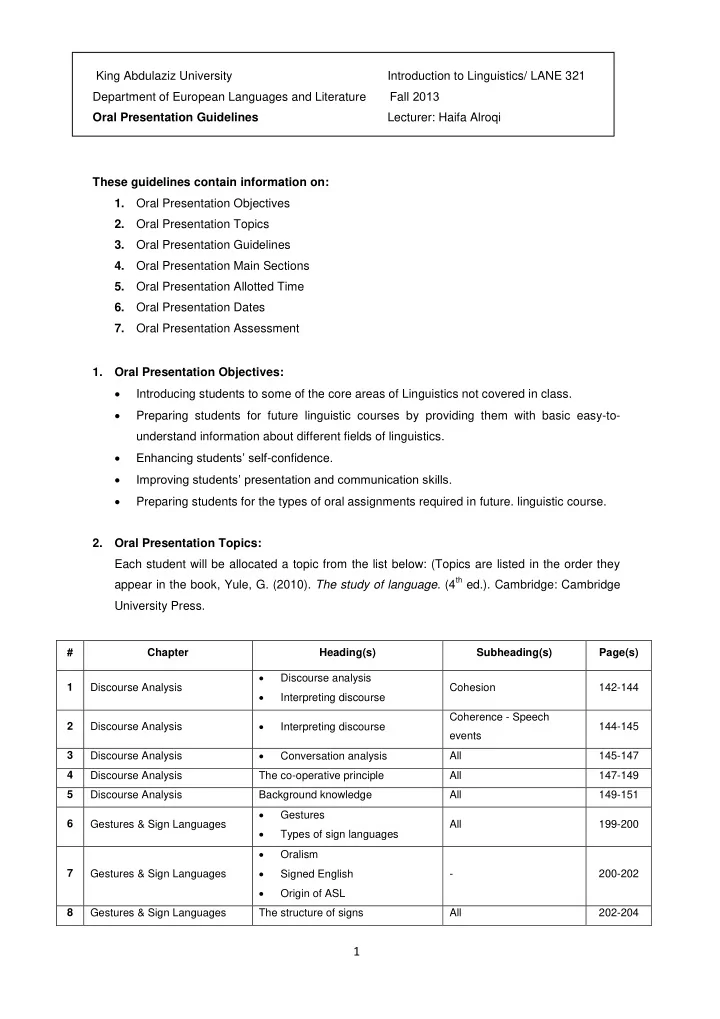
King Abdulaziz University Introduction to Linguistics/ LANE 321 Department of European Languages and Literature Fall 3102 Oral Presentation Guidelines Lecturer: Haifa Alroqi These guidelines contain information on: 1. Oral Presentation


slide-1
SLIDE 1

1

King Abdulaziz University Introduction to Linguistics/ LANE 321 Department of European Languages and Literature Fall 3102 Oral Presentation Guidelines Lecturer: Haifa Alroqi These guidelines contain information on:

  • 1. Oral Presentation Objectives
  • 2. Oral Presentation Topics
  • 3. Oral Presentation Guidelines
  • 4. Oral Presentation Main Sections
  • 5. Oral Presentation Allotted Time
  • 6. Oral Presentation Dates
  • 7. Oral Presentation Assessment
  • 1. Oral Presentation Objectives:

 Introducing students to some of the core areas of Linguistics not covered in class.  Preparing students for future linguistic courses by providing them with basic easy-to- understand information about different fields of linguistics.  Enhancing students’ self-confidence.  Improving students’ presentation and communication skills.  Preparing students for the types of oral assignments required in future. linguistic course.

  • 2. Oral Presentation Topics:

Each student will be allocated a topic from the list below: (Topics are listed in the order they appear in the book, Yule, G. (2010). The study of language. (4th ed.). Cambridge: Cambridge University Press.

# Chapter Heading(s) Subheading(s) Page(s) 1 Discourse Analysis  Discourse analysis  Interpreting discourse Cohesion 142-144 2 Discourse Analysis  Interpreting discourse Coherence - Speech events 144-145 3 Discourse Analysis  Conversation analysis All 145-147 4 Discourse Analysis The co-operative principle All 147-149 5 Discourse Analysis Background knowledge All 149-151 6 Gestures & Sign Languages  Gestures  Types of sign languages All 199-200 7 Gestures & Sign Languages  Oralism  Signed English  Origin of ASL

  • 200-202

8 Gestures & Sign Languages The structure of signs All 202-204

slide-2
SLIDE 2

2

9 Gestures & Sign Languages  The meaning of signs  Representing signs  ASL as a natural language

  • 204-207

10 Language History & Change Family trees All 225-226 11 Language History & Change Comparative reconstruction All 227-228 12 Language History & Change The history English Old English – Middle English 228-230 13 Language History & Change The history English Sound changes - Syntactic changes 231-233 14 Language History & Change  The history English  Diachronic and synchronic variation Semantic changes 233-234 15 Language & Regional Variation  The standard language  Accent and dialect

  • 240-241

16 Language & Regional Variation Dialectology Regional dialects 241-242 17 Language & Regional Variation Dialectology Isoglosses and dialect boundaries – The dialect continuum 242-244 18 Language & Regional Variation  Bilingualism and diaglossia  Language planning

  • 244-247

19 Language & Regional Variation  Pidgins and creoles  The post-creole continuum

  • 247-249

20 Language & Social Variation Sociolinguistics Social dialects 254-255 21 Language & Social Variation Sociolinguistics Education and occupation

  • Social markers

255-256 22 Language & Social Variation Speech style and style-shifting Prestige 257-258 23 Language & Social Variation Speech style and style-shifting Speech accommodation – Register and jargon - Slang 258-260 24 Language & Social Variation African American English All 260-262 25 Language & Culture  Culture  Categories All 267-269 26 Language & Culture Linguistic relativity All 269-271 27 Language & Culture Cognitive categories All 271-272 28 Language & Culture Social categories All 272-274 29 Language & Culture Gender Gendered words 274-275 30 Language & Culture Gender Gendered speech- Gendered interaction 275-277

slide-3
SLIDE 3

3

  • 3. Oral Presentation Guidelines:

 Your presentation should be an explanation of the assigned part.  Your presentation should be saved in a CD not a USB Flash Drive. USB Flash Drives might take a long time to be configured by computers and have a high risk of viruses!  Please check with your instructor in advance to ensure the compatibility of the format you are using for your presentation with the device/ computer used to show your presentation.  You must send a soft copy of your presentation to your instructor’s email address, lane321@outlook.com  You must hand in a handout of your presentation to your instructor prior to giving your presentation.  If you need extra equipments (e.g. speakers), please arrange with your instructor in advance.

  • 4. Oral Presentation Main Sections:

Your presentation must include the following:  The first slide should have:

  • The Name of the institution (i.e. Department of European Languages and Literature,

Faculty of Arts and Humanities, King Abdulaziz University)

  • The Course Title and Code (i.e. Introduction to Linguistics - LANE 321)
  • The title of your presentation (Choose a suitable title)
  • Your name/ Student ID
  • Your instructor's name (i.e. Lecturer Haifa Alroqi)
  • The academic semester (i.e. Fall 2013)
  • The date of your presentation

 Introductory slide(s): Outline of the Presentation  Body slides  Concluding slide(s): Main Points of the Presentation  References: Written according to the APA Referencing Style  A “Thank you” slide

  • 5. Oral Presentation Allotted Time:

Each Oral Presentation will be allocated a five-minute slot. Presenters are expected to strictly adhere to the time limit.

  • 6. Oral Presentation Dates:

Please refer to the instructor’s webpage, halroqi.kau.edu.sa > English > Fall 2013 > Oral Presentation Schedule > Your Section (DAR or GAR)

  • 7. Oral Presentation Assessment:
  • Your Oral Presentation is worth 10% of your total course grade.
  • The Oral Presentation will be evaluated and graded using the Oral Presentation Rubric.