This presentation was given prior to the Forums business meeting , 12 - - PDF document

this presentation was given prior to the forum s business
SMART_READER_LITE
LIVE PREVIEW

This presentation was given prior to the Forums business meeting , 12 - - PDF document

This presentation was given prior to the Forums business meeting , 12 th November 2019. Natalia Jancewicz on the topic of Degrowth A society model looking at democratically led solutions to achieve environmental sustainability, social


slide-1
SLIDE 1

1

This presentation was given prior to the Forum’s business meeting, 12th November 2019. Natalia Jancewicz on the topic of “Degrowth” A society model looking at democratically led solutions to achieve environmental sustainability, social justice and wellbeing. What is Degrowth?

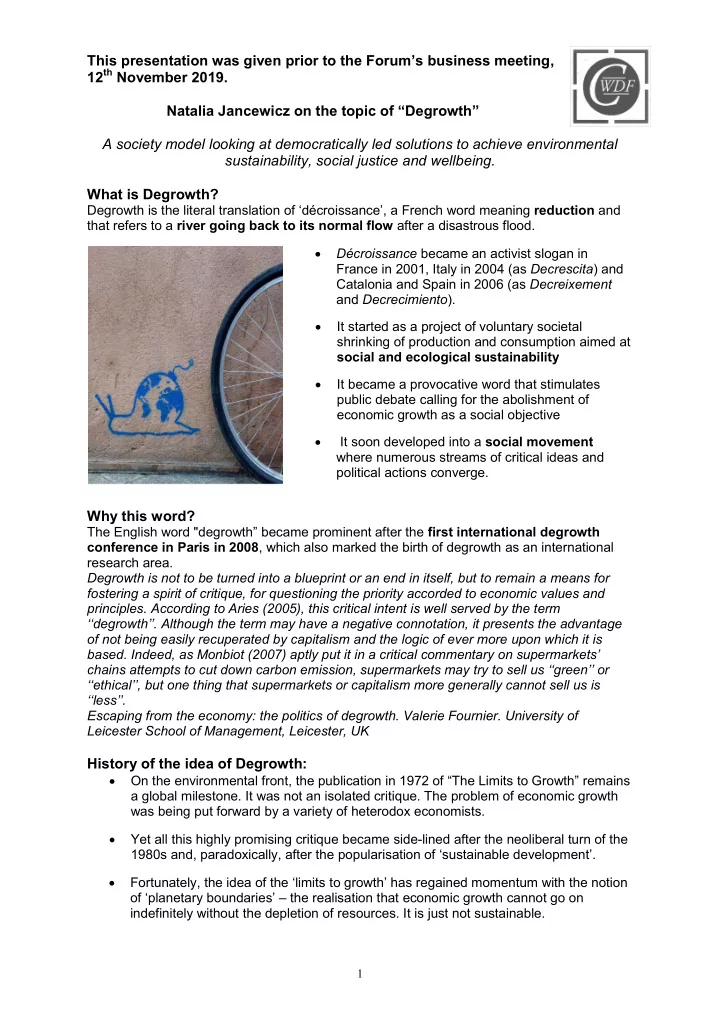
Degrowth is the literal translation of ‘décroissance’, a French word meaning reduction and that refers to a river going back to its normal flow after a disastrous flood.  Décroissance became an activist slogan in France in 2001, Italy in 2004 (as Decrescita) and Catalonia and Spain in 2006 (as Decreixement and Decrecimiento).  It started as a project of voluntary societal shrinking of production and consumption aimed at social and ecological sustainability  It became a provocative word that stimulates public debate calling for the abolishment of economic growth as a social objective  It soon developed into a social movement where numerous streams of critical ideas and political actions converge.

Why this word?

The English word "degrowth” became prominent after the first international degrowth conference in Paris in 2008, which also marked the birth of degrowth as an international research area. Degrowth is not to be turned into a blueprint or an end in itself, but to remain a means for fostering a spirit of critique, for questioning the priority accorded to economic values and

  • principles. According to Aries (2005), this critical intent is well served by the term

‘‘degrowth’’. Although the term may have a negative connotation, it presents the advantage

  • f not being easily recuperated by capitalism and the logic of ever more upon which it is
  • based. Indeed, as Monbiot (2007) aptly put it in a critical commentary on supermarkets’

chains attempts to cut down carbon emission, supermarkets may try to sell us ‘‘green’’ or ‘‘ethical’’, but one thing that supermarkets or capitalism more generally cannot sell us is ‘‘less’’. Escaping from the economy: the politics of degrowth. Valerie Fournier. University of Leicester School of Management, Leicester, UK

History of the idea of Degrowth:

 On the environmental front, the publication in 1972 of “The Limits to Growth” remains a global milestone. It was not an isolated critique. The problem of economic growth was being put forward by a variety of heterodox economists.  Yet all this highly promising critique became side-lined after the neoliberal turn of the 1980s and, paradoxically, after the popularisation of ‘sustainable development’.  Fortunately, the idea of the ‘limits to growth’ has regained momentum with the notion

  • f ‘planetary boundaries’ – the realisation that economic growth cannot go on

indefinitely without the depletion of resources. It is just not sustainable.

slide-2
SLIDE 2

2

Diagnosis: 

GDP is a faulty measure of prosperity.

Some put population growth forward as the core of the problem, but this merely distracts us from the more uncomfortable necessity of examining our economic system.

Our current economic model is based on the notion of endless growth through industrial production and limitless consumption, but we live in a bounded, finite world with physical limits. We currently use resources beyond regeneration capability. Hence continued economic growth is ecologically unsustainable and leads to financial injustice and inequality In terms of ecological unsustainability, basic natural resources are reaching the end of their

  • availability. For example, according to the International Energy Agency, conventional crude
  • il production peaked in 2006.

In terms of injustice and inequality we have only to look at the impact of overconsumption on poor countries and over future generations. If the whole world consumed like we do in the UK, we would need more than 3 planets to meet our resource demands and absorb our waste streams. Billions of people around the world remain in destitution and are also facing the consequences of the ecological crisis.

Degrowth and “Green Growth” or “Green Wash”:

It challenges the ideas of "green growth", "green economy" or "sustainable development". These programmes of reform tend to offer an optimistic view based on the use of eco- efficient technologies. However, to date, there is hardly any country that can claim an absolute reduction in material use or carbon emissions whilst growing. An example of a country which claims reduction but is still growing is Germany but this is because it is

  • utsourcing energy. Even renewable energy will not be sustainable with our present energy

consumption. It considers "sustainable development" an oxymoron (two words used together that have, or seem to have, opposite meanings) that has to be removed from the social imaginary.

Degrowth strategies and actors:

Include  Acting on different scales: local, national, global  Oppositional activism: e.g. Extinction Rebellion.  Redistribution: basic and maximum income.  Commons or extension of the sphere of free usage – community gardens, green spaces, community energy schemes  Examples of policies for degrowth: Controls on commercial advertisement; reduction of working hours/ work-sharing  Open re-localisation to include local non- speculative currencies such as “Bristol Pounds” (bristolpound.org), local exchange trading systems (good and services), re-localized production and consumption of food (Food Sovereignty) and re-localisation of energy, housing and transportation. Quote from The Centre for Alternative Technology’s quarterly magazine “Clean Slate” 113 Autumn 2019 “Investment is currently focused on building more houses (often into the countryside) together with more roads and other infrastructure.

slide-3
SLIDE 3

3

As we transition away from an economy based on fossil fuels towards zero carbon there is the potential for the creation of hundreds of thousands of new green jobs. These jobs should be distributed all over the UK, bringing vitality back to our rural economies and small towns rather than being concentrated in large cities. Achieving this will require a transition strategy that prioritises local jobs:

  • small scale renewable energy, not just off-shore wind farms.
  • re-establishing local food economies that connect urban areas with the rural ones.
  • good local public transport and live-work communities rather than commuting on high

speed long distance trains.

More on “Open Re-localisation”:

Why open? For freedom and fruitful and rich cultural exchanges; for democratic reasons we need wider links and institutions; even with a local sustainable autonomy, there is still need

  • f solidarity.

Why re-localisation? To leave the illusion of individualism and see the consequences of our actions; for environmental reasons; re-localising and abandoning the global economy in the Global South would allow people of the South to become more self-sufficient and would end the exploitation of Southern resources and work labour by the North; for cultural and social reasons - a more convivial and desirable way of life.

Promotion of small scale alternatives:

 Practice of Voluntary Simplicity  Cycling  Repair, Reuse, Reduce, Recycle  Vegetarianism or veganism  Agro-ecology and Perma-culture  Community gardens and Incredible Edible  Transition Towns and eco-villages  Natural building  Fair Trade  Consumer cooperatives  Alternative ethical banks or credit cooperatives  Decentralised renewable energy cooperatives Degrowth is complementing and reinforcing these topic areas, functioning as a connecting thread.

Voluntary simplicity

 Disconnection between income increase and life satisfaction: Easterlin Paradox. The 'Easterlin Paradox' states that at a point in time happiness varies directly with income both among and within nations, but over time happiness does not trend upward as income continues to grow.  Living better with less, slowing down life’s pace.  Much attention is given to how conscious critical consumption can promote transformation at both the individual and the social level.  If less time is spent on formal work and consumption, more time can be dedicated to

  • ther activities which are fundamental to one’s well-being: social relations, political

participation, physical exercise, art, spirituality, nature, culture, contemplation...  Such a shift will potentially be less environmentally harmful  "The implementation of policies for degrowth must occur in a unique and asymmetric manner, depending on the social and environmental conditions of each place on the

  • planet. But nevertheless,a vision of life based on happiness from frugality would be

common", Latouche (2010).  Change of values/ conversion

slide-4
SLIDE 4

4

  • From material goods to relational goods, such as: care, knowledge,

participation, new spaces of freedom and spirituality, etc.

  • from the current predatory economic logic towards a solidarity economic logic,

where people and nature are placed at the centre of economic activities, exceeding the exclusively monetary valuation of products and services.

  • It is about re-conquering values such as altruism, cooperation, hedonism

versus obsession with work, proximity, self-containment and autonomy.

Definition of degrowth

  • according to “Degrowth & Research”, the academic association dedicated to degrowth:

"Sustainable degrowth is a downscaling of production and consumption that increases human well-being and enhances ecological conditions and equity on the

  • planet. It calls for a future where societies live within their

ecological means, with open, localized economies and resources more equally distributed through new forms of democratic institutions […]The primacy of efficiency will be substituted by a focus on sufficiency, and innovation will no longer focus on technology for technology’s sake but will concentrate on new social and technical arrangements that will enable us to live convivially and frugally. Degrowth does not only challenge the centrality of GDP as an overarching policy objective but proposes a framework for transformation to a lower and sustainable level of production and consumption, a shrinking of the economic system to leave more space for human cooperation and ecosystems".

For further information...

 An email list for people working on or promoting degrowth in the UK .Location: ManchesterWebsite: https://lists.riseup.net/www/info/degrowthuk Email: degrowthuk@lists.riseup.net  Degrowth UK on Twitter  https://degrowth.org or Research & Degrowth on Facebook  https://www.degrowth.info/en/