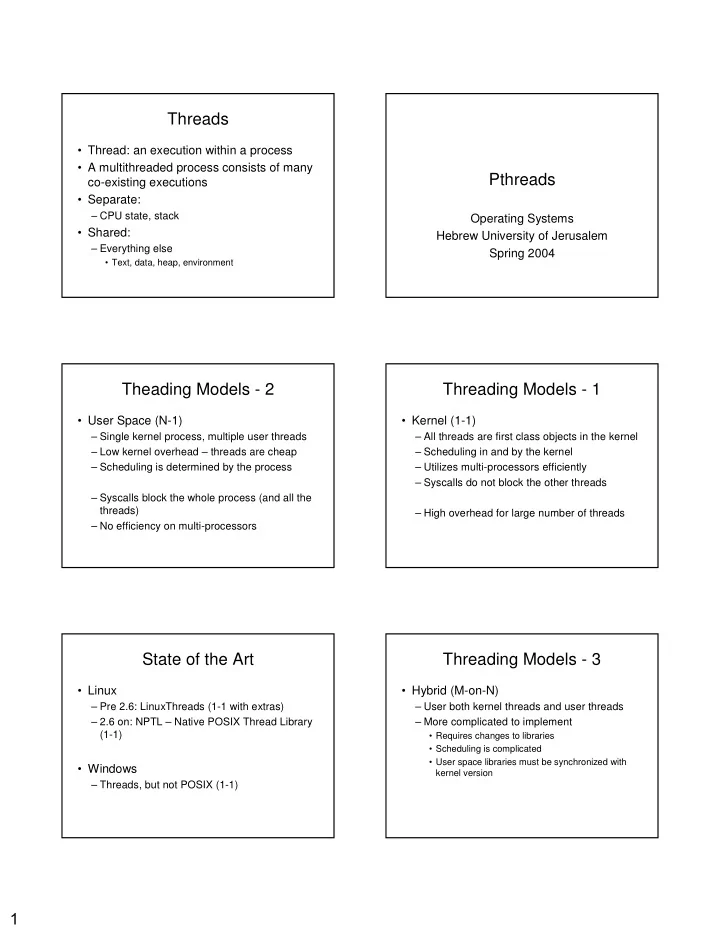
Threads Thread: an execution within a process A multithreaded - - PDF document

threads
SMART_READER_LITE
LIVE PREVIEW

Threads Thread: an execution within a process A multithreaded - - PDF document

Threads Thread: an execution within a process A multithreaded process consists of many Pthreads co-existing executions Separate: CPU state, stack Operating Systems Shared: Hebrew University of Jerusalem Everything


slide-1
SLIDE 1
  • Pthreads

Operating Systems Hebrew University of Jerusalem Spring 2004

Threads

  • Thread: an execution within a process
  • A multithreaded process consists of many

co-existing executions

  • Separate:

– CPU state, stack

  • Shared:

– Everything else

  • Text, data, heap, environment

Threading Models - 1

  • Kernel (1-1)

– All threads are first class objects in the kernel – Scheduling in and by the kernel – Utilizes multi-processors efficiently – Syscalls do not block the other threads – High overhead for large number of threads

Theading Models - 2

  • User Space (N-1)

– Single kernel process, multiple user threads – Low kernel overhead – threads are cheap – Scheduling is determined by the process – Syscalls block the whole process (and all the threads) – No efficiency on multi-processors

Threading Models - 3

  • Hybrid (M-on-N)

– User both kernel threads and user threads – More complicated to implement

  • Requires changes to libraries
  • Scheduling is complicated
  • User space libraries must be synchronized with

kernel version

State of the Art

  • Linux

– Pre 2.6: LinuxThreads (1-1 with extras) – 2.6 on: NPTL – Native POSIX Thread Library (1-1)

  • Windows

– Threads, but not POSIX (1-1)

slide-2
SLIDE 2
  • How to Compile
  • #include <pthread.h>
  • gcc myprog.c –o myprog –l pthread

thread creation

int pthread_create(pthread_t *thread, pthread_attr_t *attr, void* (*start_routine)(void*), void *arg);

  • Create a thread and run the start_routine
  • attr is usually NULL, don’t mess with it

Example

#include <pthread.h> int val = 0; void *thread(void *vargp) { val = (int)vargp; } int main() { int i; pthread_t tid; pthread_create(&tid, NULL, thread, (void *)42); pthread_join(tid, NULL); printf("%d\n",val); }

sched_yield

#include <sched.h> #include <unistd.h> int sched_yield (void);

  • Yield the processor to another thread
  • Useful on uni-processor

Who am I

  • pthread_t pthread_self(void)
  • Uses:

– Debugging – Data structures indexed by thread

  • pthread_equal: compare two pthread_t

Relationships

  • Marriage:

– pthread_join – I will wait for you forever

  • Good bye

– pthread_exit – I am going away now

  • Death

– pthread_cancel – please die

  • Divorce:

– pthread_detach – never talk to me again

slide-3
SLIDE 3
  • pthread_join
  • int pthread_join(pthread t, void *data)
  • Wait until the thread exits and return the exit
  • data. This call blocks!
  • Performs a detach after the join succeeds
  • Return values:

– 0: successful completion – EINVAL: thread is not joinable – ESRCH: no such thread – EDEADLK: a deadlock was detected, or thread specifies the calling thread

pthread_exit

  • void pthread_exit(void *data)
  • Stops execution of this thread
  • Return data to anyone trying to join this

thread

  • Don’t call from the main thread, use exit()

Example

#include <pthread.h> void *thread(void *vargp) { pthread_exit((void*)42); } int main() { int i; pthread_t tid; pthread_create(&tid, NULL, thread, NULL); pthread_join(tid, (void **)&i); printf("%d\n",i); }

pthread_cancel

  • Die you !@$#@
  • int pthread_cancel(pthread_t thread)
  • return values:

– 0: ok – EINVAL: thread is invalid – ESRCH: no such thread

pthread_cancel

  • Three phases

– Post a cancel request – Deliver to the target thread at the next cancellation point – Call cleanup routines and die

pthread_detach

  • I never want to see this thread again.
  • int pthread_detach(pthread_t thread)
  • Return values:

– 0 - ok – EINVAL – thread is not joinable – ESRCH – no such thread

  • On some systems, exit does not cause the

program to exit until all non-detached threads are finished

slide-4
SLIDE 4
  • Review: Exiting threads
  • Four options

– Exit from start routine – Call pthread_exit – Call exit – Killed by pthread_cancel

Review

  • pthread_create
  • pthread_join
  • pthread_detach
  • pthread_exit
  • pthread_cancel
  • pthread_self
  • pthread_equal
  • sched_yield