Tier I Meetings: 1. Learn How to Build a Successful RTI 2 -B - - PDF document

tier i meetings
SMART_READER_LITE
LIVE PREVIEW

Tier I Meetings: 1. Learn How to Build a Successful RTI 2 -B - - PDF document

6/16/17 Ou Outcomes of Presentation Tier I Meetings: 1. Learn How to Build a Successful RTI 2 -B Leadership Team Meeting Lets Get Organized! 2. Discover Tools to Help Your RTI 2 -B Leadership Team Meeting 2017 RTI 2 -B Summer Summit 3.


slide-1
SLIDE 1

6/16/17 1

Tier I Meetings: Let’s Get Organized!

2017 RTI2-B Summer Summit

Ou Outcomes of Presentation

  • 1. Learn How to Build a Successful

RTI2-B Leadership Team Meeting

  • 2. Discover Tools to Help Your RTI2-B

Leadership Team Meeting

  • 3. Understand TIPS Problem-Solving

Model

Ac Acknowledgements

  • Rob Horner, Anne Todd, Steve Newton – University
  • f Oregon
  • Bob Algozzine, Kate Algozzine, Dale Cusumano, and

Angela Preston – UNC at Charlotte

  • The PBIS Team Handbook -Beth Baker & Char Ryan

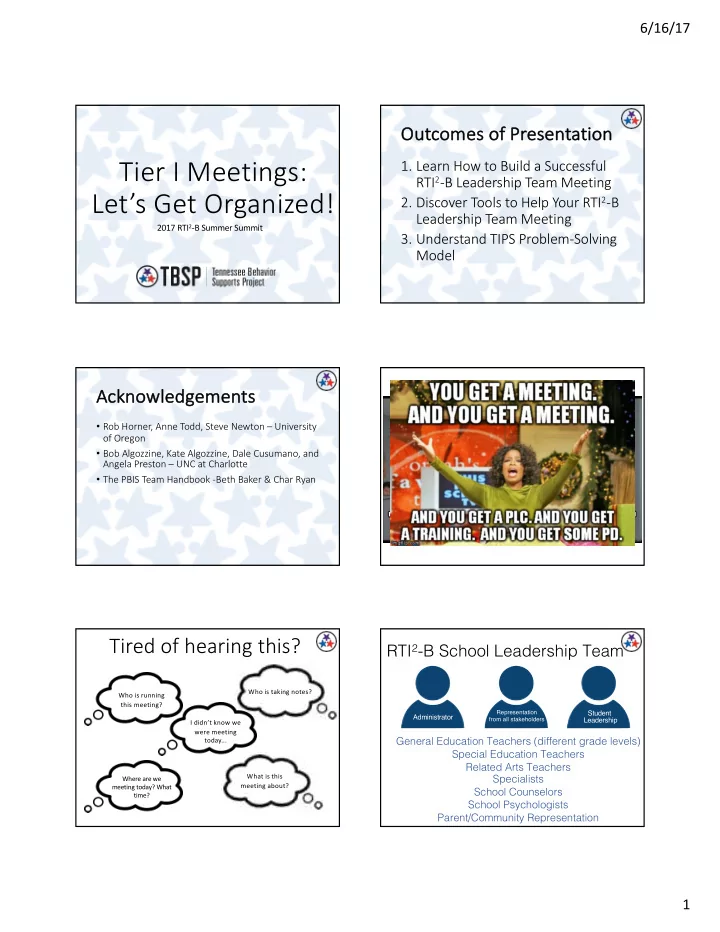
Tired of hearing this?

Who is running this meeting? Who is taking notes? I didn’t know we were meeting today... Where are we meeting today? What time? What is this meeting about?

RTI2-B School Leadership Team

Administrator

Representation from all stakeholders

Student Leadership

General Education Teachers (different grade levels) Special Education Teachers Related Arts Teachers Specialists School Counselors School Psychologists Parent/Community Representation

slide-2
SLIDE 2

6/16/17 2 RTI2-B School Leadership Team: Operating Procedures

Team Actions & Expectations Meet on monthly basis Review and analyze data Provide information and meeting summaries to staff Respond to staff input Meeting Materials & Outcomes Agenda Action Plan Data summaries, team meeting minutes shared Suggestion box, online surveys

Building a Successful RTI2-B Leadership Team Meeting

  • 1. Develop Norms and Decision Making Procedures
  • 2. Establish Team Roles and Responsibilities
  • 3. Schedule regular meetings
  • 4. Establish a meeting agenda
  • 5. Effectivity facilitate meetings
  • 6. Use data-based problem solving at each meeting
  • 7. Develop an action plan and meeting summary
  • 8. Evaluate team meetings and functioning
  • 9. Follow-up and next steps
  • 10. Celebrate and Share Successes

Building a Successful RTI2-B Leadership Team Meeting

  • 1. Develop Norms and Decision Making Procedures
  • 2. Establish Team Roles and Responsibilities
  • 3. Schedule regular meetings
  • 4. Establish a meeting agenda
  • 5. Effectivity facilitate meetings
  • 6. Use data-based problem solving at each meeting
  • 7. Develop an action plan and meeting summary
  • 8. Evaluate team meetings and functioning
  • 9. Follow-up and next steps
  • 10. Celebrate and Share Successes

Meeting Foundations

  • 1. Team Norms

Examples

  • Start on time, end on time
  • Listen to understand, not

reply

  • Use the team meeting

process

  • Assume best intentions
  • Actively participate
  • It’s ok to disagree
  • Be open to new ideas

Decision Making Examples

  • Full consensus (everyone

agrees wholeheartedly)

  • Working consensus

(everyone agrees but some members may have reservations)

  • Majority vote
  • Fist-to-five consensus
  • 2. Team Roles & Responsibilities
  • 3. Schedule

Regular Meetings

  • At least monthly (new

teams may need to meet biweekly)

  • Schedule all meetings at

beginning of year

  • Stick with consistent day of

week and time

  • Make it a priority and take

attendance

  • 4. Establish

Agenda

  • Create a standing agenda
  • Share with team at least 24

hours in advance

  • Stick to agenda (start and

end on time)

  • Display agenda/meeting

minutes for all to see

  • Start with celebrations
  • Talk about data in first five

minutes of meetings

slide-3
SLIDE 3

6/16/17 3

Team Meeting Foundations Form Team Meeting Foundations Form Example Example Meeting

Communicator Principal Team Lead Note Taker School Counselor Parent Rep Data Analyst Team Norms & Roles Not pictured = Meeting Minutes projected on screen

Building a Successful RTI2-B Leadership Team Meeting

  • 1. Develop Norms and Decision Making Procedures
  • 2. Establish Team Roles and Responsibilities
  • 3. Schedule regular meetings
  • 4. Establish a meeting agenda
  • 5. Effectivity facilitate meetings
  • 6. Use data-based problem solving at each meeting
  • 7. Develop an action plan and meeting summary
  • 8. Evaluate team meetings and functioning
  • 9. Follow-up and next steps
  • 10. Celebrate and Share Successes
  • 5. Facilitating

Meetings

Who is responsible for each task?

  • Before
  • During
  • After
  • 5. Facilitating

Meetings

Who is responsible for each task?

  • Before
  • During
  • After
slide-4
SLIDE 4

6/16/17 4

  • 6. Data in Tier I

Meetings

  • Tiered Fidelity Inventory

v2.1

  • Office Discipline Referrals
  • SRSS-IE
  • PIRS
  • Attendance
  • 7. Action Plan &

Summary

  • Document decisions

completed

  • Document action steps

including:

  • What
  • Who
  • By When

Make it a goal to talk about data within the first 5 minutes of every meeting.

Building a Successful RTI2-B Leadership Team Meeting

  • 1. Develop Norms and Decision Making Procedures
  • 2. Establish Team Roles and Responsibilities
  • 3. Schedule regular meetings
  • 4. Establish a meeting agenda
  • 5. Effectivity facilitate meetings
  • 6. Use data-based problem solving at each meeting
  • 7. Develop an action plan and meeting summary
  • 8. Evaluate team meetings and functioning
  • 9. Follow-up and next steps
  • 10. Celebrate and Share Successes
  • 8. Evaluate Team Meetings
  • Check-in with team about meetings
  • Are they an efficient use of time?
  • Are tasks being completed?
  • Be open to making adaptations
  • 9. Follow-up and Next Steps
  • Document and share with staff, families, school

board, community

  • 10. Celebrate and Share Successes
  • Review and summarize decisions made at end of

meeting

  • Include next steps, assignments, and future meetings

TIPS

Team-Initiated Problem Solving

The goal of TIPS is to ensure that meetings have Predictability, Participation, Accountability, and Communication.

To be used during meetings of school-based problem solving teams

What is TIPS?

PBIS.org

What?

Framework for problem solving that has been

  • perationalized into a set of practical procedures

When? How?

Focuses on data-based decision making to improve student outcomes

slide-5
SLIDE 5

6/16/17 5

Critical Features of TIPS

Meeting Foundations Meeting Minutes Problem Solving Process Effective teams establish effective foundations for their meetings

  • Meeting schedule is

created

  • Members attend meetings
  • Projected agenda is

reviewed/followed

  • Team roles defined and

assigned

  • Solutions identified by

team can be approved for implementation

Critical Features of TIPS

Meeting Foundations Meeting Minutes Problem Solving Process Effective teams document critical features of their meetings

  • Document meeting

foundations

  • Guide meetings through

problem-solving steps

  • Record decisions made

during the meeting

  • Previous problems are

reviewed with data

  • Fidelity
  • Outcome data

Critical Features of TIPS

Meeting Foundations Meeting Minutes Problem Solving Process Ongoing use of data to inform decision-making about each problem solving process

Meeting Minutes: Critical Elements

  • Me

Meeting Demographics

  • Logistics of current and next

meeting

  • Attendance
  • Roles
  • Ov

Over erall System ems Update

  • Big picture view of

practices/curriculum implemented

  • Pr

Problem Solving with Action Pl Plans and Evaluation

  • n
  • Problem precision elements
  • Goals
  • Solutions with Plans
  • Evaluation Data
  • Gen

Gener eral Task sks

  • What, Who, and By When
  • Ev

Evaluation of Meeting

  • Meeting Efficient
  • Strategies implemented with

fidelity

  • Are we making positive

changes in students lives?

The purpose is to guide the meeting and record critical decisions.

District Logo Meeting Info Agenda Items Systems Overview Problem Solving Process School Name

slide-6
SLIDE 6

6/16/17 6

Problem Solving Process Organizational/Housekeeping Task List How did we do?

Problem Solving with Action Plans and Evaluation

  • 1. Previously Defined Precise Problem Statements
  • 2. Current Precise Problem Statements

Problem Solving with Action Plans and Evaluation Precise Problem Statements

Primary Precise

The hallway has been crazy lately.

Who? What? When?

Where?

Why? How?

Precision Elements

In the month of April there has been 34 ODRs in the 2nd grade hallway for physical aggression in order to

  • btain peer attention.

Problem Solving with Action Plans and Evaluation Example

slide-7
SLIDE 7

6/16/17 7

Before Meeting

Minute Taker sends to team at least 24 hours in advance Facilitator is responsible for sending agenda items to Minute Taker Data Analyst is responsible for sending Precise Problem statements items to Minute Taker X X X X X X Mark members who are present with an “X” in the box Keep track of items for next meeting here Monitor upcoming data windows

During Meeting

Precise problem statement from previous meeting Evaluating- did it work?

(Previously Defined Precise Problem Statement)

Before Meeting During Meeting

New precise problem statement Evaluate outcomes at next meeting

(New Precise Problem Statement)

During Meeting Next Meeting

Include Who and By When? Everyone votes (thumbs up, down, to the side)

During Meeting

Minute Taker sends to team finished notes no later than 24 hours after meeting Communicator shares updates with staff

After Meeting

Example Walkthrough

slide-8
SLIDE 8

6/16/17 8

In the month of April there has been 34 ODRs in the 2nd grade hallway for physical aggression in

  • rder to obtain peer

attention. 05/01/2017 April 1- 30 = 20 school days 34 ODRs/20 days = 1.7 ODRs/day Fewer than .8/day By June 1st

2nd grade team will reteach expectations to all 2nd grade classrooms by 05/05 Expectations will be posted in 2nd grade hallways – Melissa by 05/05 Bee Bucks will be worth double if given in hallways (make these green), classroom with the most green tickets get’s an extra recess - 2nd grade team ODR reports by June 1st -Abbie 2nd grade team sends date in time of when they taught expectations to Tara, Tara will count green tickets

Example Walkthrough Example Walkthrough

06/01/2017

2 out of 5 2nd grade teachers sent their dates to Tara, all green tickets were given out 2 teachers were out sick the week they were supposed to be taught

X .95/day X X

Tara will let 2nd grade team know outcomes and talk to 3 teachers who didn't’t complete action steps. Will reprint more green tickets and do it again for last few days of school.

Example Walkthrough

X X X X

Resources

  • TIPS: http://www.pbis.org/training/tips/tips-

materials

  • Data Tools: http://etbsp.utk.edu/web-

resources/data-tools/

  • Data Webinar: http://tennesseebsp.org/tier-1-data-

webinars/

  • Summit Resources: www.tennesseebsp.org
  • The PBIS Leadership Team Handbook – Beth Baker

and Char Ryan

Questions?