Tillage and Cropping Systems to Increase Dryland Crop Production in - - PowerPoint PPT Presentation

tillage and cropping systems to increase dryland crop
SMART_READER_LITE
LIVE PREVIEW

Tillage and Cropping Systems to Increase Dryland Crop Production in - - PowerPoint PPT Presentation

Tillage and Cropping Systems to Increase Dryland Crop Production in Southwest Oklahoma by Gary Strickland Extension Educator OCES Jackson County Team Approach OSUs IPM Program Area Extension Staff Mr. Jerry Goodson (SWREC),


slide-1
SLIDE 1

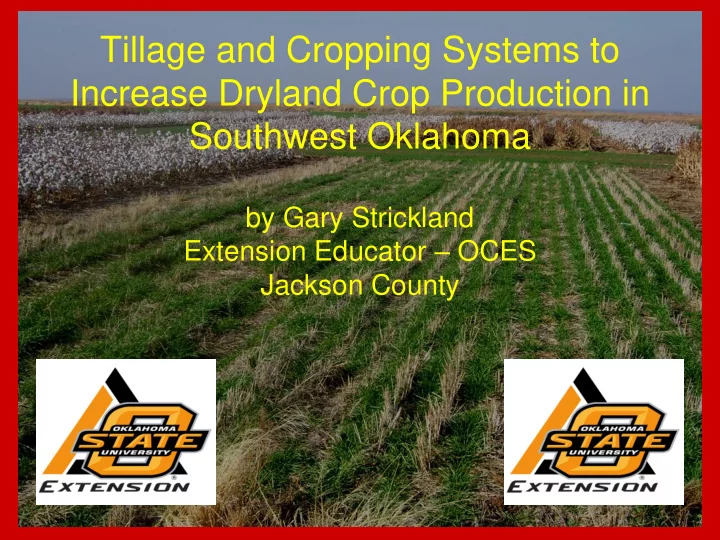
Tillage and Cropping Systems to Increase Dryland Crop Production in Southwest Oklahoma

by Gary Strickland Extension Educator – OCES Jackson County

slide-2
SLIDE 2

Team Approach

  • OSU’s IPM Program
  • Area Extension Staff – Mr. Jerry Goodson

(SWREC), Dr. Mark Gregory, Mr. Rick Kochenower, Mr. Terry Pitts, and Daniel Skipper

  • State Extension Staff – Dr. J.C. Banks, Mr.

Shane Osborn, Dr. Jeff Edwards, Dr. Chad Godsey, Dr. Randy Taylor

  • OAES – Mr. Rocky Thacker and SWREC Crew,
  • Jackson County OCES Program
  • Local and Private Industry Sponsors (i.e.;

Oklahoma Grain Sorghum Producers, Seed Companies, Coops, etc…)

slide-3
SLIDE 3

Objectives of the Study

  • Determine the impact of different cropping

systems on resident insect populations

  • Determine the effect of tillage and cropping

management systems on weed species population dynamics

  • Determine and demonstrate the effects of tillage

and crop rotation on the economic components

  • f weed, insect, and yield management in

cotton, wheat, and grain sorghum production systems in Southwest Oklahoma

  • To estimate the effects of tillage and cropping

systems on SOM accumulation

slide-4
SLIDE 4

Study Design

  • Randomized Complete Block with a Split

Plot Design

  • Two Tillage Systems
  • Three Crops (Cotton, Wheat, Grain

Sorghum)

  • Seven Cropping Systems (C-W-GS, C-W,

C-GS, W-DCGS-C, W, C, GS)

slide-5
SLIDE 5
slide-6
SLIDE 6

Summary of Insect Data

  • To date, no significant differences have

been noted between tillage treatments or among cropping systems regarding insect populations or species.

  • Crop scouting principle has been

reinforced in this study

  • When a buildup of insect pests occurs a

corresponding buildup of beneficial insects has occurred

slide-7
SLIDE 7

Table 5. Wheat Insects 2002/2003 Treatment

∞ ‡ Greenbug

Parasitized Greenbugs Beneficials Weekly Counts

† 6 7 7 8 9 10 6 7 8 9 10

  • 4. W-DCGS-C (NT) 2.7 2.7 75 46 5.7 3.3 64 13 28 6.3 7.0
  • 6. W (NT) 1.7 0.3 61 15 10 5.0 70 16 15 6.0 13
  • 11. W-DCGS-C (CT) 5.3 0.3 80 12 5.0 6.3 84 13 9.3 7.0 5.0
  • 13. W (CT) 1.7 0.7 63 7.7 4.0 4.3 64 9.0 6.7 5.3 8.0

Pest and Beneficial Insect Relationship

slide-8
SLIDE 8

10 20 30 40 50 60 70 80 90

Numbers of Total Insects from both Sweep and Linear Foot of Row Counts

Insect and Week Count: Greenbug (GB); Parasitized Greebug (PGB); Beneficial (B)

IPM PRINCIPLE REINFORCED - 2002/2003 WHEAT

W-DCGS-C (NT) W (NT) W-DCGS-C (CT) W (CT)

slide-9
SLIDE 9

5 10 15 20 25 30 35 NT - Week 6 CT - Week 6 NT - Week 7 CT - Week 7 NT - Week 8 CT - Week 8

Numbers of Total Insects from both sweeps and linear row foot counts Weeks of Insect Buildup and Decline

IPM Principle Reinforced 2007 Cotton Crop

Aphids Beneficials

slide-10
SLIDE 10

Soil Organic Matter Management - Importance in Dryland Crop Production

  • Soil Erosion Prevention
  • Increased Soil Water Storage Capacity
  • Increased Water Infiltration Rates
  • Decreased Soil Evaporation Rates
  • Increase of In-Season Precipitation Use

Efficiency

  • Increased Organic Matter Pool
  • Increased Cation Exchange Complex (CEC)
  • Increased Anion Exchange Complex (AEC)
  • Decrease in Soil Compaction in the Long Term
slide-11
SLIDE 11

TS C-W- GS C-W C-GS W- DCGS- C C W GS Mean L.S.D. (.05) NT 2.00(2) 1.49(6) 1.93(2) 1.63(6) 2.03(2) 1.84(6) 2.08(2) 1.71(6) 2.13(2) 1.71(6) 1.94(2) 1.68(6) 2.42(2) 1.79(6) 2.08(2) 1.69(6) NS(2) NS(6) CT 1.76(2) 1.64(6) 1.87(2) 1.83(6) 1.82(2) 1.70(6) 1.84(2) 1.72(6) 1.79(2) 1.69(6) 1.96(2) 1.87(6) 2.06(6) 1.69(6) 1.87(2) 1.73(6) NS(2) 0.13(6)(.10)

(2) 2 inch sampling depth; (6) 6 inch sampling depth

Tillage by Crop Rotation System SOM Comparisons (2002-2008).

slide-12
SLIDE 12
slide-13
SLIDE 13

5 10 15 20 25 30 35 40 45

Soil resistance, kPa 1000 2000 3000 4000 5000 6000 7000 Soil depth, cm 5 10 15 20 25 30 35 40 45

C-W-GS C-W C-GS W-DCGS-C C W GS

Rotations Water content, g g-1 0.12 0.15 0.18 0.21 0.24 0.27

Table of significance Rotation / Tillage *** / *** *** / ns *** / * *** / *** *** / *** * / *** ns / ***

A B

slide-14
SLIDE 14

Organic Matter Summary

  • The interaction between tillage systems and cropping systems was

significant at the .05 probability level therefore comparisons should be primarily between cropping systems within a tillage system.

  • Soil organic matter accumulation, in general, indicate no significant

differences between cropping systems within tillage treatments to date with the exception of the 6 inch sampling depth in the CT cropping systems. But the data does reflect a trend across cropping systems of increasing organic matter content in the top two inches when compared to the six inch depth in both systems, NT systems are 38% higher and the CT systems are 16% higher.

  • However, a significant difference between the two systems does exist

(as indicated by the significant interaction) with the NT systems showing higher levels of SOM across all cropping systems, except for the W only system, at the 2 inch layer.

slide-15
SLIDE 15

Summary of Weed Data

  • Only a few significant differences have been noted to date

between tillage treatments or among cropping systems

  • In general the NT systems show higher weed populations

than the CT systems

  • Common weed species that continue to be present in the field

include: common purslane, prickly lettuce, winter grasses (bromegrass species primarily), marestail, and henbit

  • New weed species that have appeared with time include:

honeyvine milkweed, morningglory, red stem filaree, and common groundsel.

  • To date current herbicide programs seem to be working in

terms of weed population control with the exception of the Grain Sorghum No-Till Mono-Crop where significant increase in pigweed species occurred and has remained after a glyphosate and two atrazine herbicide applications; and common groundsel in the cotton systems.

slide-16
SLIDE 16

2006 Cotton Weed Populations

Treatments Common Purslane Prickly Lettuce Pigweed C-W (NT) 1.0ψ (P.E.) 0.0 (P.H.) 0.5 (P.E.) 0.5 (P.H.) 0.5 (P.E.) 0.0 (P.H.) C (NT) 4.3 (P.E.) 0.0 (P.H.) 0.3 (P.E.) 0.0 (P.H.) 4.0 (P.E.) 0.0 (P.H.) C-W (CT) 0.0 (P.E.) 0.0 (P.H.) 0.0 (P.E.) 0.0 (P.H.) 0.7 (P.E.) 0.0 (P.H.) C (CT) 0.0 (P.E.) 0.0 (P.H.) 0.0 (P.E.) 0.0 (P.H.) 0.0 (P.E.) 0.0 (P.H.)

Ψ: Weed numbers are from counts taken in 1/1000 of an acre.

slide-17
SLIDE 17
slide-18
SLIDE 18

Post-E Pigweed Counts in 2008 Grain Sorghum Systems

Tillage System C-GS GS Mean L.S.D. (.05)

NT 5.8ψ 57.2 31.5 24.2 CT 0.33 0.5 0.42 NS

Ψ: Numbers are counts taken in 1/1000 of an acre

slide-19
SLIDE 19
slide-20
SLIDE 20

5000 10000 15000 20000 25000 30000

Weeds/A Cropping Systems by Tillage Treatment

Grain Sorghum Crop System Average Weed Population (Pre-Harvest) 2002-2008

slide-21
SLIDE 21

20000 40000 60000 80000 100000 120000 140000 160000 Pigweed (PE) Groundsel (PH)

Plants - Thousand/Acre Weed Species by Tillage and Cropping System

2009 Cotton Weed Counts

C-W-NT C-GS-NT C-NT C-WCT C-GS-CT C-CT

slide-22
SLIDE 22
slide-23
SLIDE 23

Crop Herbicide Systems

Herbicide Time of Applica- tion Mode of Action Group Crop Use Crop Rotation Intervals (M) Broadleaf Tank Mixes Grazing Restric- tion (Days) Roundup (Glyphosate) Pre, Post, HA Inhibition of EPSP Syn. (9) C, W, GS All Crops – 0M Yes 0 Days Dual (metolachlor) Pre & Post Shoot Inhibitors (15) GS, C W-4.5M; C & GS – Next Spring Yes Do not feed Maverick

(sulfosulfuron)

Post ALS Inhibitor (2) W C &GS – 12M Yes 0 Days Osprey (mesosulfuron- methyl) Post ALS Inhibitor (2) W C – 3M; GS- 10M Yes 0 Days Olympus Flex Post ALS Inhibitor (2) W C & GS – 12M Yes 0 Days Finesse Grass & Broadleaf Post ALS Inhibitor (2) W C & GS - Bioassay Yes 7 Days Axial XL Post ACCase Inhibitor (1) W C & GS – 4M Yes 30 Days

slide-24
SLIDE 24

Crop Herbicide Systems Continued

Herbicide Time of Applica- tion Mode of Action Group Crop Use Crop Rotation Intervals (M) Broadleaf Tank Mixes Grazing Restric- tion Power Flex Post ALS Inhibitor (2) W C & GS – 9M Yes 7 Days MCPA Post Synthetic Auxin (4) W After Harvest Yes 7 Days

Harmony Extra

Post ALS Inhibitor (2) W C & GS – 1.5M Yes NA Peak (prosulf- uron) Post ALS Inhibitor (2) W & GS W – 0M GS – 1M C – 18M Yes 30 Days Basagran (bentazon) Post PS II Inhibitor (6) GS W-0M C – 0M Yes Buctril (bromoxy- nil) Post PS II Inhibitor (6) GS W – 1M C – 1M Yes 45 Days Atrazine Post PS II Inhibitor (5) GS See Label Yes 21 Days

slide-25
SLIDE 25

Crop Yield and Economic Responses

slide-26
SLIDE 26

538 425 557 640 364 486 169 554 552 371 100 200 300 400 500 600 700

Lint Yield (Lbs./A) Cropping Systems by Tillage Treatment

Average Cotton Yields 2003-2008

slide-27
SLIDE 27

74 59 15 49 64 63 37 42 10 20 30 40 50 60 70 80

Yield (Bu./A) Cropping Systems by Tillage Treatment

Wheat Yields 2003-2008

slide-28
SLIDE 28

1649 2831 2690 1743 1932 500 1000 1500 2000 2500 3000

Yield (Lbs./A) Cropping Systems by Tillage Treatment

Grain Sorghum Yields 2003-2008

slide-29
SLIDE 29
  • 20

20 40 60 80 100 120 140 160 1 2 3 4 5 6 7

Dollars Per acre Cropping System Treatments

Cropping Systems by Tillage Average Crop Year System Returns: 2003-2009

NT CT

C-W-GS C-W C-GS W-DCGS-C C W GS

slide-30
SLIDE 30
  • 40
  • 20

20 40 60 80 100 120 140 160 1 2 3 4 5 6 7

Dollars Per Acre Cropping System Treatments

Cropping System by Tillage Adjusted Average Crop Year System Returns: 2003-2009 (mono-crops minus 2007)

NT CT

C-W-GS C-W C-GS W-DCGS-C C W GS

slide-31
SLIDE 31

Production Economic Summary for 2003-2009

  • While not always significant, the NT crop systems have shown a

consistent trend for higher return dollars beyond production inputs than the CT systems.

  • With only a few exceptions the crop rotations have indicated a

trend for higher yields and/or returns in the year by year comparisons

  • When averaged across years the NT C-W and

C-GS crop rotation systems are doing significantly better than the mono-crop systems. However C and W only systems (especially within the CT tillage system) have done surprisingly well in comparison as all years are considered. This is somewhat tied to the 2007 elevated crop year yields and commodity prices. When the 2007 crop year is removed from the data then the NT Rotation Systems and CT-CW rotation perform significantly better.