Time Curves: Folding Time to Visualize Patterns of Temporal - - PowerPoint PPT Presentation

time curves folding time to visualize patterns of
SMART_READER_LITE
LIVE PREVIEW

Time Curves: Folding Time to Visualize Patterns of Temporal - - PowerPoint PPT Presentation

Time Curves: Folding Time to Visualize Patterns of Temporal Evolution in Data Benjamin Bach, Conglei Shi, Nicolas Heulot, Tara Madhyastha Tom Grabowski, Pierre Dragicevic Microsoft Research-Inria Joint Centre, IBM Watson Research Centre IRT


slide-1
SLIDE 1

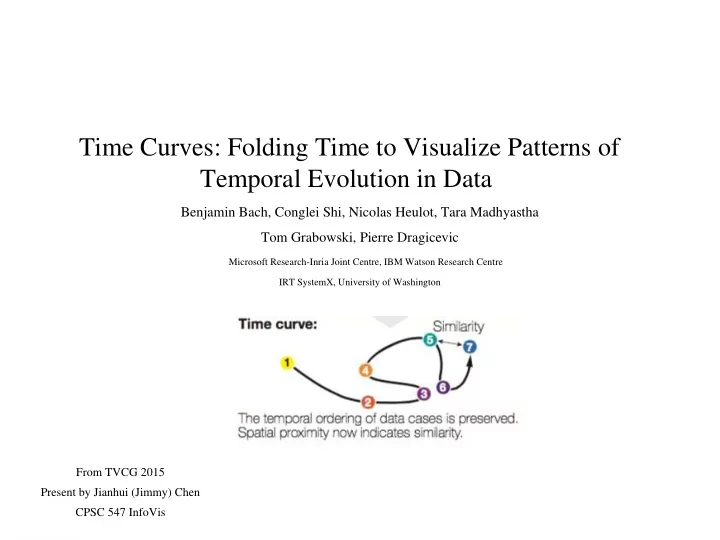
Time Curves: Folding Time to Visualize Patterns of Temporal Evolution in Data

Benjamin Bach, Conglei Shi, Nicolas Heulot, Tara Madhyastha Tom Grabowski, Pierre Dragicevic

Microsoft Research-Inria Joint Centre, IBM Watson Research Centre IRT SystemX, University of Washington

From TVCG 2015 Present by Jianhui (Jimmy) Chen CPSC 547 InfoVis

slide-2
SLIDE 2

Overview

Data: 7 versions of a Wiki article Task: explore document history Pattern: after 4, 5, the article comes back to 3 at 6

2

Encoding channels: shape, colour

slide-3
SLIDE 3

Outline

What Why How Validation

3

slide-4
SLIDE 4

What

General temporal data: Wiki articles Videos fMRI Data abstraction: distance matrix

4

slide-5
SLIDE 5

Outline

What Why How Validation

5

slide-6
SLIDE 6

Why

Task: overview and identify patterns

Wiki article on Chocolate Wiki article on InfoVis Long progress at first, edit war in the middle. Cluster, progress, cluster…

6

Motivation: patterns can be of great interest to domain experts or general audience

slide-7
SLIDE 7

Outline

What Why How Validation

7

slide-8
SLIDE 8

How (method)

Information encoding TL TC Rank distance: how far in time Y Y Curvilinear distance: cumulated changes Y Y+ Spatial distance: effective changes N Y Timeline Time curve

8

slide-9
SLIDE 9

How (implementation)

  • A combination of other methods
  • Sufficient for re-implementation

Distance matrices: number of characters inserted or deleted, Euclidean distance,… Time points positions: “classical” MDS method (not clearly defined) [46] Curves: Bézier curve Overlap removal: a simple iterative approach (not clearly defined) Rotating curves : time goes from left to right

[46] Multidimensional scaling: I. Theory and method

9

MDS: multipledimensional scaling

slide-10
SLIDE 10

Live demo

http://www.aviz.fr/~bbach/timecurves/

10

slide-11
SLIDE 11

Outline

What Why How Validation

11

slide-12
SLIDE 12

Validation

12

slide-13
SLIDE 13

Validation (algorithm)

# time points time (sec) 50 9 100 20 500 500

Computational Complexity O(N3) Perceptual scalability: depends on data complexity and and down-sampling method.

Stability: shape is kept when adds new time points.

13

slide-14
SLIDE 14

Validation (domain situation)

Informal user feedback Users : one neuroscientist over two months Task : identify/compare patterns in fMRI data Result: encouraging feedback regarding the usability

14

Pattern: meaningful difference between individuals in (b)

fMRI:functional magnetic resonance imaging

slide-15
SLIDE 15

Time curves: summary

What: Data Time series: Wikipedia histories, videos and dynamic network What: Derived Pairwise distances Why: Tasks Reveal patterns in temporal datasets How: Encode Circles and dots:time stamp Curve:evolution Distance and colour: similarity Scale About 100 time points

15

slide-16
SLIDE 16

What else?

Patterns and examples!

16

slide-17
SLIDE 17

Geometric characteristics

Edit war in Wiki Ineffective reversal Many small changes Chaotic processes

17

No effective progress

Curves between two remote time points

slide-18
SLIDE 18

Patterns

Cluster : minor revision Transition: big progression Cycle : back to previous point after a long progression Outlier : large sudden changes …

18

Specific combination of geometric characteristics

slide-19
SLIDE 19

Surveillance video

video video

Patterns Cluster: minor changes Outliers: moving people Derived data Time stamp: one frame/second Distance : normalized absolute pixel difference

Video summarization, anomaly detection

19

slide-20
SLIDE 20

Cloud coverage and precipitation

Patterns: Extremes: Jan & Aug Dec goes to Apr

20

slide-21
SLIDE 21

Conclusion

  • A general approach for visualizing patterns of evolution

in temporal data

  • Demonstrated by lots of examples (solid work)
  • Gives developing history of time curve method

Useful in other domains such software engineering management, law making study…

slide-22
SLIDE 22

Critiques

  • No direct comparison with previous work
  • Validation is insufficient

22

Video Interpretation from [37]

[37] Image Spaces and Video Trajectories: Using Isomap to Explore Video Sequences

Animated movie example in the paper

slide-23
SLIDE 23

Thanks! Q&A

23

slide-24
SLIDE 24

24