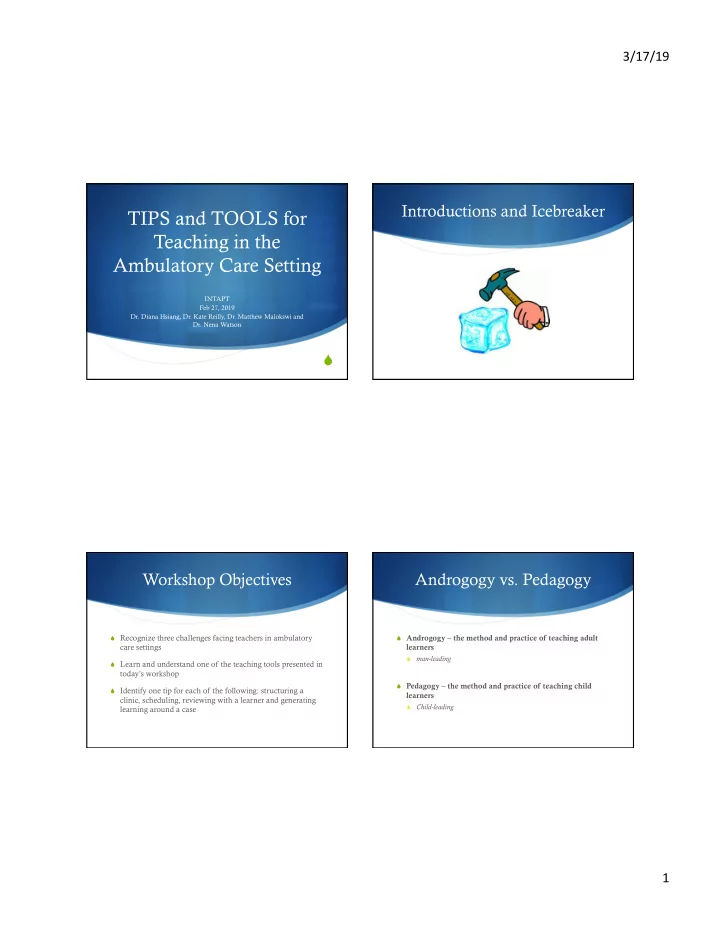
TIPS and TOOLS for Teaching in the Ambulatory Care Setting INTAPT - - PDF document

tips and tools for teaching in the ambulatory care setting
SMART_READER_LITE
LIVE PREVIEW

TIPS and TOOLS for Teaching in the Ambulatory Care Setting INTAPT - - PDF document

3/17/19 Introductions and Icebreaker TIPS and TOOLS for Teaching in the Ambulatory Care Setting INTAPT Feb 27, 2019 Dr. Diana Hsiang, Dr. Kate Reilly, Dr. Matthew Malokswi and Dr. Nena Watson Workshop Objectives Androgogy vs.


slide-1
SLIDE 1

3/17/19 1

  • TIPS and TOOLS for

Teaching in the Ambulatory Care Setting

INTAPT Feb 27, 2019

  • Dr. Diana Hsiang, Dr. Kate Reilly, Dr. Matthew Malokswi and
  • Dr. Nena Watson

Introductions and Icebreaker Workshop Objectives

Recognize three challenges facing teachers in ambulatory

care settings

Learn and understand one of the teaching tools presented in

today’s workshop

Identify one tip for each of the following: structuring a

clinic, scheduling, reviewing with a learner and generating learning around a case

Androgogy vs. Pedagogy

Androgogy – the method and practice of teaching adult

learners

man-leading

Pedagogy – the method and practice of teaching child

learners

Child-leading

slide-2
SLIDE 2

3/17/19 2

Adult Learning Theory: Assumptions

Malcolm Knowles Fundamental assumptions:

1.

Self-directed

2.

Come to clinic/projects with important previous life experiences

3.

Readiness to learn related to social developmental tasks

4.

Prefer learning solutions for immediate relevant problems

5.

Internally motivated to learn

Adult Learning Theory: Principles

Adults need to be involved in the planning and evaluation of

their instruction.

Experience provides the basis for the learning activities. Adults are most interested in learning subjects that have

immediate relevance and impact to their job or personal life.

Adult learning is problem-centered rather than content-

  • riented

Application of Adult Learning to Ambulatory Teaching

Structure teaching around recent clinical cases Build on learners previous clinical experiences Encourage learners to formulate their own daily learning

  • bjectives

Highlight relevance of teaching points to future clinic work,

upcoming exams etc.

Encouraging learners to develop a self-directed study plans at the

end of clinical days

SPICES Model

slide-3
SLIDE 3

3/17/19 3

SPICES – Student-centred learning

Negotiating a learning contract/expectations at the

beginning of a session/longitudinal rotation in order to tailor the experience Versus

Offering a standard experience which is teacher-centred

without taking into consideration the goals and objectives of the specific learner

SPICES – Problem-based learning

Reading around cases or topics encountered in clinic

Versus

Prescribing a reading list for information gathering purposes

SPICES – Integrated or Interprofessional Learning

Interaction with a variety of healthcare professionals to

facilitate learning about interprofessional Versus

Discipline specific learning

SPICES – Community-based

Community-based – a different patient population, greater

variety of presentations, different setting and practice pace Versus

Hospital-based

slide-4
SLIDE 4

3/17/19 4

SPICES - Elective

Elective experiences/flexibility within a placement allows

students to tailor their experience to learning needs Versus

Standardized program

SPICES – Systemic/Planned

Using a logbook or practice profile to ensure students are

seeing the required range of core clinical problems and focus on appropriate learning objectives. Versus

Opportunistic or apprenticeship-based, which may lack the

needed variety

  • Challenges: Preceptor-Related

Preceptor Educational Training Retention of Teachers Preceptor compensation Burnout Competing Academic Interests

slide-5
SLIDE 5

3/17/19 5

Challenges: Student Related

Disagreement on teaching styles with preceptors Level of self-direction Competing clinical responsibilities

Challenges: Patient Related

Patient characteristics Medical cases – Variety? Relevant? Practical? Resistant to learners involvement Poor understanding of the role a learner plays Additional time spent Consent

Challenges: Structure Related

  • Private vs Public Clinic and learner autonomy
  • Academic vs Community
  • Specialized vs Generalized Practice
  • Continuity vs Block – structured experience
  • Physical Space Issues
  • Time Management Considerations
  • Office Staff Involvement/”buy in”
  • Clinic Compensation

Think-Pair-Share

What strategies have you tried to help with the challenges

you have experienced while teaching in the ambulatory care setting?

slide-6
SLIDE 6

3/17/19 6

Organizational TIPS: Reviewing

One Student/One Clinician

  • Sitting in Model: Student observes
  • Hot seating
  • Directed observation
  • Note taking
  • Apprenticeship Model: Clinician observes
  • Team Member Model: Student works independently

Organizational TIPS: Reviewing

Many Students/One Clinician

Grandstand Model

Organizational TIPS: Reviewing

Many Students/One Clinician

Supervising Model

Organizational TIPS: Reviewing

Many Students/One Clinician

Report Back Model

slide-7
SLIDE 7

3/17/19 7

Organizational TIPS: Reviewing

Many Students/One Preceptor

Breakout Model

Organizational TIPS: Scheduling

Curriculum

X+Y block scheduling

Clinic

Wave Scheduling Multiple learners

Organizational TIPS

Learner Orientation

Clinical space Healthcare staff Charting method/system Healthcare policies Brief learners on Day to day responsibilities & Expectations Practice style/approach Agreed upon objectives of learning rotation Setting daily limited teaching goals “Primer” to patients Resource/Materials as reference guides

Organizational TIPS

Patient orientation

Patient preparedness Handouts, brochures, posters Understanding learner roles Practice “high profile” Emphasis on affiliation/relationship with academic institution (plaque, certificate) Comprehensiveness of care Volunteer registry for interested patients

slide-8
SLIDE 8

3/17/19 8

Teaching TOOLS

Learning contracts

Tools for structuring adragogical principles of learning Created by learner with input from educator Components:

  • Skills and knowledge to be learned
  • Learners interests
  • How learner intends to acquire skills and knowledge
  • Criteria used to evaluate whether the identified learning as taken place

Encourages self-directed learning Facilitate agenda negotiation Disadvantages: 1. time consuming to construct, 2. may require

educator training

Teaching TOOLS

One Minute Clinical Preceptor

Focuses teaching on learners clinical reasoning Efficiently structures clinical review sessions Based on 5 Microskills

1.

Get a commitment – “What do you think is going on with this patient?”

2.

Probe for evidence – “What factors in the history and physical support your diagnosis?”

3.

Teach general rules - Keep it brief and focused on identified issues

4.

Provide feedback/Reinforce what was done right – Be specific

5.

Correct mistakes - Start with learner self-evaluation; Be specific

Teaching TOOLS

One Minute Clinical Preceptor

https://www.youtube.com/watch?v=eRBdfXRj5N0

Teaching TOOLS

Eight Step Preceptor (ESP) model

  • Created by modifying OMP model by incorporating additional adult learning

principles

  • Model includes principles of adult learning theory that have been associated

with improved learning

  • Based on 8 Microskills

1. Assess level of learner 2. Listen without interruption 3. Get commitment 4. Probe for supporting evidence 5. Teach general rules 6. Reinforce what was right 7. Correct mistakes 8. Have learner identify learning objectives

slide-9
SLIDE 9

3/17/19 9

Teaching TOOLS

Learner-Centered Case Presentations Summarize briefly the history and physical findings Narrow the differential to two or three relevant possibilities Analyze the differential by comparing and contrasting the

possibilities

Probe the preceptor by asking questions about uncertainties,

difficulties, or alternative approaches

Plan management for the patient’s medical issues Select a case-related issue for self study

Teaching TOOLS

Logbooks Enquiry or history-taking

Physical examination Interpretation of data

Task or carrying out a procedure Options or differential diagnosis Management of the patient

Education of the patient

Teaching TOOLS

Focus Scripts

Scripts can facilitate learning for focused acute and chronic care office visits

Learning to take a focused history Learning the components of a focused physical exam Performing a specific task Documenting document focused evaluations

Rotating Board

  • 1. How would you schedule your clinic?
  • 2. How would you observe/review?
  • 3. Which teaching tool (s) would you use?
slide-10
SLIDE 10

3/17/19 10

Conclusions One-Minute Paper

Commit to one TIP or TOOL that you will use in the next

month.

References